

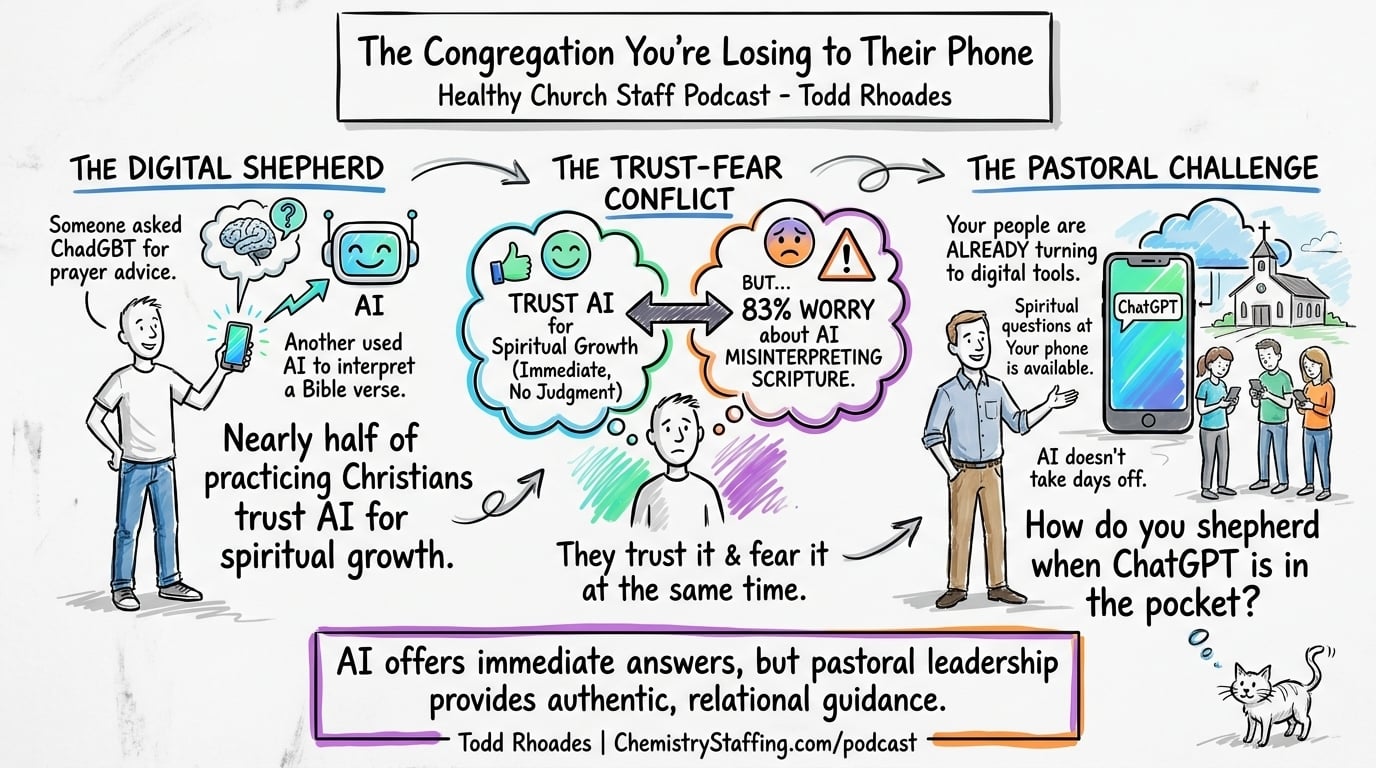
Someone in your church asked ChatGPT for prayer advice this week.
🎧 Listen to this episode:
Another person used AI to help them interpret a Bible verse they didn't quite understand.
And yet another member is getting daily devotional content from an algorithm that knows their schedule better than you do.
Before you dismiss this as unlikely, consider this: Nearly half of practicing Christians say they would trust AI to help with their spiritual growth. Not "might consider it"—they actually trust it.
According to recent Barna research, the same people sitting in your services on Sunday are asking Siri about theology on Tuesday. And most church leaders have no idea this shift is happening right under their noses.
If this sounds familiar—or even if it doesn't—we need to talk about what this means for how you lead and shepherd your congregation.
The Reality You're Competing With (Whether You Like It or Not)
Here's what's actually happening: Your people aren't rejecting the church. They're just really busy.
When someone has a spiritual question at 10 PM on a Wednesday, you're not available. But their phone is.
AI doesn't have office hours. It doesn't take Mondays off. It never says "let me get back to you." It gives immediate answers with zero awkwardness and absolutely no judgment.
And here's the kicker: it often sounds really, really good.
Think about what this means for you as a leader. Your people are forming spiritual habits (which is good!) and getting theological input from sources you'll never see. They're not asking your permission. They're not telling you about it. It's just quietly becoming part of their spiritual routine.
The Tension Nobody's Naming
But here's where it gets tricky.
That same Barna study found that 83% of Christians worry about AI misinterpreting Scripture.
Read that again. They trust it AND fear it at the same time.
They know AI isn't a pastor. But it's available. And in our culture, availability often wins.
"The question isn't 'How do we stop this?' The question is: 'How do we shepherd people who are being spiritually formed by more than just us?'"
Your congregation isn't being rebellious by using these tools. They're being human. They're seeking help where it's accessible. And most of the time, they're doing it because we haven't created easy on-ramps for real conversation.
Three Critical Shifts Church Leaders Need to Make
I'm not saying technology is evil. I'm not saying AI is the enemy. But I am saying we need to wake up to what's happening and lead differently. Here are three shifts that need to happen starting today:
1. Acknowledge the Gap
If people are turning to AI for spiritual help, ask yourself: What gap are they trying to fill?
Maybe it's accessibility—they can't find you when they need help.
Maybe it's the fear of looking dumb in front of their pastor.
Maybe it's confidentiality—they don't want their question becoming prayer request fodder.
Maybe your church simply doesn't have easy ways for people to ask questions outside of a Sunday service or scheduled class.
Here's the hard truth: You cannot compete with a phone on convenience. But you can create more on-ramps for real connection.
Start by asking your team:
- Where are people getting stuck spiritually and turning to their phone instead of us?
- What would make it easier for someone to reach a real human on our team?
- Are we creating a culture where questions are welcomed, or do people feel dumb for not knowing?
2. Teach Discernment, Not Avoidance
Your people are already using these tools. Pretending they're not doesn't help them.
What if you actually talked about it from the stage? What if you equipped people in a staff meeting or sermon series?
Teach them to ask better questions like:
- Who taught the AI?
- What worldview is embedded in this answer?
- Does this align with what Scripture actually teaches?
Jesus didn't just give people answers. He taught them how to think. We've got to do the same with the digital tools our congregations are already using every single day.
Scripture to Consider: Hebrews 10:24-25
"And let us consider how we may spur one another on toward love and good deeds, not giving up meeting together, as some are in the habit of doing, but encouraging one another—and all the more as you see the Day approaching."
Why it matters: This reminds us that physical gathering and mutual encouragement are irreplaceable elements of Christian community—something no algorithm can replicate.
3. Lean Into What AI Cannot Do
AI is incredibly good at giving information. But it can't give presence.
It can create a devotional or even generate a sermon outline. But it can't weep with you at 2 AM when your marriage is falling apart.
It can quote you a verse. But it can't lay hands on you and pray with the authority of someone who's walked with Jesus for decades.
It doesn't know your community's context. It can't discern the Spirit's leading in a specific situation. It can't sit with you in uncomfortable silence.
Your job isn't to out-inform the algorithm. You're going to lose that battle. AI can process information 24/7 without breaking a sweat.
Your job is to out-love it, out-presence it, and out-shepherd it. Because that's the lane AI will never be able to touch.
"The Word became flesh and made his dwelling among us. We have seen his glory, the glory of the one and only Son, who came from the Father, full of grace and truth." — John 1:14
The incarnation itself teaches us that presence matters. God chose embodiment over distance. There's a reason for that.
This Isn't About Being Anti-Tech
Let me be clear: this conversation isn't about demonizing technology. It's about being pro-people.
People need more than data. They need a shepherd.
They don't need you to be omnipresent—only God can do that. But they do need you to be present. And that means being intentionally available, creating spaces for human conversation, and showing up in ways that algorithms simply cannot.
Questions for Your Next Staff Meeting
- How many of us have actually used AI for ministry work? What was helpful? What felt insufficient?
- Where do we think people in our congregation are most likely turning to digital tools instead of real people—and why?
- What are we doing well to create easy connection points for pastoral care? Where are we making it too hard?
- What's one specific way each of us could make ourselves more accessible this month?
Your Bottom Line for This Week
You cannot compete with AI on speed. You cannot compete with AI on convenience.
But you can way out-shepherd it in ways that no algorithm ever will.
Your people don't need you to be omnipresent. But they do need you to be present.
So start talking about this as a team. Not in panic mode, but in a "we see what's happening and we're going to lead into it" mode.
Create low-barrier ways for people to connect with real humans. Teach discernment. Model healthy use of technology while demonstrating the irreplaceable value of incarnational ministry.
Lead well this week. Your people need you more than they need another algorithm.
Need to Talk This Through?
If this article surfaced questions about how to lead your team through changing cultural dynamics—or if you're facing hiring, staffing, or leadership challenges—I'd love to hear from you.
Email me at podcast@chemistrystaffing.com
This post is based on Episode 681 of the Healthy Church Staff Podcast. Listen to the full episode for more insights on leading in a digital age.