
You hired a 24-year-old with a great heart and solid references. Three months in, they can't remember what you discussed in last week's one-on-one meeting. They struggle to finish a project without constantly checking their phone. They're not lazy. They're not rebellious. Something just feels... different.
🎧 Listen to this episode:
If you've noticed this with your younger staff members or volunteers, you're not alone—and you're not imagining it.
The Research That Should Wake Us Up
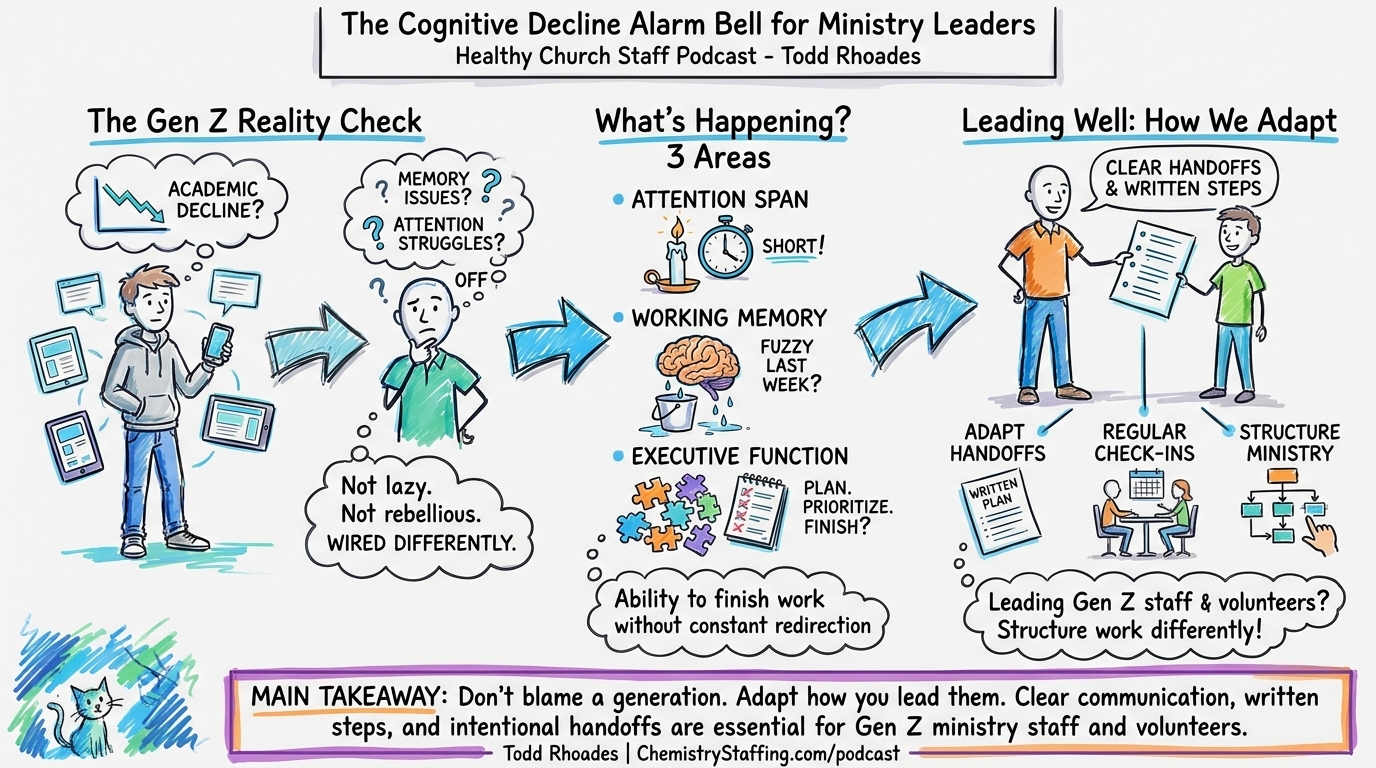
According to recent research from Relevant Magazine, Gen Z averages approximately nine hours of daily screen time. Perhaps more significantly, they're the first modern generation performing worse academically than the one before them.
But here's what's critical to understand: this isn't about intelligence. This generation isn't dumber than previous ones. Their brains are simply wired differently now, shaped by unprecedented levels of digital exposure from childhood.
As church leaders, we have a choice: we can complain about this reality, or we can adapt our leadership to develop the next generation of ministry leaders effectively. I'm choosing the latter, and I hope you'll join me.
What's Actually Happening in Their Brains
The research points to three specific areas where high screen time has created measurable differences:
1. Attention Span
The ability to maintain focus on a single task has significantly decreased. What took your attention for 30 minutes may only hold theirs for 10.
2. Working Memory
The capacity to hold and manipulate information in their mind—like remembering conversation details from last week—has been compromised by constant digital interruption.
3. Executive Function
This is the ability to plan, prioritize, and complete work without constant redirection. In ministry, this isn't "extra credit"—it's fundamental to the job.
If you're hiring Gen Z staff or volunteers, you're not just hiring different preferences or cultural styles. You're likely hiring people whose brains actually process information differently than yours does, shaped by environmental factors you didn't experience at their age.
"Do not conform to the pattern of this world, but be transformed by the renewing of your mind. Then you will be able to test and approve what God's will is—his good, pleasing and perfect purpose." — Romans 12:2 (NIV)
Where We Go Wrong (Without Realizing It)
The breakdown usually happens in pretty ordinary ways:
- We assume they'll figure it out because we did at their age
- We give vague instructions and expect them to fill in all the gaps
- We pile on multiple projects and wonder why none of them get finished well
- We treat phone-checking like disrespect when much of it is deeply ingrained habit they can't easily shut off
- We label them unfocused or immature when what we're actually seeing is a brain that needs more structure than ours did
Here's the disconnect: they think their experience is normal. You might not realize their brain works differently than yours. Without this awareness, frustration grows on both sides, and we risk losing gifted, Jesus-loving team members who simply needed to be led differently.
4 Practical Strategies to Lead Gen Z Staff Effectively
This generation loves Jesus. They want to serve. They want to make a difference just as much as you did at their age. They just need you to lead them a little differently. Here's how:
Strategy #1: Shrink the Task
Don't say: "Plan the spring retreat."
Instead say: "By Friday, bring me three possible dates and two venue options."
Break the work into smaller, concrete steps. Their output will improve dramatically—and honestly, so will yours. Clarity always increases effectiveness, regardless of generation.
Strategy #2: Build In Check-Ins
Don't assign something and disappear for two weeks. When you see them in the hallway, ask: "How's it going on that project we talked about?"
A five-minute mid-point conversation can save hours of wasted effort and prevent the frustration of discovering at the deadline that they went in the wrong direction.
This isn't hovering. This isn't micromanaging. This is helping them finish well.
Strategy #3: Name the Phone Thing Out Loud
Don't shame it. Don't make it a character issue. Simply say: "I know our phones are built to interrupt us. Let's put them face-down during this meeting, okay?"
Make it a team habit, not a personal failure. When you normalize the boundary, you remove the shame and create space for better focus.
Strategy #4: Teach Them How to Remember
Show them how to take notes during meetings. Help them set up reminders on their phone. Walk them through creating a simple task management system—whether that's a phone app or a paper planner.
These aren't "soft skills" anymore. Nobody taught them these practices, and in today's environment, they're essential to how work actually gets done, especially in ministry.
Discussion Question for Your Team
Think about the younger staff members or volunteers you work with. What specific challenges have you noticed in areas like attention span, task completion, or memory retention? How have you been interpreting these struggles—and might you need to reconsider those interpretations?
The Discipleship Piece You Can't Miss
Here's what strikes me: Jesus repeated himself with his disciples. Constantly. Not because they were slow or stupid, but because meaningful change takes time, and transformational truth needs to be heard more than once.
If this generation needs more repetition, more structure, and more check-ins, that may actually look closer to how Jesus discipled people than handing someone a vision statement and a login and calling it leadership development.
"Above all else, guard your heart, for everything you do flows from it." — Proverbs 4:23 (NIV)
Our minds and hearts require active protection in a digital age that constantly seeks our attention.
The question isn't whether this generation can be effective in ministry. The question is whether we're willing to adapt our leadership style to help them get there.
Every Generation Has Been Written Off
It's easy to hear this research and feel discouraged. It's tempting to think, "I don't have time for all this extra work."
But remember: every generation has faced criticism.
- Boomers were called selfish
- Gen X was labeled cynical
- Millennials were dismissed as entitled
And yet God used every single one of them to accomplish His kingdom work in the church.
The church that figures out how to develop Gen Z leaders won't just survive the next decade—they'll gain team members who are brave, justice-oriented, honest, and deeply committed to authenticity in their faith.
They just need leaders who won't give up on them.
Action Steps for This Week
- Audit one process: Look at how you currently onboard or train younger team members. Where could you add more repetition, written documentation, or check-in points?
- Have one conversation: Sit down with a Gen Z staff member or volunteer and ask, "What's one thing I could do to help you succeed better in your role?" Then listen without defending your current system.
- Make one adjustment: Don't explain why things should already work. Just implement one change based on what you learn.
You're Not Just Hiring Staff—You're Shaping Future Leaders
If their brains are wired differently, your leadership must adapt. Not because you're lowering the bar, but because you refuse to lose them.
You're not just filling positions. You're shaping the next generation of church leaders—both in your local church and in the broader Body of Christ.
And that is absolutely worth the extra effort.
The Gen Z leaders in your church today will be the senior pastors, missionaries, and ministry innovators of tomorrow. How you invest in them now will shape the church for decades to come.
What's your experience leading Gen Z staff or volunteers? I'd love to hear what's working (and what's not) in your context. Send me your thoughts at podcast@chemistrystaffing.com.
And if you know a ministry leader who's struggling with these exact issues, please share this article with them. Sometimes just knowing you're not alone—and that there are practical solutions—makes all the difference.
Need help navigating staffing challenges in your church? At Chemistry Staffing, we work with churches across the country on hiring, staff development, compensation studies, and succession planning. Reach out to explore how we might be able to help your team thrive.