

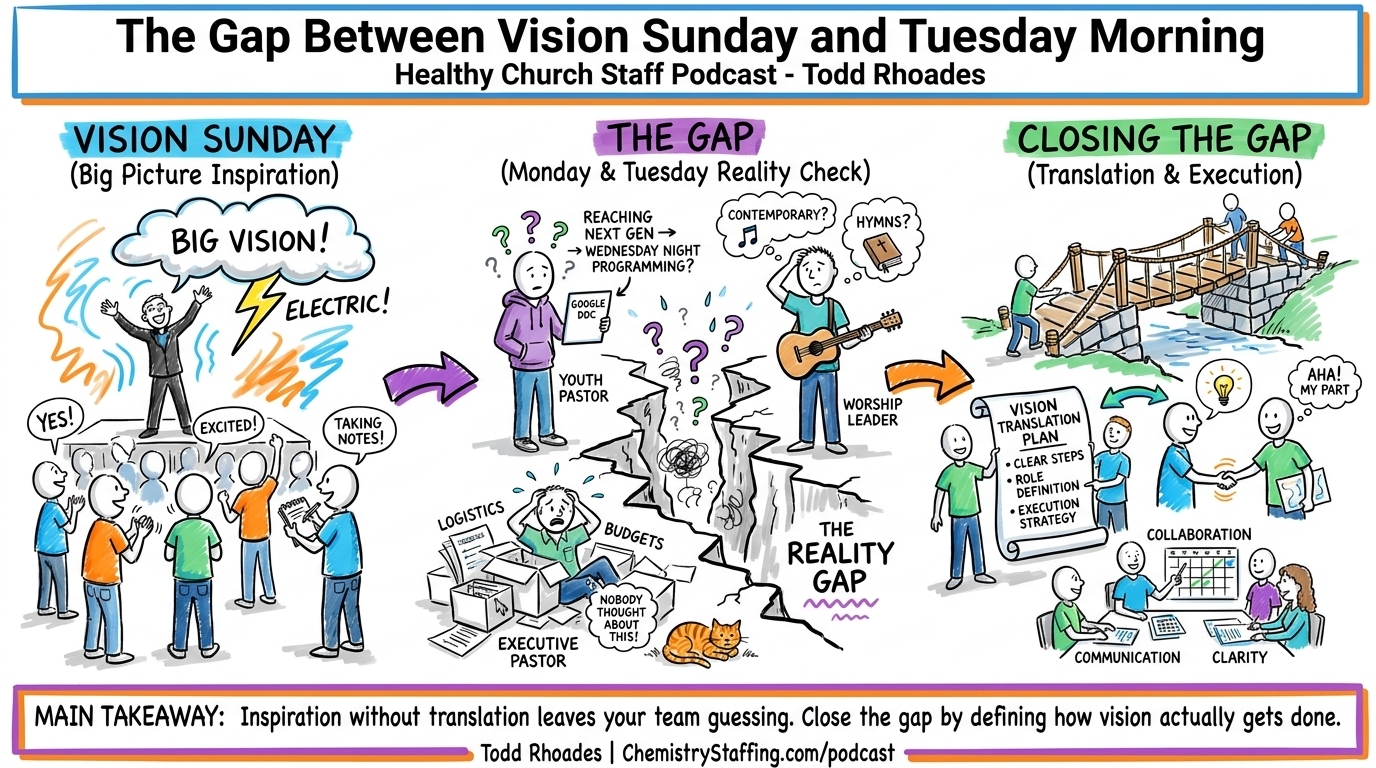
Sunday morning rolls around. Your senior pastor is on fire. The vision is big. The room feels electric. People are nodding, some are literally taking notes, and everybody's excited.
🎧 Listen to this episode:
Then Monday hits. You have your staff meeting. The same vision gets unpacked. It's still inspiring. It's still exciting.
But by Tuesday morning, your youth pastor is staring at a Google document, wondering how "reaching the next generation" translates to Wednesday night programming. Your worship leader is trying to figure out if the vision means contemporary music or a return to hymns. Your executive pastor is drowning in logistics because nobody thought about all of this stuff on Sunday.
The gap between Vision Sunday and Tuesday morning is real. And if you don't close it, your team is going to drown in it.
The Vision-to-Execution Gap That's Killing Your Momentum
I was reading something from The Unstuck Group recently about the roles an executive pastor cannot delegate. One line stopped me cold: the gap between vision and execution kills more churches than bad vision ever will.
Here's the thing about vision—it's supposed to be inspiring. It's supposed to be big picture. But inspiration without translation just leaves your team guessing. And guessing leads to frustration, frustration leads to drift, and drift leads to disengagement.
What you end up with is a room full of people working really hard on things that just don't connect.
"Write down the revelation and make it plain on tablets so that a herald may run with it." — Habakkuk 2:2
Vision must be communicated clearly enough that others can run with it. Not just hear it. Not just nod at it. But actually run with it.
Where the Wheels Fall Off
Vision usually gets cast from the stage, right? It sounds amazing. It's exciting. People buy into it. But here's what often doesn't happen:
- Nobody tells the children's pastor what it means for Sunday morning check-ins
- Nobody tells the worship team if this changes the song selection philosophy
- Nobody tells the campus pastor if this affects budget or staffing model
- Nobody tells the small groups pastor if this shifts curriculum or structure
So everybody goes back to their corner on Monday and Tuesday morning and tries to interpret the vision through their own lens. And six months later, the senior pastor wonders why the vision doesn't seem to be catching with the team.
Here's the hard truth: It's not that your team doesn't believe in the vision. It's that they don't know what it means for them on Tuesday.
This Isn't About Beating Up the Visionary Leader
Listen, I love visionary leaders. Casting vision is hard. It's necessary. It should be inspiring. But vision without translation is just a good sermon.
If you're a senior leader, you can't assume that your team automatically knows how to take what you say and make it reality in their departments. If you're the executive pastor or ops leader, you're the translator—this is your job. And if you're the staff member in the middle, you should have permission to ask, "What does this mean for my area?"
That's where we start to close the gap.
How to Bridge Vision Sunday and Tuesday Morning
For Senior Leaders: Test for Clarity
Stop after you cast vision and ask two critical questions:
- "What did you hear?"
- "What does this mean for your area?"
Don't assume clarity. Test for it. Your job isn't just to inspire—that's half of it. The other half is to equip your team to translate that inspiration into action.
Give them language. Give them examples. Give them permission to ask questions.
For Executive Pastors: You're the Bridge—Own It
Your job is to take the big vision and break it into digestible, actionable pieces. Meet with each department and ask, "Based on what you heard, what do you think changes for you?" Then help them connect the dots between Sunday's big ideas and Tuesday's to-do list.
This isn't dumbing down the vision. This is making it real for the individual people on your team.
For Staff Members: Ask the Question
If you don't know how the vision affects your area, you need to say something. Ask: "Can you help me understand what this means for youth ministry?" or "How does this change what we're doing in worship?"
Don't wait for somebody to hand you clarity—it might not come. They might assume you get it. So if you don't get it, go get it by asking questions.
And when you do figure it out, share it with your team. Because they're wondering too.
What This Actually Looks Like in Practice
Let's say the vision is: "We're going to become a church of discipleship, not just attendance."
Great. Love it. Very inspiring.
But what does it actually mean?
- Do small groups become mandatory?
- Does Sunday school shift from seeker-focused to believer-focused?
- Does the kids' curriculum change?
- Do we stop counting attendance and start tracking group participation?
- What does this mean for our newcomer strategy?
You see the difference? Vision gives direction. Strategy gives decisions. Your team absolutely has to have both.
If you only give them vision, they'll fill in the blanks themselves. And the way they fill in the blanks might not be the way you want them to. You'll end up with ten different strategies under one confused umbrella that doesn't look anything like your vision.
Questions for Your Next Staff Meeting
- On a scale of 1-10, how clear are you on our current vision? How well are you communicating it to your volunteers?
- Think about our last major initiative. What questions did you have on "Tuesday morning" that weren't answered on "Sunday"?
- What's one specific example where we've successfully bridged the Sunday-to-Tuesday gap? What made that work?
- What is ONE thing we could change in the next month to help close the gap between vision-casting and vision-execution?
The Bottom Line
Vision without translation creates confusion, not momentum.
Your team wants to run with the vision. They just want to know where to run and how fast. If you give them that clarity and they buy into your vision, watch out—things are going to start to happen.
"Then I said to them, 'You see the trouble we are in: Jerusalem lies in ruins, and its gates have been burned with fire. Come, let us rebuild the wall of Jerusalem, and we will no longer be in disgrace.' I also told them about the gracious hand of my God on me and what the king had said to me. They replied, 'Let us start rebuilding.' So they began this good work." — Nehemiah 2:17-18
Notice what Nehemiah did? He gave honest assessment of reality AND clear next steps. Vision is most effective when it includes both inspiration and implementation.
Your Next Steps
- Schedule a Vision Translation Meeting – Within the next week, calendar 30 minutes specifically to discuss practical implementation of your most recent initiative.
- Create a "Tuesday Morning Checklist" – Develop a simple template: What does this vision mean for my ministry? What changes? What stays the same? What resources do I need?
- Establish a Question Channel – Set up a designated way (Slack channel, shared doc, regular meeting time) where staff can ask clarifying questions about vision.
- Practice Reverse Communication – After the next vision moment, ask 2-3 staff members to articulate what they heard and what it means for their area. This reveals gaps before they become problems.
If there's any way I can help you or your church work through how to narrow this gap between Vision Sunday and Tuesday morning, I'd love to have a conversation. We help churches all the time with strategy, staffing strategy, and overall vision implementation.
You can reach out to me anytime at podcast@chemistrystaffing.com. I'd be honored to help.
This article is based on Episode 678 of the Healthy Church Staff Podcast. Listen to the full episode for more insights on church leadership and staffing.