

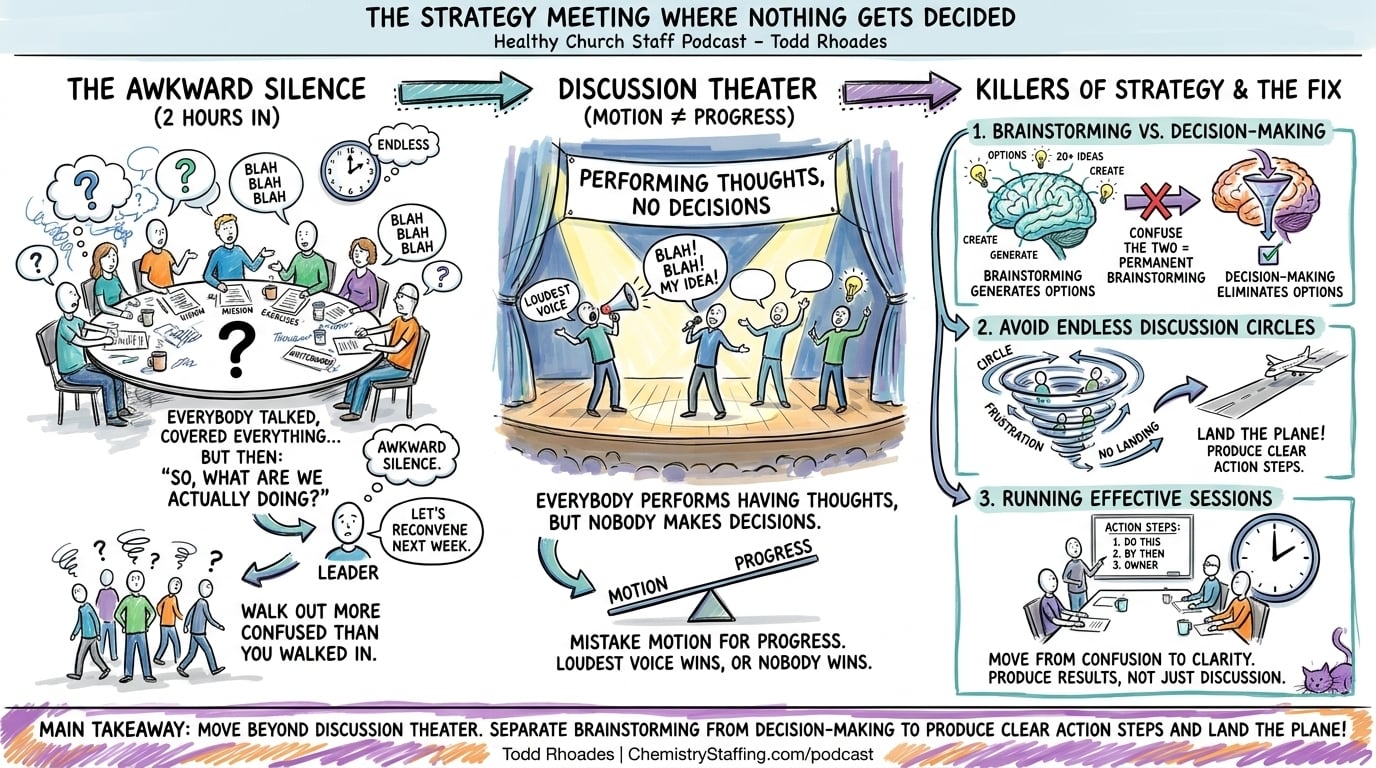
Picture this: You're two hours into what was supposed to be a "strategic planning session." Everyone has shared their thoughts. You've covered vision, mission, and tackled three different whiteboard exercises. The discussion has been rich, engaging, even inspiring.
🎧 Listen to this episode:
Then someone asks the inevitable question: "So what are we actually doing?"
Awkward silence fills the room.
The meeting ends with a familiar refrain: "Let's think about this and reconvene next week." Your team walks out more confused than when they walked in, wondering what just happened to the last three hours of their lives.
If this scenario sounds painfully familiar, you're not alone. And more importantly, you're not stuck with it.
The Problem: Most Strategy Meetings Are Actually "Discussion Theater"
Here's what I've observed after years of working with church leadership teams: Most strategy meetings aren't strategy meetings at all. They're what I call "discussion theater."
In discussion theater, everyone performs having thoughts, but nobody makes decisions. You mistake motion for progress. The loudest voice wins—or worse, nobody wins. You leave feeling like you've accomplished something because you talked a lot, but when pressed for specifics, there's nothing concrete to show for it.
"For God is not a God of disorder but of peace—as in all the congregations of the Lord's people." - 1 Corinthians 14:33 (NIV)
God calls us to order and clarity, not endless circular conversations that lead nowhere. So why does this keep happening in our churches?
The Three Strategy Killers Destroying Your Planning Sessions
1. You Confuse Brainstorming With Decision-Making
Brainstorming generates options—sometimes 20 different possibilities. Decision-making eliminates options until you land on one clear path forward. These are two completely different activities, but most teams get stuck in permanent brainstorm mode.
Why? Because we're afraid to hurt feelings. "I don't want to take that off the table—that was Sarah's idea, and I don't want to hurt her feelings." So you keep the conversation open forever, circling back to options you discussed two hours ago.
But here's the truth: Open conversations never close gaps.
2. You Don't Have Clear Decision-Making Authority
Either you don't have a decision-maker in the room, or you have too many decision-makers around the table. Here's a leadership principle that will save you hours of frustration:
Committees can discuss, but only leaders can decide.
Jesus understood this. He sought input from the twelve, but when it came time to make the call, the decision was his. You need the same clarity in your planning sessions.
3. You Mistake Inclusion for Endless Discussion
I get it. You want everyone to feel heard and valued. You want consensus and buy-in. These are good desires, but endless discussion isn't inclusion—it's paralysis.
True inclusion means creating space for input within a structure that leads to action. Your team doesn't just want to be heard; they want to be part of something that actually moves forward.
How to Reset Your Strategy Meetings for Real Results
Your staff is watching how you handle these meetings. If you can't make decisions in the room, they wonder if you can lead the church. If you can't prioritize in planning, they'll assume you can't prioritize their time either.
Clarity in your meetings creates confidence in your leadership. Here's how to get there:
Start Every Meeting With One Question
Before you dive into discussion, ask: "What specific decision are we making today?"
Notice that's decision, singular. Not 20 decisions. Not a list of topics to cover. One clear decision that you can walk away with.
If you can't answer that question in one sentence, cancel the meeting and reschedule. I'm serious. Until you can articulate the specific decision you need to make, you're not ready for a productive planning session.
Set a Decision Deadline Before You Start Talking
"We're going to decide this by 3 PM today."
Time pressure creates clarity. Do you always hit your deadline? No, and that's okay. But that ticking clock forces you to move from idea collection to decision-making mode. It prevents you from camping out in comfortable conversation land.
"Plans fail for lack of counsel, but with many advisers they succeed." - Proverbs 27:14 (NIV)
Assign One Person as the Final Decision-Maker
Maybe it's your senior pastor. Maybe it's your executive pastor. But make it clear: everyone else advises, one person decides.
This doesn't mean you ignore input or steamroll the team. It means you gather wisdom, consider options, and then empower someone to make the call so you can move forward.
End Every Session With Three Written Commitments
Don't leave the room until you can clearly state:
- What we decided
- Who's doing what by when
- When we're checking back
If those three things aren't crystal clear, you didn't have a strategy meeting. You had a chat.
Discussion Questions for Your Team:
- On a scale of 1-10, how clear are you typically on what you need to do when you leave our planning meetings?
- What patterns do we see in our strategy discussions? Do we tend to overthink, under-decide, or get stuck in analysis mode?
- What's one decision we've been circling around that we could commit to making in the next two weeks?
- How can we better balance getting everyone's input with moving toward clear conclusions?
The Real Cost of Indecision
Strategy without decisions is just expensive conversation. Every hour spent in unproductive planning is an hour not spent serving your community, developing your team, or advancing the mission God has given you.
But there's a deeper cost: your team's confidence in your leadership. When planning sessions consistently end without clear direction, your staff starts to wonder if you can provide the decisive leadership the church needs during challenging seasons.
"I also told them about the gracious hand of my God on me and what the king had said to me. They replied, 'Let us start rebuilding.' So they began this good work." - Nehemiah 2:18 (NIV)
Notice what Nehemiah did: he shared the vision, made the decision clear, and the people responded with action. That's the kind of leadership clarity your team is craving.
Your Next Step
This week, look at your next planning meeting and apply the one-question test: "What specific decision are we making?" If you can't answer that clearly, postpone until you can.
When you do meet, don't leave the room until someone can clearly state what you've decided, who's responsible, and when you're checking back.
Action Items to Implement This Week:
- Designate a "decision deadline" for each agenda item in future meetings
- Assign one person to track and summarize decisions made during each meeting
- Create a simple "parking lot" system for ideas that arise but aren't today's focus
- Choose one pending decision from recent meetings and resolve it by a specific date
Your team isn't craving more conversation—they're craving clarity. Give them decisions they can act on, and watch how it transforms not just your meetings, but your entire leadership dynamic.
Remember: the goal isn't perfect decisions, it's clear decisions that move you forward. You can always course-correct later, but you can't build momentum without motion.
What's your experience with strategy meetings that go nowhere? Have you found ways to create more decisive planning sessions? I'd love to hear your thoughts and learn from what's working in your context. Send me your insights at podcast@chemistrystaffing.com.
If you'd like help facilitating a breakthrough strategy session for your team, or if you're facing any staffing challenges—from compensation analysis to team transitions—we're here to serve. Reach out at podcast@chemistrystaffing.com and let's have a conversation about how we can support your church's mission.