

Picture this: You've just wrapped up your worship pastor's annual performance review. You covered attendance numbers, budget adherence, event execution, and administrative efficiency. The spreadsheet looks great, all the boxes are checked, but something feels... off.
🎧 Listen to this episode:
You never once discussed the teenager who encountered God during worship last month. No mention of the elderly widow who told you the music helped her process her grief. The breakthrough moments, the life change, the actual ministry—none of it made it into the evaluation.
You just measured ministry like it was a marketing department.
If this sounds painfully familiar, you're not alone. Churches across the country are wrestling with the same challenge: how do you evaluate Kingdom work using corporate tools?
The Corporate Copycat Problem
Here's what happened: Most churches borrowed their performance review systems from the business world. It made sense—we needed structure, accountability, and clear expectations. But there's a fundamental flaw in this approach.
Ministry isn't business.
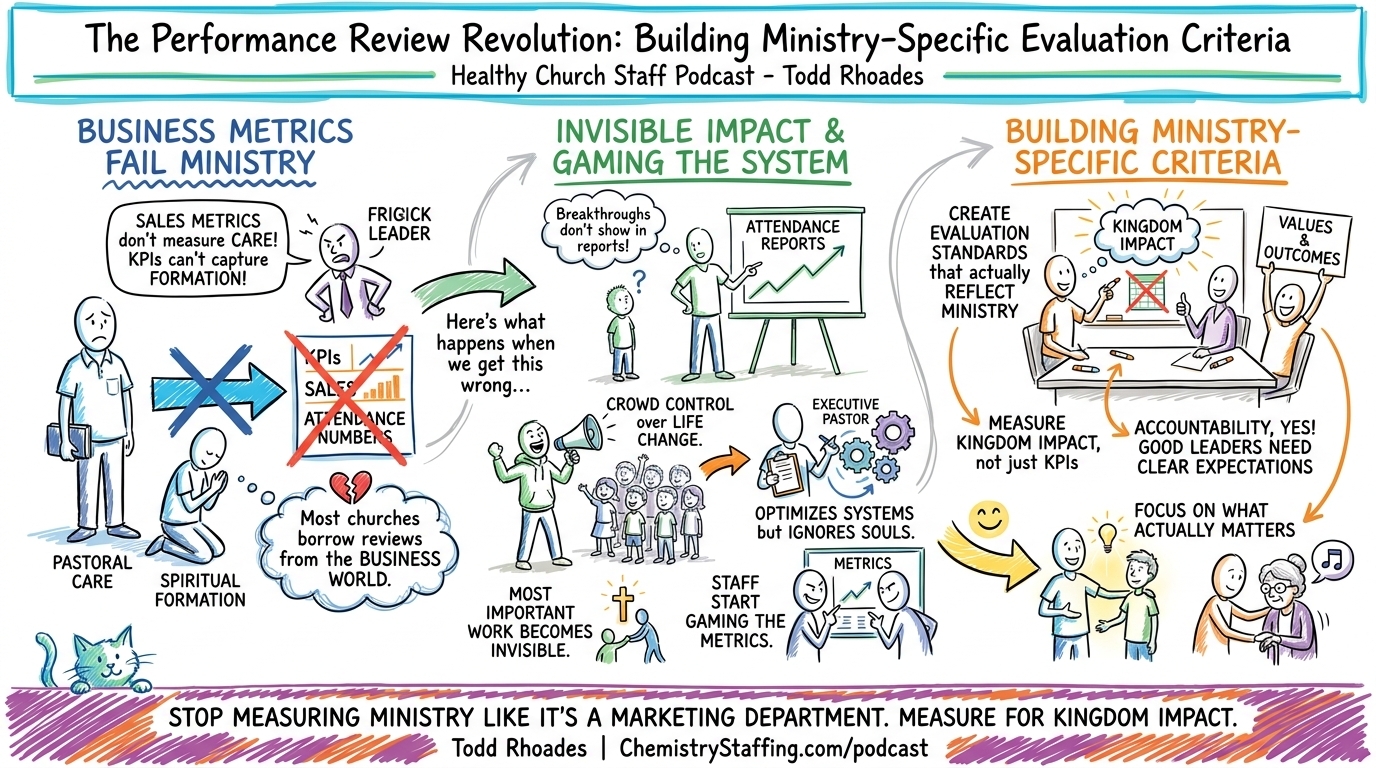
You can't measure spiritual formation with a spreadsheet. You can't KPI your way to Kingdom impact. Sales metrics don't capture pastoral care, and quarterly reports miss the quiet moments where lives are transformed.
But we keep trying anyway because numbers feel objective, measurable, safe. They give us something concrete to point to when the board asks, "How are things going?"
When Metrics Miss the Ministry
Here's what happens when we get this wrong—and I've seen this play out in churches everywhere:
Your youth pastor stops investing in the quiet kid because breakthrough moments don't show up in attendance reports. Why spend time with the withdrawn teenager when you need to focus on growing the Wednesday night numbers?
Your children's pastor prioritizes crowd control over life change. It's easier to measure how well the program ran than whether little hearts encountered Jesus.
Your executive pastor optimizes systems but ignores souls. Operational efficiency gets the spotlight while staff health and spiritual development get pushed to the margins.
The result? Staff start gaming the metrics instead of serving people. They focus on what gets measured rather than what matters most. The most important work—the soul work, the relationship work, the slow work of discipleship—becomes invisible.
"The person matters more than the position." - This should be the foundation of every ministry evaluation.
The Hidden Cost
When we measure ministry workers like corporate employees, we're not just missing important data—we're actually reshaping their priorities. What gets measured gets attention. What gets attention gets results. But in ministry, some of our most significant results can't be quantified.
A Better Approach: Ministry-First Evaluation
I'm not anti-accountability. Good leaders need clear expectations and honest feedback. But we need to measure what actually matters in ministry. Here's how to build an evaluation system that honors both excellence and calling:
Start With Mission, Not Metrics
Before you open a single spreadsheet, ask this question: "What does success actually look like for this specific role?" Root your answer in your church's mission, not borrowed business objectives.
For your worship pastor, success might include creating space for encounter, developing team members spiritually, and fostering unity in the congregation. Yes, there may be some metrics involved, but they're not the starting point.
Include Both Quantitative and Qualitative Measures
Create space in your evaluations for storytelling, not just statistics. Ask your staff to share stories of life change, breakthrough moments, and ministry wins that numbers can't capture.
Consider adding questions like:
- "Tell me about a time this quarter when you saw God move in unexpected ways"
- "What relationships are you most encouraged by right now?"
- "Where have you seen the biggest growth in people you're investing in?"
Measure Inputs They Can Control
Focus on actions and attitudes your staff can directly influence, not just outcomes that depend on many factors beyond their control. A youth pastor can control their investment in relationships, their preparation for teaching, and their availability to students. They can't control how many kids show up on any given night.
Build in Peer Feedback
Ministry is team sport. Include perspectives from other staff members who see different sides of each person's contribution to the overall mission.
Ministry-Specific Evaluation Examples
Worship Pastor: Evaluate on team development, spiritual leadership during rehearsals, and creating space for congregational encounter—not just attendance numbers.
Youth Pastor: Focus on relational investment, discipleship depth, and volunteer development—alongside event attendance.
Children's Pastor: Assess volunteer equipping, safety protocols, AND the spiritual formation happening in young hearts.
Executive Pastor: Measure staff health, team unity, and systems that serve people—not just operational efficiency.
The Practical Challenge
Here's your homework this week: Pull out your last performance review template. Look at it with fresh eyes.
Circle everything that could apply to any business. Then ask yourself: "What are we missing that's uniquely ministry?"
That gap—that's where you start building your next review season.
Scripture Foundation
"Now it is required that those who have been given a trust must prove faithful." - 1 Corinthians 4:2
Paul reminds us that stewardship and faithfulness are core to ministry evaluation. We're not just managing programs or hitting targets—we're stewarding the Gospel and the people God has entrusted to our care.
Discussion Questions for Your Team
- What ministry outcomes do we most want to see but find hardest to measure?
- Where would you love more specific feedback that traditional evaluations don't address?
- What's one ministry-specific metric we could start tracking that would better reflect our Kingdom impact?
- How can we give each other more meaningful feedback that goes beyond task completion?
The Bottom Line
If your performance reviews could work at a Fortune 500 company, they're probably not working well for your ministry.
Your staff are Kingdom workers, not corporate employees. They're called to measure success in changed lives, growing faith, and flourishing community—not just growing numbers.
This doesn't mean lowering standards or avoiding difficult conversations. It means raising the standard to what actually matters in ministry while creating space for the kind of feedback that helps people grow in both competence and calling.
Ready to Revolutionize Your Reviews?
I've spent considerable time developing a comprehensive performance review system specifically designed for churches. It addresses the unique challenges of ministry evaluation while maintaining the accountability that healthy organizations need.
Whether you have a robust review process you're looking to improve, or you're starting from scratch, this framework can help you measure both ministry and metrics that truly matter.
If you're interested in learning more about creating evaluation systems that honor both excellence and calling, I'd love to help. Send me an email with "Staff Performance Review" in the subject line, and I'll share some resources that can help you get started.
Your staff deserve evaluation systems that recognize their calling, celebrate their growth, and guide their development in ways that matter for the Kingdom. It's time to stop measuring ministry like it's marketing and start evaluating what actually moves the mission forward.
What's one change you could make to your review process this week that would better reflect your ministry values? I'd love to hear about it—drop me a line and let me know how you're rethinking staff evaluation at your church.