

You were so excited when you hired them. They seemed perfect for the role, brought great energy, and fit well with the team. Six months later, they handed in their resignation. So you started the search process again, found another solid candidate, and eighteen months later... same story.
🎧 Listen to this episode:
If this sounds familiar, you're not alone. Many churches find themselves trapped in a cycle where good people simply don't stay. Your remaining staff knows it, your board talks about it, and your congregation has started to notice. You might be wondering if it's something you're doing wrong, or perhaps you've convinced yourself it's just bad luck.
Here's the truth: revolving doors don't just happen. They're the result of broken systems, and the good news is that broken systems can be fixed.
The Hidden Cost of Constant Turnover
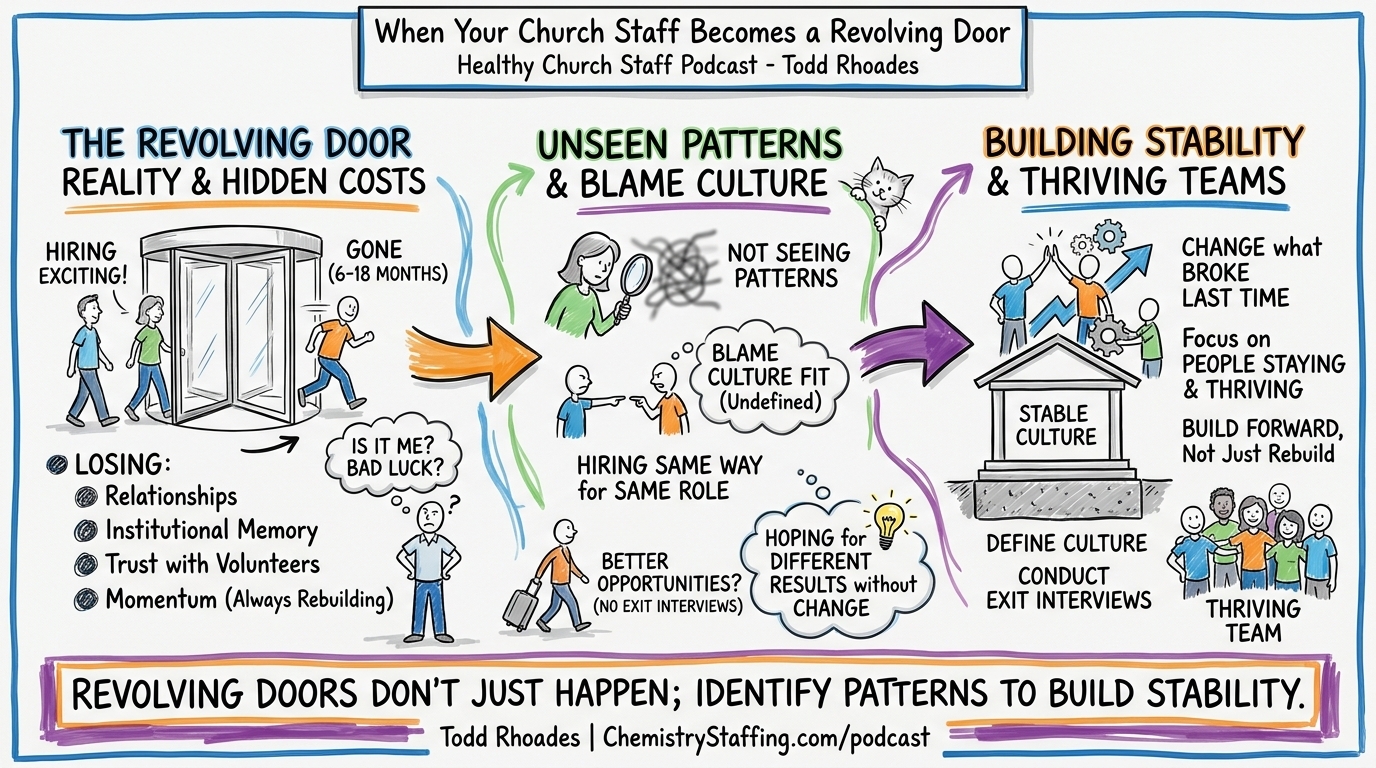
Before we dive into solutions, let's be honest about what chronic staff turnover is actually costing your church. Every time someone leaves your team, you lose far more than their skills and abilities.
You lose their relationships. That youth pastor who just left? They took with them all the connections they'd built with students, parents, and volunteers. The worship leader who moved on? Gone are the relationships with musicians and the comfort level the congregation had developed.
You lose institutional memory. New staff members don't know why certain decisions were made, what's been tried before, or the nuances of how things work in your specific context.
You lose trust. Volunteers become hesitant to invest deeply when they've seen multiple staff members come and go. Congregation members start to wonder about the stability of leadership.
But here's what most leaders miss: you lose momentum because you're always rebuilding instead of building forward.
The Patterns You're Not Seeing
After working with hundreds of churches through the staffing process, I've noticed some common patterns that create revolving doors. The tricky part is that these patterns often operate below the surface, making them difficult to identify.
The Definition Problem
You keep saying people leave because they're "not a good culture fit," but when pressed, you realize you've never actually defined what your culture is. Without clear cultural expectations, how can anyone succeed in fitting into something undefined?
The Same Mistake, Different Person
You keep hiring for the same role the same way, but you never ask the crucial question: why couldn't the last three people succeed in this position? Maybe the role itself needs to be redesigned rather than simply refilled.
The Exit Interview Gap
When people leave for "better opportunities," you take that at face value without digging deeper. What made those opportunities better? Was it compensation, work environment, growth potential, or something else entirely?
The Hope Strategy
You keep hoping the next hire will be different and will stick around, but without changing anything that contributed to previous departures, you're likely to see the same results.
"Instead, speaking the truth in love, we will grow to become in every respect the mature body of him who is the head, that is, Christ. From him the whole body, joined and held together by every supporting ligament, grows and builds itself up in love, as each part does its work." - Ephesians 4:15-16
Building the Stability You Want
I've been in the church staffing world for a long time, and I can tell you with confidence that stability is absolutely possible. But it requires intentional effort and honest assessment. Here's how to start:
Conduct Honest Post-Mortems
After every departure, do a thorough analysis. I call it an autopsy – not to assign blame, but to identify patterns and learning opportunities. Ask the hard questions: What would have had to be different for this person to stay and thrive? What systemic issues contributed to their departure?
Most of the time, it's not entirely the staff member's fault or entirely the church's fault. It's usually both. But you can only control your side of the equation, so focus on what you can change.
Revolutionize Your Onboarding
Take a hard look at your onboarding process. Are you setting people up to succeed or merely survive? Define what success looks like in the first 90 days, six months, and first year. Create clear, achievable wins that new staff members can accomplish early on.
Stop hiring urgently and start hiring strategically. Build systems that help people win, not just work harder.
Learn from Stable Churches
In our work with churches across the country, we've identified some key differences in how stable churches operate:
- They hire slowly and take time to find the right fit rather than filling positions quickly
- They onboard intentionally over a longer period, ensuring new staff members are truly set up for success
- They create early wins that build confidence and momentum
- They have honest conversations about fit and performance before issues become crises
- They redesign roles when necessary rather than just refilling positions that aren't working
Discussion Questions for Your Leadership Team:
- When you think about our current staff culture, what are our greatest strengths in creating a place people want to stay and serve?
- How well do we handle conflict and difficult conversations as a staff? What could we improve?
- What makes our team members feel most valued and supported in their roles?
- If someone asked a former staff member about their experience here, what would we want them to say?
- What's one specific change we could make in the next month to improve our staff culture?
Your Challenge This Week
If your church has become known as a place where staff don't stay long – where most of your team has been there three years or less – then you know who you are. Here's your challenge:
Look at your last three departures and identify just one pattern. Only one. Don't overwhelm yourself trying to fix everything at once. Write down that one pattern, then ask yourself: what would I change about our hiring, onboarding, or management process to address this specific issue?
Maybe you'll notice that people consistently leave because expectations weren't clear from the beginning. Or perhaps you'll see that new staff members weren't given adequate support during their first few months. Whatever the pattern, focus on that one thing and make a plan to address it.
Action Steps to Take This Month:
- Schedule individual check-ins between supervisors and team members to discuss role clarity and job satisfaction
- Review and update job descriptions to accurately reflect current expectations
- Create or revisit your staff values/culture document
- Identify one process causing frustration and commit to addressing it
- Establish a regular feedback system for ongoing communication about team health
The Bottom Line
Revolving doors aren't the result of bad luck or external circumstances you can't control. They're symptoms of broken systems, and broken systems can be fixed. But it starts with honest assessment and the willingness to change what isn't working.
Stability is possible for your church staff. I've seen it happen countless times. But it requires moving beyond hope-based strategies to intentional, systematic changes in how you hire, onboard, and support your team members.
"Whatever you do, work at it with all your heart, as working for the Lord, not for human masters, since you know that you will receive an inheritance from the Lord as a reward. It is Christ you are serving." - Colossians 3:23-24
Remember, you're not just building a stable staff – you're creating an environment where people can thrive in their calling to ministry. That's worth the effort it takes to get it right.
If you're feeling overwhelmed by where to start or need help breaking the revolving door cycle at your church, we'd love to help. This is exactly the kind of challenge we help churches navigate every day. Reach out to us at podcast@chemistrystaffing.com and let's talk about how we can support you in building the stable, healthy staff culture your church deserves.