

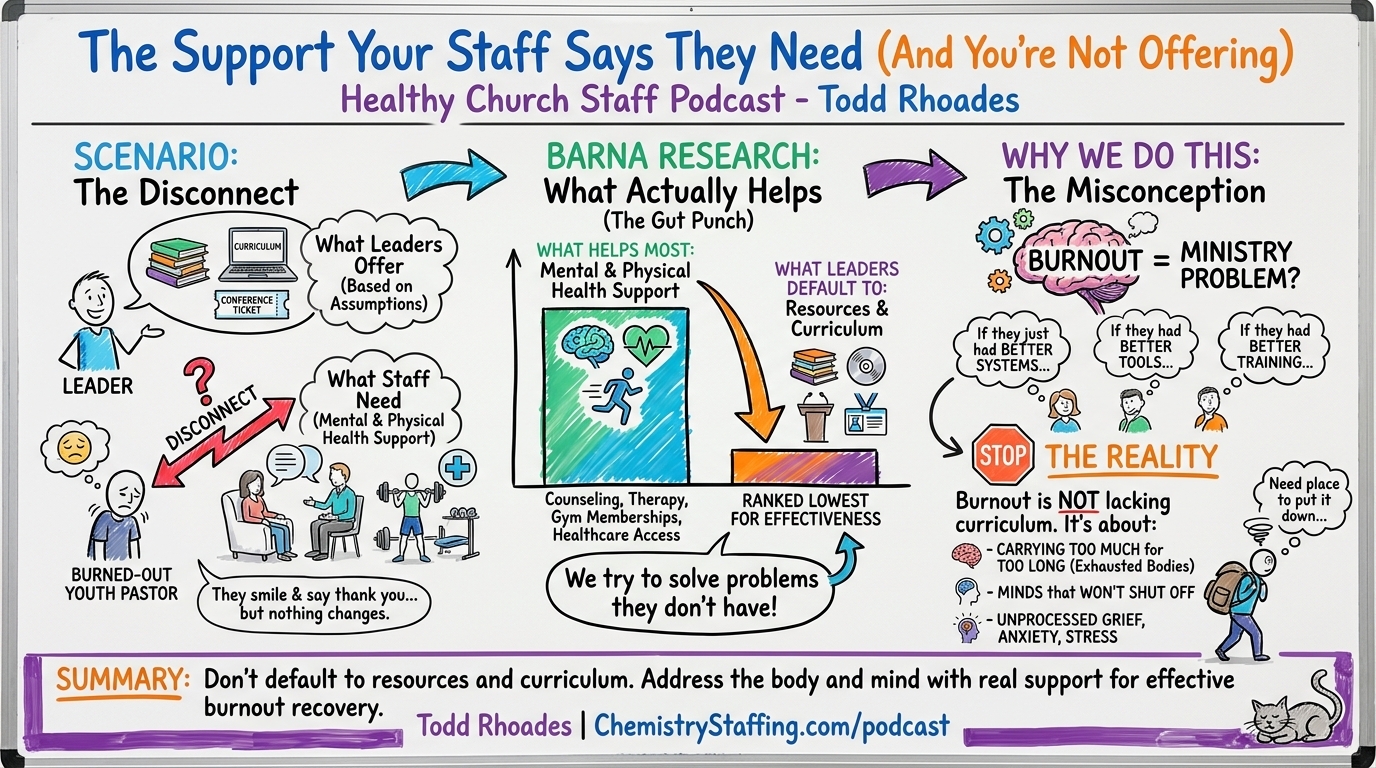
Your youth pastor stops by your office and tells you they're struggling with burnout.
🎧 Listen to this episode:
So you do what good leaders do.
You offer them access to that upcoming leadership conference. Maybe you point them toward a new curriculum or that resource library subscription you just purchased. You remind them about the counseling budget—if they really need it.
They smile, say thank you, and walk away.
But nothing changes.
Here's why: you just offered them what you think helps. Not what actually does.
The Disconnect Between Good Intentions and Real Support
A recent Barna study asked burned-out pastors and church staff what actually helps when they're struggling. The number one answer? Mental and physical health support.
Not another conference. Not a new curriculum. Not even a better resource library.
Counseling. Therapy. Gym memberships. Healthcare access. The stuff that addresses the body and the mind—not just the ministry.
But here's the gut punch: most churches aren't offering anything like that.
Instead, we default to what we've always done. We offer more resources, more curriculum, more training, more conferences. And according to Barna, those actually ranked at the bottom of the list for effectiveness in addressing burnout.
We're working hard to solve a problem our staff doesn't actually have.
Why We Keep Missing the Mark
So why do we keep doing this? Why do well-meaning church leaders keep offering solutions that don't address the real issue?
I think it's because we've fundamentally misunderstood what burnout is.
We think burnout is a ministry problem. We assume if our staff just had better systems, better tools, or better training, they'd be fine. The burnout would disappear.
But burnout isn't about lacking the right curriculum or missing the latest leadership techniques.
Burnout is about carrying too much for too long with no place to put it down.
It's about bodies that are exhausted and minds that won't shut off. It's about unprocessed grief, unaddressed anxiety, and untreated stress. It's about spiritual leaders who've given everything to care for everyone else while slowly depleting themselves.
And we keep handing them another book to read.
What Scripture Says About Caring for the Whole Person
Matthew 11:28-30 - "Come to me, all you who are weary and burdened, and I will give you rest. Take my yoke upon you and learn from me, for I am gentle and humble in heart, and you will find rest for your souls. For my yoke is easy and my burden is light."
3 John 1:2 - "Dear friend, I pray that you may enjoy good health and that all may go well with you, even as your soul is getting along well."
Now listen—I know your heart is good here. You're not ignoring this on purpose. You're not trying to give bad advice. But we need to get honest about the gap between what we're offering and what actually moves the needle.
What Your Staff Actually Needs
Let me be direct: mental health support isn't a luxury anymore. It's baseline care.
I know what some of you are thinking: "That's just a cultural thing, Todd. Back in my day, we didn't have any mental health support. We just toughed it out."
And I get it. I really do. But this is the reality of ministry today. The pace is faster. The expectations are higher. The complexity is greater. And the old "just buckle down and push through" approach isn't sustainable—and it's costing us our best people.
Here's what effective staff support actually looks like:
Mental Health Access
If your staff has healthcare, that's great. But do they have the time to use it? Do they feel permission to see a therapist or counselor without shame?
Have you normalized counseling as a leadership tool—not as a "your marriage is falling apart" last resort? Because until you do, having a counseling benefit on paper doesn't mean your staff will actually use it.
Physical Health Support
Burnout shows up in the body first. Disrupted sleep. Tension headaches. Digestive issues. Weight gain or loss. Chronic fatigue.
Some churches are covering gym memberships or offering wellness stipends. Others are providing standing desks, encouraging walking meetings, or building actual rest into their rhythms—not just a day off to catch up on errands.
Protected Rest
And speaking of rest: are you building in Sabbath rhythms for your team? Real rest, where they're not checking email or "just handling one quick thing"?
Jesus cared about bodies. He fed people. He rested. He withdrew from the crowds. Paul told Timothy to stop drinking only water and take a little wine for his stomach.
The Bible doesn't separate the spiritual from the physical—we're the ones doing that. And it's costing us.
Questions to Ask Your Team This Week
- On a scale of 1-10, how would you rate your current energy level?
- What's one thing that's draining your tank right now?
- When you think about the support you need most to thrive—not just survive—what comes to mind first?
- How comfortable do you feel being honest about your mental or physical health struggles with this team?
- What's one change we could make in the next 30 days that would help you be healthier?
The Real Issue Underneath
I think I know what's really going on here. And it's not that we don't care.
We're afraid that if we name the mental and physical toll of ministry, it'll sound like we're weak. Or that we're not trusting God enough.
So we spiritualize it. We say "just pray more" or "lean into your calling." It's almost like the worse it got, the harder we had to lean in, because God called us to do this and He never said it would be easy.
But that's not biblical leadership—that's just grinding people down in the name of faithfulness.
Galatians 6:2 - "Carry each other's burdens, and in this way you will fulfill the law of Christ."
Your staff doesn't need more curriculum. They need more care.
Two Things You Can Do This Week
Here's what I want you to do:
First, ask your team directly: "What kind of support would actually help you right now?"
Don't assume. Don't guess. Just ask. And then—this is important—actually listen. Create space for honest answers. Make it safe for them to tell you the truth.
Second, pick one thing you can actually offer in the next 90 days.
Maybe it's access to counseling. Maybe it's a wellness stipend. Maybe it's protected rest with actual boundaries. Maybe it's giving everyone an extra day off per month, no questions asked.
You can't fix everything. But you can close one gap. So start there.
Action Steps for Church Leaders
- Audit your current benefits: List all staff support offerings. Are they ministry-performance focused or whole-person health focused?
- Send an anonymous survey: Ask staff to rank what types of support would help them most.
- Research one new benefit: Look into the cost and logistics of adding mental or physical health support.
- Add wellbeing check-ins: Include 10 minutes in one-on-ones focused on personal health, not just ministry updates.
- Create a "rest-is-holy" culture: Identify one policy that subtly punishes rest and change it.
You Have More Power Than You Think
When that youth pastor comes to your office and tells you they're tired and burned out, they're actually looking for help. Real help. Not another resource to add to their already overwhelming workload.
And you have more power to offer that help than you might think.
You might need to have some conversations—with your board, with your finance team, with other church leaders. You might need to ask, "What do we do here? How do we actually care for our people?"
And I want you to know: I'm offering to have that conversation with you.
If there's any way I can help your church—whether it's in the area of church health, figuring out how to provide better support to your staff, or just thinking through what healthy staffing looks like—I'd love to talk with you.
Just reach out to me at podcast@chemistrystaffing.com. Send me a short email, and I'll reach back out to set up a time to talk. No sales pitch, no pressure—just a conversation about how we can help your team thrive.
Because at the end of the day, healthy churches are built by healthy staff. And healthy staff need more than good intentions—they need genuine, whole-person care.
Want to talk about how to better support your church staff? Email Todd at podcast@chemistrystaffing.com or visit chemistrystaffing.com to learn more about building a healthier church team.