

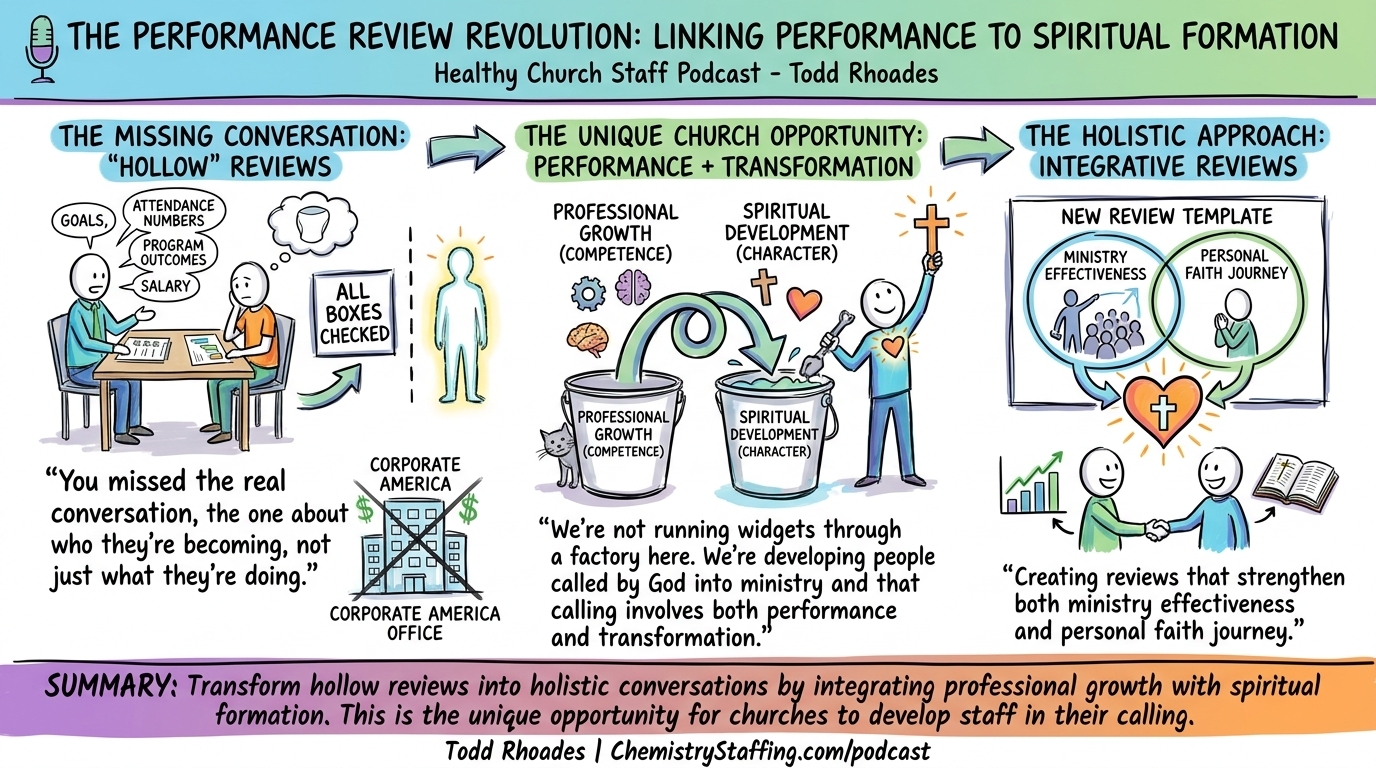
You just finished another performance review with your church staff member. You checked all the boxes on ministry goals, talked about attendance numbers and program outcomes, maybe discussed salary and next year's objectives.
🎧 Listen to this episode:
But something feels... hollow.
Like you missed the real conversation—the one about who they're becoming, not just what they're doing.
If that sounds familiar, you're not alone. Most church leaders struggle with this same feeling because we've borrowed performance review systems from corporate America without considering the unique nature of ministry work.
The Corporate Template Trap
Here's what I've discovered after years of working with churches: most performance reviews look exactly like those in corporate America. Goals, metrics, competencies, ratings—and there's nothing inherently wrong with these elements. They're valid and necessary parts of any staff evaluation.
But here's the thing: we're not running widgets through a factory. We're developing people called by God into ministry, and that calling involves both performance and transformation.
The problem emerges when we split spiritual growth from professional development as if they're completely separate categories. Character goes in one bucket, competence in another. Sunday becomes about spiritual formation, Monday about performance management.
Your staff starts living compartmentalized lives where faith becomes personal and work becomes professional. But ministry doesn't work that way—at least, it shouldn't.
The Under-Spiritual Problem
Now, I understand the hesitation. You don't want to become overly spiritual about everything, and there's wisdom in that balance. But what if we're being under-spiritual about some of the most important conversations we have with our staff?
When we separate professional development from spiritual formation, we miss the profound truth that in ministry, who you're becoming directly impacts what you're accomplishing. This connection simply doesn't exist in the same way in the business world.
"Whatever you do, work at it with all your heart, as working for the Lord, not for human masters, since you know that you will receive an inheritance from the Lord as a reward. It is the Lord Christ you are serving." — Colossians 3:23-24
Questions That Change Everything
The revolution begins with asking different questions in your reviews. Instead of focusing solely on metrics and goals, try incorporating questions like these:
- "Where did you see God working through you this year?"
- "What character area is He developing in you right now?"
- "How has your calling been refined through this role?"
- "What spiritual disciplines are supporting your ministry effectiveness?"
These open-ended questions connect their growth to their calling, not just to their job description. They address both fruit and character because in ministry, personal transformation and professional effectiveness are inseparably linked.
The Three-Part Framework
Here's a practical framework that's working for churches across the country. Structure your reviews around three core areas:
1. Competence
How well did they execute their responsibilities? This covers the traditional performance metrics you're already tracking—ministry goals, program outcomes, and professional development.
2. Character
How did God shape them through their work this year? This explores personal growth, spiritual development, and character formation that happened through ministry experience.
3. Calling
How is their role aligning with where God is leading them? This discusses future direction, gifting development, and how their role serves their larger sense of calling.
With this framework, you're not just evaluating performance—you're participating in their spiritual formation. Your staff review becomes a form of discipleship.
Discussion Questions for Your Team:
- How do you see your professional responsibilities and spiritual growth intersecting in your daily ministry work?
- What would it look like if our performance reviews became spaces for spiritual mentoring and discipleship?
- What specific spiritual disciplines could we incorporate into our review conversations?
Deeper Questions for Spiritual Formation
As you implement this approach, consider weaving in questions that address the whole person:
- "What has this year taught you about yourself?"
- "Where have you struggled to trust God in your role?"
- "How has serving here grown your faith?"
- "What areas of character is God inviting you to develop?"
These aren't fluffy add-ons to the "real" review—these are the real review. They acknowledge that ministry effectiveness flows from transformed hearts, not just trained hands.
"As iron sharpens iron, so one person sharpens another." — Proverbs 27:17
Making the Transition
I know this might feel like a significant shift from your current process. Here's how to start small:
This week, rewrite just three questions in your performance review template:
- Replace one competency question with a character question
- Replace one goal question with a calling question
- Replace one metric question with a spiritual formation question
You still need all those traditional metrics and goals—but begin making space for the deeper conversations that will transform both your staff and your ministry effectiveness.
Action Steps:
- Schedule a team meeting to redesign your current performance review template
- Identify 2-3 spiritual disciplines each team member wants to focus on in the next quarter
- Create a "growth partnership" system where staff members can choose accountability partners for both ministry and spiritual goals
- Plan training for supervisors on leading spiritually-integrated performance conversations
The Bottom Line
Your performance reviews should feel more like discipleship conversations than corporate evaluations. When we connect performance to spiritual formation, we're not just building better staff—we're participating in God's work of reshaping leaders.
This shift acknowledges what we know to be true: the best ministry flows from people who are growing in both competence and character, who understand their calling and are being transformed by the work God has given them to do.
"So Christ himself gave the apostles, the prophets, the evangelists, the pastors and teachers, to equip his people for works of service, so that the body of Christ may be built up until we all reach unity in the faith and in the knowledge of the Son of God and become mature, attaining to the whole measure of the fullness of Christ." — Ephesians 4:11-13
Make your next review about the whole person, not just the employee. The difference will transform not only your review process but the culture of growth and development throughout your entire church staff.
Struggling with your current performance review system? Whether you don't have one at all or feel like yours needs a complete overhaul, I'd love to help. Send me your thoughts and questions at podcast@chemistrystaffing.com—let's work together to create reviews that truly serve your staff's growth and your church's mission.