

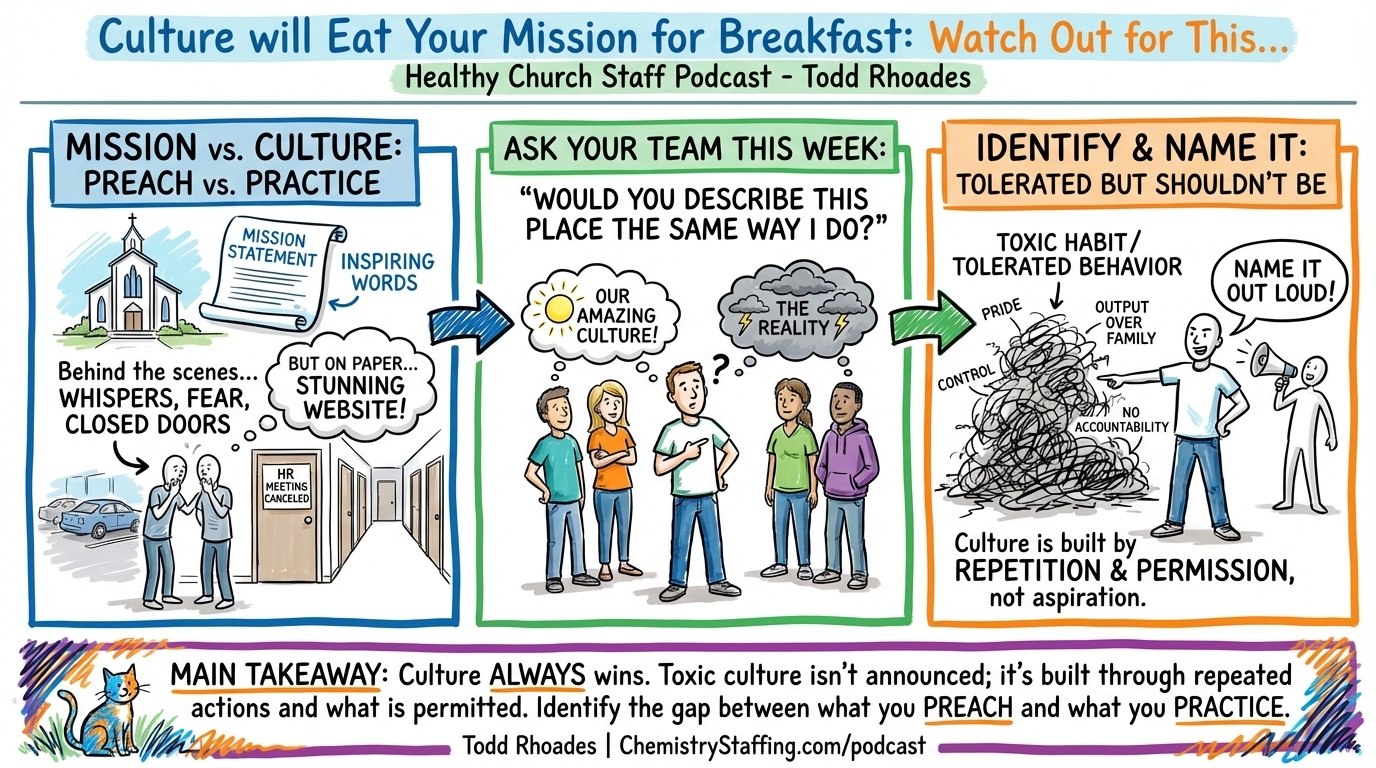
The church website was absolutely stunning. Beautiful design, inspiring mission statement, and weekend worship that was polished to perfection. On paper, it looked like a healthy, growing church that any pastor would be proud to lead.
🎧 Listen to this episode:
But behind the scenes? Staff members whispered concerns in the parking lot. HR meetings got mysteriously canceled. Everyone smiled brightly on Sunday mornings, but the weekday hallways were lined with closed doors and tense silence.
The mission statement proclaimed one thing. The culture lived out something entirely different.
And here's the hard truth every church leader needs to understand: culture always wins.
Mission vs. Culture: The Critical Difference
After years of working with churches and witnessing both beautiful successes and devastating failures, I've learned to define it this way:
- Mission is what you preach
- Culture is what you practice
This distinction might seem simple, but it's where most churches—including healthy, well-intentioned ones—begin to drift off course.
You can say you value humility, but if your senior leaders never admit mistakes, your real organizational value is pride. You can declare that you value family, but if staff members get punished for prioritizing their children's needs, your actual value is productivity over people. You might claim to value accountability, but if nobody feels safe to offer pushback or honest feedback, what you really value is control.
"Culture isn't built by aspiration. It's built by repetition and permission."
How Toxic Culture Creeps In
Here's what makes cultural drift so dangerous: toxic culture rarely announces itself with fanfare. It doesn't show up one day wearing a name tag that says, "Hi, I'm here to destroy your ministry."
Instead, it seeps in gradually—one quiet compromise at a time.
The signs are subtle at first:
- People laugh less in meetings
- Staff members disengage emotionally from their work
- Team gatherings become performative rather than authentic
- Your best people quietly start looking for other opportunities
By the time these symptoms become obvious, the cultural foundation has already shifted significantly. And when crisis hits—because it eventually will—that's when you discover what's really been formed beneath the surface.
Crisis: The Great Revealer
How your church responds when pressure hits reveals your true culture. You might think you know what your church values, but crisis has a way of exposing what's actually been shaped over time versus what's merely been stated in your staff handbook.
Peter Drucker famously said that "culture eats strategy for breakfast." In the church world, I'd take it one step further: culture eats mission for lunch.
I've seen this pattern repeatedly in high-profile church failures. When the reports come out detailing what actually happened behind closed doors, the breakdown always traces back to cultural issues that developed over months, years, and sometimes even decades. The public failure wasn't the beginning of the problem—it was simply when the private cultural decay finally became visible.
Scripture Reflection
1 Corinthians 12:25-27: "so that there should be no division in the body, but that its parts should have equal concern for each other. If one part suffers, every part suffers with it; if one part is honored, every part rejoices with it. Now you are the body of Christ, and each one of you is a part of it."
What Gospel Culture Actually Looks Like
A gospel-centered church should feel like the gospel. If your church preaches grace but practices fear, something fundamental is broken.
Scripture is packed with "one another" commands that weren't just intended for Sunday morning congregational life. They apply equally—perhaps even more importantly—to how church leadership functions together:
- Love one another
- Bear with one another
- Encourage one another
- Serve one another
- Honor one another
These aren't just nice ideals to aspire toward. They're practical instructions for building the kind of culture that can sustain healthy ministry over the long haul.
So here's the diagnostic question every church leader needs to honestly answer: What kind of fruit is your staff culture currently bearing?
Practical Culture Assessment
Take a moment to consider these questions:
- Do staff members feel safe to disagree respectfully with leadership decisions?
- When someone makes a mistake, is the focus on learning or blame?
- Are people celebrated for their contributions, or only noticed when something goes wrong?
- Do team members genuinely enjoy spending time together, or is it merely professional obligation?
- How do leaders respond when their personal preferences conflict with someone else's family needs?
Discussion Questions for Your Team
- If our church culture was a restaurant, what type would it be and why? What would be on the menu?
- What behaviors and attitudes do we currently celebrate or reward on our team? What do we tend to overlook that might not align with our mission?
- Where have you noticed gaps between our stated values and our actual practices in how we serve together?
Taking Action: Where to Start
Culture change doesn't happen overnight, but it does start with honest acknowledgment and intentional steps. Here's how to begin:
Step 1: Ask the Hard Question
Gather your team this week and ask: "Would you describe this place the same way I do?" Create space for honest feedback without defensiveness.
Step 2: Name What's Been Tolerated
Identify one specific thing in your church culture that's been tolerated over time but shouldn't be. Maybe it's the way certain people get treated differently, or how decisions get made behind closed doors, or the expectation that staff should be available 24/7.
Name it out loud. Bring it into the light.
Step 3: Align Actions with Aspirations
Choose one area where you can immediately start practicing what you preach. If you say you value work-life balance, implement policies that actually support it. If you claim to value transparency, start sharing more about decision-making processes.
Action Items to Consider
- Schedule individual coffee conversations between staff members who don't normally work closely together
- Add a "culture check" question to weekly team meetings: "What did we celebrate well this week?"
- Establish a monthly "mission alignment" review to assess if recent decisions support your stated values
- Plan a team activity outside of work that builds relationships and reflects your church's heart for community
Your Culture Will Always Win
Here's the bottom line: your culture will always eat your mission for breakfast. So instead of fighting against this reality, leverage it. Let your culture prove your message rather than contradict it.
The churches that thrive long-term aren't necessarily the ones with the most polished mission statements or the most impressive weekend services. They're the ones where what happens behind closed doors on Tuesday afternoon reflects the same values proclaimed from the platform on Sunday morning.
When you don't mind your culture—when you let it drift unchecked—that's when devastating falls happen. But when you intentionally cultivate a culture that embodies your mission, you create an environment where both staff and congregation can flourish.
Titus 2:7-8: "In everything set them an example by doing what is good. In your teaching show integrity, seriousness and soundness of speech that cannot be condemned, so that those who oppose you may be ashamed because they have nothing bad to say about us."
The health of your church culture isn't just an internal staff issue—it's a mission-critical factor that determines your church's long-term effectiveness in reaching your community with the gospel.
Your culture is being formed every day through countless small interactions, decisions, and responses. The question isn't whether you're building culture—you are. The question is whether you're building the kind of culture that advances your mission or undermines it.
What will you choose to build today?
This post is part of a series based on the book "When the Church Falls: What We Can Learn from Leadership Collapses and How to Prevent the Next One." If you're wondering where your church culture might be drifting, take the free assessment at whenthechurchfalls.com.
I'd love to hear your thoughts on this topic. What cultural challenges is your church working through? Email me at podcast@chemistrystaffing.com—I read every message and often respond personally.