

Picture this: You just spent two hours planning an exciting new ministry initiative. You're energized. The vision is clear. You can already see the impact it's going to make.
🎧 Listen to this episode:
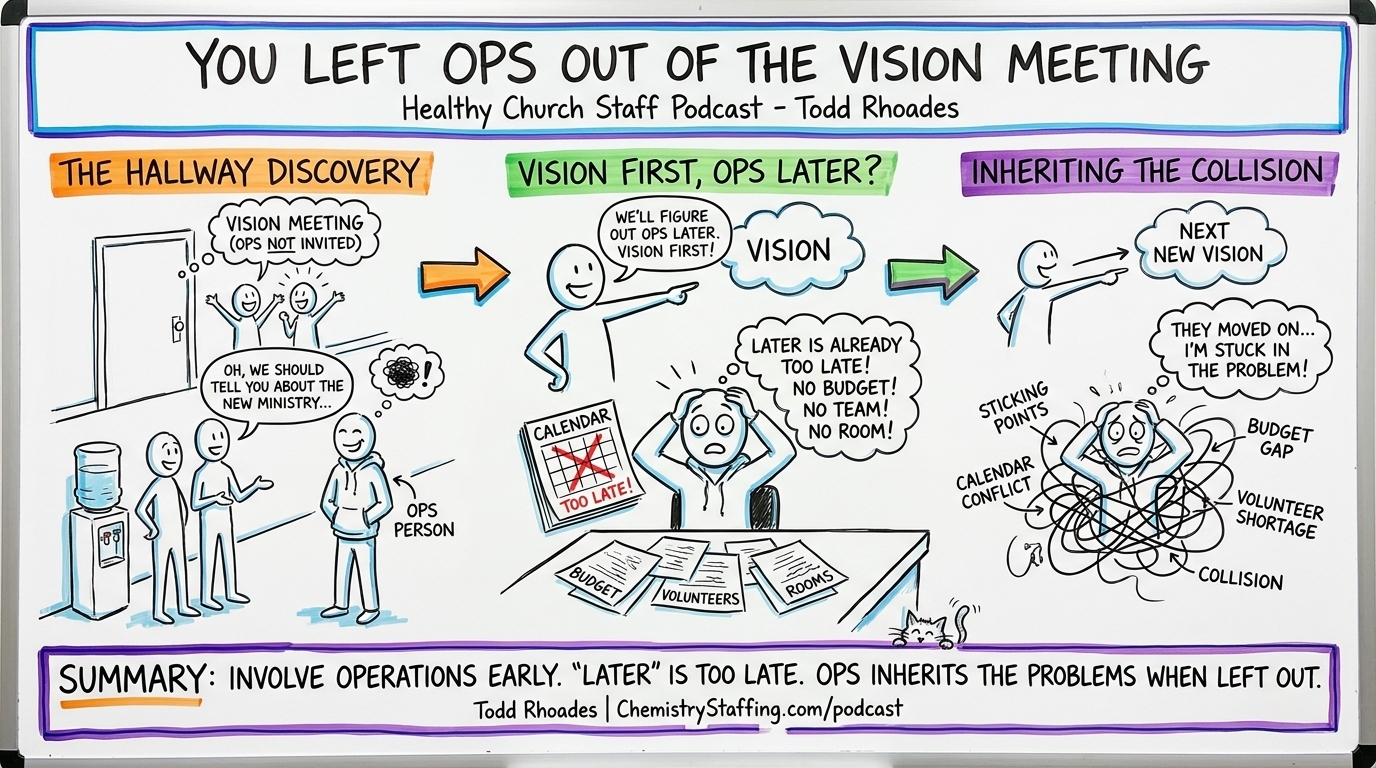
Then, as you're walking down the hallway still buzzing with excitement, you run into the person who actually has to staff it, budget it, and unlock the building for it.
"Oh, hey—we should tell you about this," you say.
They smile. They say it sounds great. They're genuinely supportive.
And then they walk back to their desk and start doing the math you skipped. The calendar that can't hold it. The budget line that doesn't exist. The volunteer team you don't have. The Sunday that's already packed.
Sound familiar?
If you've ever wondered why your operations team seems resistant to new ideas, or why brilliant ministry visions keep stalling out in the implementation phase, this might be why.
The Vision-First Trap
Here's what typically happens: You're the visionary leader. You think vision first, operations later. That sequence feels efficient. Paint the big picture first, then figure out the details.
But here's the problem—for the person who actually has to pull it off, "later" is already too late.
They weren't in the room when decisions were made. They inherited a collision:
- The new ministry needs rooms that are already booked
- It requires a volunteer team you haven't recruited
- It demands a budget line that doesn't exist
- It's scheduled for a Sunday that's already maxed out
You decided the vision. They inherited the impossible logistics.
And while you've already moved on to the next exciting idea, they're stuck in the middle of the problem. When they raise concerns about feasibility, you call it resistance. When they ask who's paying for it or who's unlocking the doors, you wonder why they're being so negative.
But from their perspective? They're not resisting the vision. They're trying to figure out how to make Sunday actually work.
Who You Actually Left Out
Let's be specific about who we're talking about here:
- Your operations director who knows which closet is already promised and which one is full
- Your admin team who manages the calendar and knows what's actually possible timing-wise
- Your facilities lead who understands the building can't absorb one more launch right now
- Your finance person who has to find money that isn't budgeted
- Your volunteer coordinator who knows you're already asking too much of your volunteers
These aren't minor players. They're the people who know how to turn vision into reality. They know the constraints you're unaware of. They see the problems you're going to run into three weeks from now.
But you treated them like a follow-up email. "This is where we're going. Make it happen."
They treat Sunday like a machine that actually has to start. And when it fails—when the ministry launch is chaotic or doesn't happen at all—you don't blame the meeting they weren't in. You blame the person who couldn't make an impossible plan look easy.
That's not leadership. That's using your operations team as a shock absorber for decisions they never got to influence.
"Even so the body is not made up of one part but of many... God has placed the parts in the body, every one of them, just as he wanted them to be. If they were all one part, where would the body be? As it is, there are many parts, but one body." — 1 Corinthians 12:14, 18-20 (NIV)
The Recap Fix Doesn't Work
Now, I know your heart. You weren't trying to sideline anyone. You genuinely thought operations comes after vision. You wanted to protect the dreaming phase from getting bogged down in logistics too early.
That's reasonable. It's even somewhat wise in certain contexts.
But it's also how the person who unlocks the building becomes an afterthought.
You'll be tempted to fix this by sending a recap. You'll share the meeting notes. You'll invite them to "weigh in" after the decision is made.
But here's the truth: That's not a seat at the table. That's a courtesy after the decision.
They don't need a summary of what you already decided. They need the opportunity to say what you cannot actually pull off—not because they lack faith or vision, but because they know the real constraints you're unaware of.
They need a capacity veto. Not a personality veto. A reality check on:
- Rooms
- Budget
- Bodies (staff and volunteers)
- Hours
- Keys and access
- Timeline
If those elements can't hold the vision, then the vision isn't ready yet. It's incomplete.
Vision that cannot survive the calendar, the budget, and the building is not vision. It's just a hallway briefing with extra enthusiasm.
A Different Way Forward
Here's what I'm suggesting: Put your operations people in the room before you fall in love with the idea. Before you make all the decisions they have to execute.
I know this feels like it will slow you down. I know it seems less efficient. But here's what actually happens when you include them early:
1. You get better ideas. Operations people see the whole system. They often have insights that make your vision better, not smaller. They know shortcuts you don't. They see opportunities you're missing.
2. You avoid costly mistakes. That ministry launch you were planning for November? They can tell you in October that it's impossible, or they can tell you in the planning meeting that January is more realistic. Which conversation would you rather have?
3. You build trust and ownership. When people are in the room for the decision, they own it differently. It's not your vision they're executing—it's our vision we're building together.
4. You honor the body of Christ. Every role matters. Every perspective has value. When you consistently exclude certain team members from strategic conversations, you're communicating—whether you mean to or not—that their role is less important.
Discussion Questions for Your Team
- Team Assessment: On our team, do we have any unspoken hierarchies where certain roles are valued more than others? What evidence do we see of this?
- Personal Reflection: Think about a time when you felt excluded from an important conversation. How did that affect your engagement with the work?
- Practical Exploration: Who are the people on our team who might feel like they're "just operations"? How can we better communicate that their role is essential?
- Application: What is one specific change we can make this week to ensure every team member feels valued and included in vision conversations?
Your Challenge This Week
Before your next vision meeting—before the next "big idea" session—do something that might feel uncomfortable:
Invite your operations people into the room.
Not for a report-out at the end. For a real chair at the table. Give them permission to say what you can't pull off and when you realistically can.
You're still the leader. It's still your call. The vision is still yours to cast. But you stop treating the person who runs Sunday like a detail you'll handle with an email later.
Because later is how ministries die in the hallway.
Action Items for Leaders
- Audit your meetings: Review who's invited to vision and planning meetings. Who's missing who should be there?
- Schedule listening sessions: Have one-on-one conversations with operations staff to understand their perspective and challenges.
- Reframe role descriptions: Review how you talk about different positions to ensure all language reflects that every role advances the mission.
- Establish "no silos" communication: Create a regular rhythm where vision and strategic thinking are shared with ALL staff, not just leadership.
- Celebrate operational wins: Recognize accomplishments from operations staff in the same way you celebrate ministry wins.
The Bottom Line
If the person who has to staff it, budget it, and unlock the building wasn't in the room, you didn't finish the vision. You announced it prematurely. You announced it in the hallway.
Real vision isn't just about the what and the why. It's also about the who, when, where, and how. And the people who know those answers? They're not obstacles to your vision. They're essential partners in making it real.
This week, bring them into the room. Not because I'm trying to slow you down, but because I know you actually want a vision that can survive Sunday.
"Whatever you do, work at it with all your heart, as working for the Lord, not for human beings, since you know that you will receive an inheritance from the Lord as a reward. It is the Lord Christ you are serving." — Colossians 3:23-24 (NIV)
What's your experience with this? Have you been the visionary who left ops out, or the operations person who found out in the hallway? I'd love to hear your story and what you've learned. Send your thoughts to podcast@chemistrystaffing.com.
This post is based on Episode 716 of the Healthy Church Staff Podcast. For more resources on building healthy church teams, visit chemistrystaffing.com.