

Your project's behind schedule. Your calendar looks absolutely insane. And you know—you absolutely know—you need help.
🎧 Listen to this episode:
But instead of asking, you just power through.
You tell yourself, "I've got this." Or that everyone else is already slammed. Or maybe, if you're being completely honest, you don't want to look like you can't handle it.
So you do what you always do: carry it alone. Until one day, you just can't carry everything anymore.
If this sounds painfully familiar, you're not alone. And more importantly, there's a way forward that doesn't involve drowning in silence.
The Self-Sufficiency Trap in Ministry
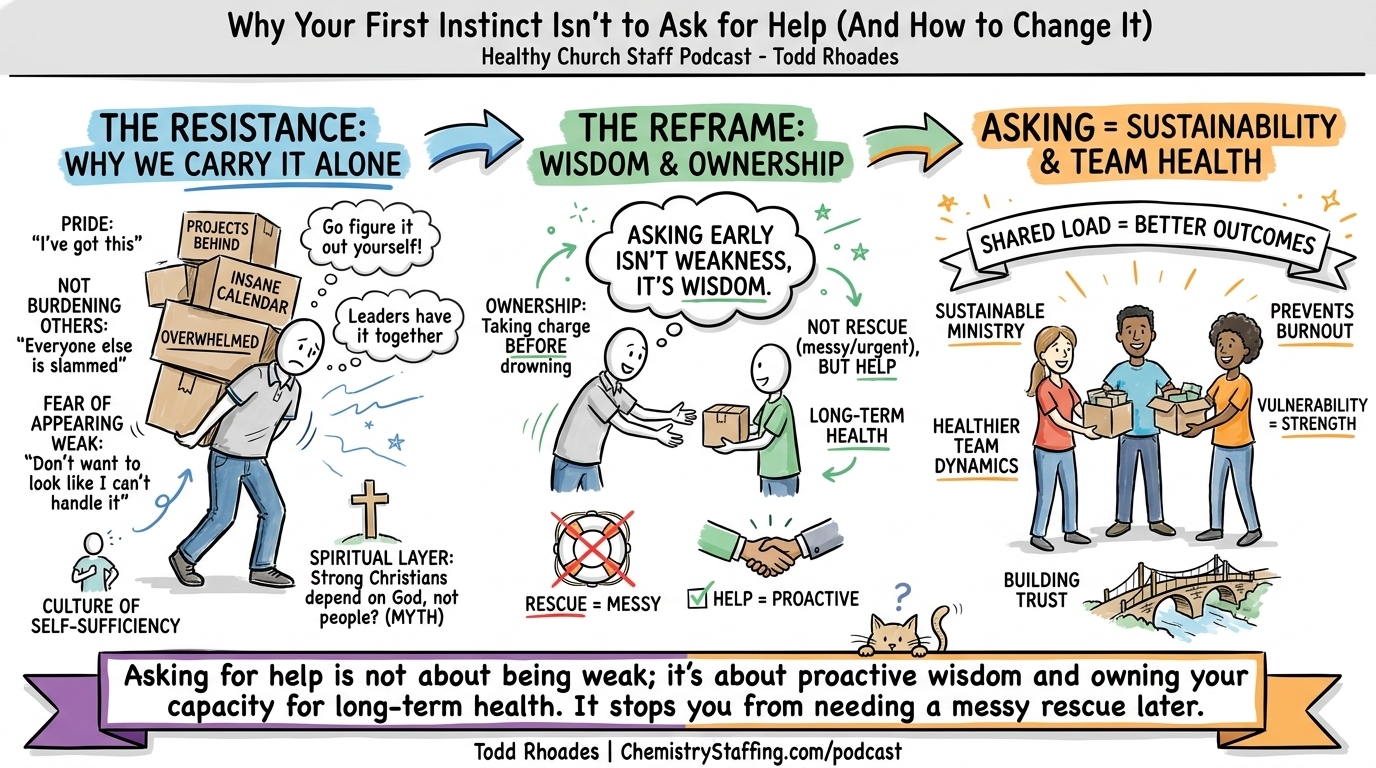
Most of us were shaped by a culture that celebrates self-sufficiency. "Figure it out yourself." "Don't be a burden." "Real leaders have it all together." And with AI promising to make us more productive, we've added another layer: "Just get AI to do it."
But here's the thing—when you take all of this cultural baggage and put it into a ministry context, it gets even worse. Because now there's a spiritual layer on top of everything else.
"Strong Christians depend on God, not people."
"If I was more prayerful, I wouldn't need help."
"Asking for assistance is admitting I'm not spiritual enough."
None of these statements are true, but we tell them to ourselves anyway. And so asking for help starts to feel like a confession of weakness—or worse, a confession of inadequate faith.
What Really Happens When We Don't Ask
You think you're being responsible by not asking for help. You think you're protecting people, being strong, carrying your weight.
But you're actually creating a much bigger problem—a long-term problem.
Because when you wait until you're drowning, you don't ask for help. You need rescue. And rescue is very different from help.
Rescue is messy. It's urgent. It's chaotic. It involves other people having to scramble because you didn't ask soon enough. You've gone from "I could use some support" to "This is a dumpster fire and everything's burning down unless someone intervenes right now."
And here's the worst part: you've just modeled to your team that suffering in silence is the standard. They're watching you burn out quietly, and they're learning how to do the same.
What Scripture Says About Carrying Burdens Alone
"Moses' father-in-law replied, 'What you are doing is not good. You and these people who come to you will only wear yourselves out. The work is too heavy for you; you cannot handle it alone.'" — Exodus 18:17-18 (NIV)
"Carry each other's burdens, and in this way you will fulfill the law of Christ. If anyone thinks they are something when they are not, they deceive themselves." — Galatians 6:2-3 (NIV)
The Reframe You Need: Asking Is Ownership, Not Weakness
I get it. You're not trying to be a martyr. You genuinely don't want to burden people. And if you're a guy like me, there's something about masculinity that makes asking for help feel like defeat. (Don't even ask me to stop for directions until I'm completely lost and it's turned into a crisis.)
But here's the reframe that changes everything:
Asking for help before you're drowning is not weakness. It's actually a sign of good leadership.
Think about it this way: when you ask early, you're saying, "I care more about getting this done well than I care about looking capable." You're prioritizing your team's success, your church's mission, over your ego. You're protecting the work—and protecting yourself—from unnecessary collapse.
Patrick Lencioni talks about vulnerability-based trust as the foundation of healthy teams. And it starts when leaders admit they don't have it all together. When you ask for help, you're not showing weakness. You're actually showing strength—the kind that builds culture.
What This Actually Looks Like in Practice
So how do we change this pattern? Here are three practical shifts you can make starting today:
1. Separate Asking from Needing
Asking is proactive. Needing is reactive.
Start asking before it's urgent. Try something like: "Hey, I've got a project coming up. Could you take a look at this with me next week?"
Not: "I'm buried and everything's on fire—can you drop everything and help me right now?"
See the difference? One is collaboration. The other is crisis management.
2. Name It Out Loud With Your Team
Change the narrative by being explicit about it:
"I'm working on getting better at asking for help earlier, so I'm reaching out now. This isn't a crisis—it's just collaboration. Could you help me think through this?"
When you frame it this way, you're literally teaching your team a new culture around asking for help.
3. Notice How You Respond When Others Ask You
Here's a powerful exercise: the next time someone asks you for help, notice how you feel about them.
Do you think they're weak? Probably not.
Do you respect that they're being honest and proactive? Probably so.
Exactly. That's the whole point. Extend yourself the same grace you extend to other people when they ask for your help.
Action Steps to Take This Week
- Identify Your "Ask" – Before this week ends, identify one specific thing you're currently struggling with and ask at least one other person for help, input, or support.
- Model From the Top – If you're a leader, share one thing you need help with in your next team meeting. Demonstrate vulnerability and normalize help-seeking behavior.
- Reframe the Language – Replace "I hate to bother you" with "I'd value your input on this" or "Could I borrow your expertise?" Shift from burden language to partnership language.
- Create Help Channels – Establish a team communication thread or regular check-in specifically for sharing what you're working on and where you could use assistance.
We've Spiritualized Self-Sufficiency (And That's the Problem)
Ministry amplifies this whole problem because we've spiritualized self-sufficiency. We've made "I can do all things through Christ" mean "I shouldn't need people."
But that's not what Paul meant.
Paul had a team. He asked for help constantly. He wrote letters asking churches to send him support, to send people, to pray for him. Jesus himself sent disciples out in pairs—not alone, but together. Even Jesus in the garden asked his friends to stay awake with him. (He didn't get it, but he asked.)
Asking for help isn't a lack of faith. It's how the Body of Christ is supposed to function.
"Two are better than one, because they have a good return for their labor: If either of them falls down, one can help the other up. But pity anyone who falls and has no one to help them up." — Ecclesiastes 4:9-10 (NIV)
Your Bottom Line
Asking for help before you're desperate is not weakness. It's actually wise stewardship of the life and ministry that God has given you.
You don't have to carry all this alone. And you weren't meant to.
So here's my challenge: What's one thing you're currently carrying alone that you could ask for help with this week? Not when it becomes a crisis. Not when you're drowning. Right now, while it's still manageable.
And if you're a leader, what message are you sending by how you handle your own need for help? Your team is watching. What are they learning?
We're here for you. At Chemistry Staffing, we help churches build healthier teams and stronger cultures. If you found this helpful, I'd love to hear from you. What's your biggest struggle with asking for help? Email me at podcast@chemistrystaffing.com and let's talk about it.
This post is based on Episode 694 of the Healthy Church Staff Podcast. Subscribe to never miss an episode.