

You know what would actually help your youth pastor right now?
🎧 Listen to this episode:
A three-month sabbatical. Or maybe letting him hand off half his responsibilities to someone else for a few weeks. Or actually delegating that admin work instead of just saying you will "at some point."
You know this would help. He knows this would help.
But neither of you can figure out how to make it happen. So instead, you keep having the same conversation about burnout, and nothing ever actually changes.
If this sounds painfully familiar, you're not alone. And you're in the right place.
What Actually Relieves Pastoral Burnout (According to Research)
I was reading through some recent research on pastoral burnout this week, and one thing jumped out at me. The research is pretty clear on what relieves pastoral burnout most effectively.
Can you guess what it is?
It's not a day off. It's not a staff retreat or a mental health sermon series.
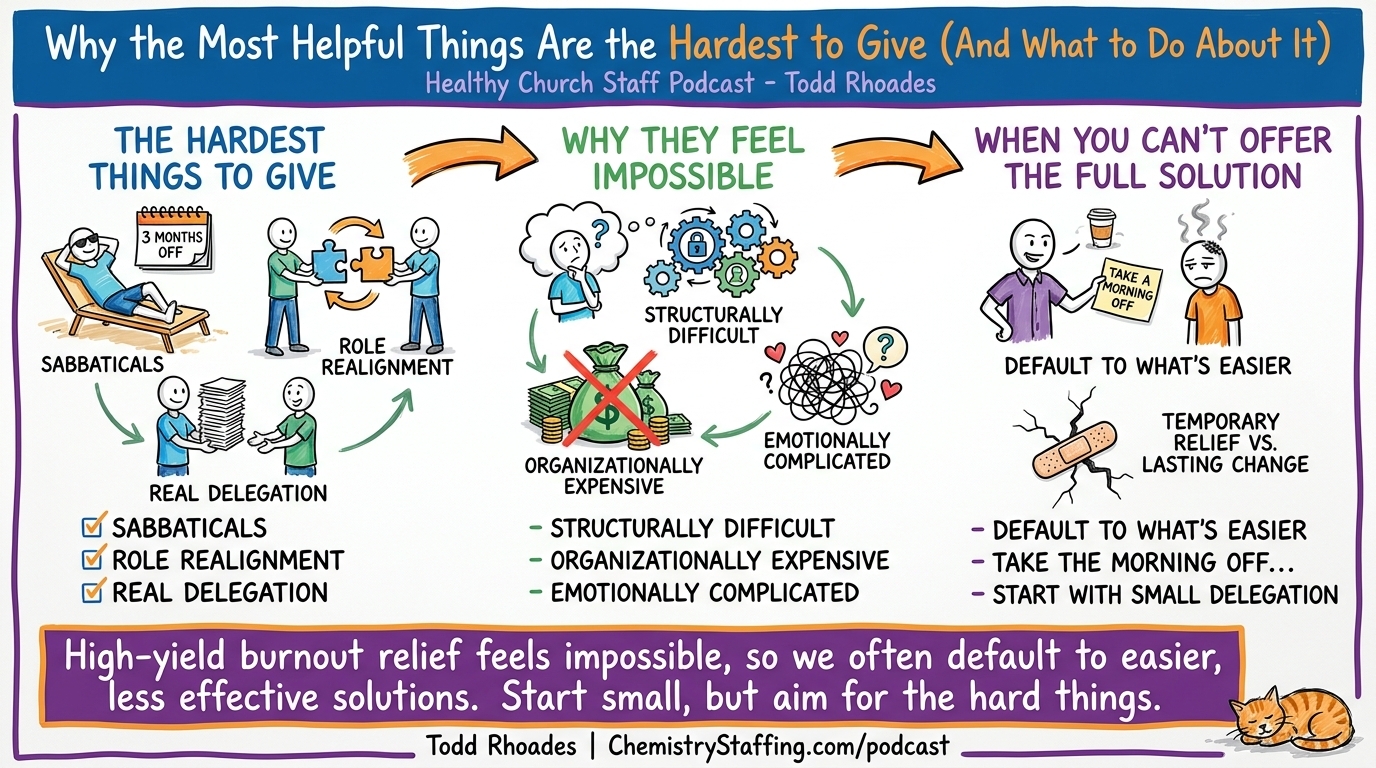
Here are the top three pastoral burnout relief solutions:
- Sabbaticals
- Role realignment
- Real delegation
Now, all three of these have something in common. They're structurally difficult, organizationally expensive, and emotionally complicated.
In other words, they're hard to give, even when you know they'd work.
So we default to what's easier. We offer a morning off. A coffee meeting to encourage them. A nice text message. And then we wonder why the burnout doesn't lift.
Why We Avoid High-Yield Burnout Solutions
Here's the uncomfortable truth: we don't avoid sabbaticals because we're heartless. We usually don't even avoid them because of budget constraints.
We avoid sabbaticals because we can't figure out how to cover for the person when they're gone.
We don't avoid role realignment because we don't care about our staff. We avoid it because we don't have another hire in the budget.
And we don't avoid delegation because we're control freaks. We avoid it because we've tried before and it just didn't stick.
So instead of admitting we can't do the big thing, we try to offer the small things and call it progress. Your staff member smiles and says thanks, but inside they're thinking, "We've tried this before. This probably won't help."
"Moses' father-in-law replied, 'What you are doing is not good. You and these people who come to you will only wear yourselves out. The work is too heavy for you; you cannot handle it alone.'" — Exodus 18:17-18
What to Do When You Can't Do the Full Thing
Listen, this isn't about guilt. You're doing the best you can with what you have. I know that. What I want to talk about is what to do when you can't offer the complete solution.
1. Name What You Can't Do (With Honesty)
If you can't give a sabbatical yet, just say that. Don't pretend a long weekend is the same thing.
Say something like: "I know what you really need is a sabbatical. We can't do that right now, but here's what we can do."
That honesty alone will help relieve some pressure. Because when you pretend small things are big solutions, your staff feels gaslit. They start thinking they're the problem for not feeling better.
2. Start Moving Toward the High-Yield Solution (Even If It's Slow)
If you can't do a three-month sabbatical, maybe start planning a four-week one for next year.
If you can't hire someone to help with role realignment, maybe realign 10% of their responsibilities this quarter.
If you can't fully delegate, pick one thing this month and hand it off with real authority.
Progress beats paralysis. Your staff doesn't need perfection, but they do need direction.
3. Stop Offering Low-Yield Solutions as If They're Fixes
Let me be frank with you. A pizza party is not a burnout relief strategy. A staff meeting about self-care is not structural change.
These things aren't bad—they're just not sufficient. When we treat them like they are, when we pat ourselves on the back and say we did something, we accidentally communicate that "your burnout isn't serious enough to warrant real change."
That's absolutely not the message we want to send, but it lands anyway.
What This Looks Like in Real Life
Sit down with that burned-out staff member and say:
"Hey, I've been thinking about what might actually help you—not just what's easy for me or the church to offer."
Then ask: "If I could give you one structural change in the next six months, what would make the biggest difference?"
Be quiet and listen. Don't defend. Don't problem-solve. Just listen.
Then say: "I can't promise all of that right away, but here's what I can start working toward."
And here's the key: actually start working toward it. Put it on your calendar. Budget for it. Bring it to the elders.
When your staff sees you moving in the direction of real relief—even if it's slow—it changes the emotional weight they're carrying. Because hope isn't just about feeling better today. Hope is believing that things can actually be different tomorrow.
"Then, because so many people were coming and going that they did not even have a chance to eat, he said to them, 'Come with me by yourselves to a quiet place and get some rest.'" — Mark 6:31
The Bottom Line
The most helpful things are hard to give. But partial movement is better than perfect paralysis.
You can't fix everything overnight, but you can start. And sometimes, that's exactly what your staff needs to keep going.
Action Steps You Can Take This Week
- Schedule a 30-minute "role audit" conversation with each staff member to identify one task that could be reduced, delegated, or eliminated
- Institute a "no-meeting morning" or afternoon once per week to protect time for deep work or rest
- Create a "sabbatical fund" line item in next year's budget—even $500-$1000 shows you're moving toward the goal
- Identify one high-capacity volunteer who could take on a project currently on a staff member's plate
- Send each staff member home today with permission to cancel one non-essential thing on their calendar this week
Let's Continue the Conversation
What's one "10% version" of a high-yield solution you could implement in your church this month? What barriers are you facing as you try to offer real pastoral burnout relief solutions to your staff?
I'd love to hear from you. Send your thoughts, questions, or stories to podcast@chemistrystaffing.com.
And if you found this helpful, I'd encourage you to share it with another church leader who might need to hear it. We're all in this together, and sometimes the most helpful thing we can do is name what we're all experiencing.
This post is based on Episode 706 of the Healthy Church Staff Podcast. For more conversations about building healthy church staff cultures, subscribe wherever you listen to podcasts.