

She's the kids director. She's also a mom. And right now, on the same carpet, her own child will not sit down.
🎧 Listen to this episode:
If she corrects her child, the other parents hear a mom losing it. If she lets it go, the volunteers hear a leader playing favorites. The entire room is watching both jobs at once—her being the children's director and her being a mom.
She cannot win this moment. But you put her in it.
If you've ever led a church staff team, you've likely encountered this scenario. Maybe it's your kids director whose toddler melts down during children's church. Maybe it's your youth pastor whose teenager rolled their eyes during small group. Perhaps it's happening right now, every single Sunday, and you've been calling it "ministry as a family."
The room calls it something else. They call it watching someone fail at two jobs simultaneously.
When the Child Becomes the Object Lesson
Here's what actually happens in these situations: The child isn't just in the room. The child becomes the lesson.
"Even the director's kid..." You've heard that sentence. You may have even said that sentence.
The teenager in the youth room becomes the example—of how staff kids should behave, of what happens when ministry families get it right (or wrong). A normal kid night automatically becomes a referendum on the entire family. A bad attitude becomes a staff story that gets repeated in parking lot conversations.
The child didn't apply for that position. They just came to church with their parent.
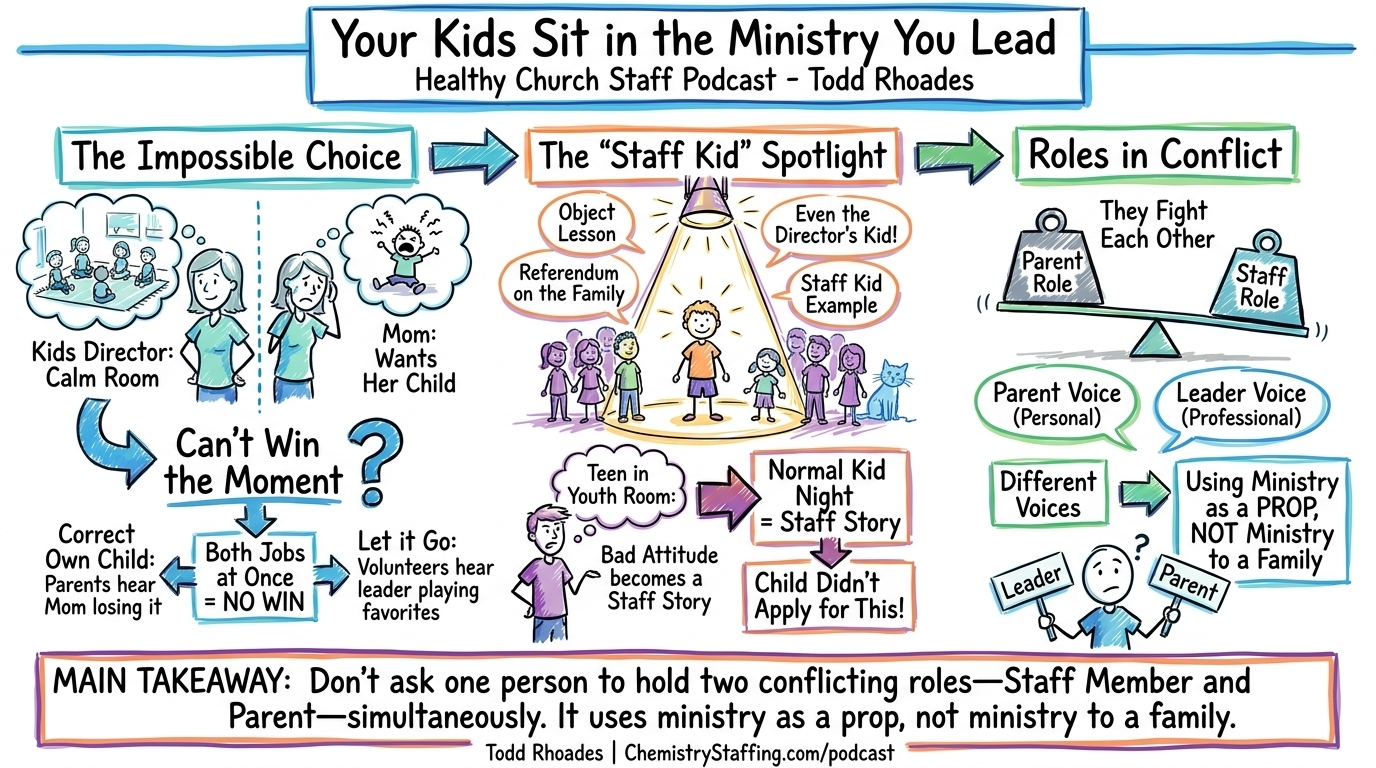
That's not ministry to a family. That's using a family as a prop. And the difference matters more than most church leaders realize.
"Let the little children come to me, and do not hinder them, for the kingdom of heaven belongs to such as these." — Matthew 19:14 (NIV)
The Impossible Split: Two Roles That Fight Each Other
You've asked one person to hold two roles that fundamentally conflict with each other. And they're trying—desperately—to do both well.
Parenting is one job. Leading a ministry is another. They use different voices, different instincts, different priorities.
When her kid melts down during the lesson, the leader in her wants a calm room. The parent in her wants her child. Both instincts are absolutely right. But both cannot run in the same thirty seconds.
The youth pastor cannot be dad and program director in the same circle. If he's hard on his teenager, he's a bad dad. If he's soft, he's a bad leader. The volunteers are watching. The other teenagers are watching. And everyone has an opinion about which role he's failing at in that particular moment.
You call it "doing ministry as a family." They experience it as a split they cannot resolve in public.
Discussion Question
Be honest: Have you witnessed a staff member struggle with this dual role? What did you observe in the room? How did volunteers and other parents respond?
Your Heart Was Good. The System Isn't.
I know your heart here. You thought this was a gift.
The kids get to be with mom. The youth pastor's teenager gets to be in the room dad already loves. You weren't trying to turn a child into an object lesson or create an impossible situation. That intention is decent and kind.
It's also how a Sunday morning becomes a test that both the staffer and the kid fail publicly.
Love that leaves them in the same room with no plan is not family-friendly. It's a conflict of roles you've never actually named. And unnamed conflicts don't resolve themselves—they just repeat, week after week, until someone breaks.
The Room Already Picked a Side
Here's what you need to understand: The volunteers already decided. The parents already decided. They made their choice about whether she's primarily "mom" or "director" the very first time her kid acted up.
The teenager already knows they're being watched differently than every other student in the room.
You can keep calling it normal. You can keep saying everything's fine. But the room is not experiencing normal, and everyone knows it except maybe you.
"Whatever you do, work at it with all your heart, as working for the Lord, not for human masters, since you know that you will receive an inheritance from the Lord as a reward." — Colossians 3:23-24 (NIV)
Name a Plan This Week
So here's what I want you to do. Pick one staffer this week whose child is in their own ministry and name a plan.
Not someday. Not when it becomes a bigger problem. This week.
A plan might look like:
- Different room: Their child attends a different service or age group
- Co-leader coverage: Another leader handles their child when issues arise
- Rotating Sundays: They're not parent-on-duty the same weeks they're leading
- Clear role designation: They lead the room; someone else manages their child
Tell the staffer first. Explain that this is about setting them up to succeed, not about their failure. Then tell the volunteers so the room isn't left guessing about expectations and roles.
If you cannot move the child, move the duty. Someone else handles that kid when behavioral issues arise. The staffer leads the rest of the room.
That's not rejection. That's not splitting up a family. That's how you let a parent be a parent at home and a leader at work—without asking them to perform both roles simultaneously under congregational scrutiny.
Action Item: Create Your Plan This Week
Step 1: Identify one staff member whose child is in their ministry area
Step 2: Schedule a conversation with them this week
Step 3: Together, design a specific plan that relieves the dual-role pressure
Step 4: Communicate the plan to relevant volunteers and parents
Step 5: Implement immediately—don't wait for another public failure
If You Won't Name a Plan, You Already Have One
Here's the truth you need to hear: If you will not name a plan, you've already named one by default.
The plan is that they do both jobs. Badly. In public. Every single Sunday.
They try to be both leader and parent in the same moment. They fail at both in front of everyone who matters—their volunteers, the families they serve, their own children, and ultimately, themselves.
That's not sustainable. It's not kind. And it's not what you want for staff members you value.
You Want Leaders Who Can Actually Lead
Here's something else to consider: You actually want staff who can lead without parenting in public.
You want your kids director fully present to all the children, not constantly managing her own child's behavior while trying to model leadership. You want your youth pastor able to address difficult situations with students without the complication of his own teenager being in the mix.
The plan you create isn't just about reducing stress (though it does that). It's about unleashing your staff to do their actual jobs with excellence and focus.
Reflection Question
How would your ministry areas improve if staff members could lead without simultaneously managing their own children? What would change about their effectiveness, their volunteer relationships, and their own stress levels?
This Week, Choose Kindness
I know this feels uncomfortable. It might seem like you're asking families to separate on Sundays or that you're somehow communicating that staff kids aren't welcome in their parents' ministries.
That's not what this is about at all.
This is about stopping the practice of asking one person to be two people in the same room, at the same time, under intense scrutiny. That's not a reasonable expectation for anyone.
A plan is kinder than another Sunday of freeze. A conversation this week is more compassionate than watching your staff member navigate an impossible situation week after week.
Your kids director is also a mom in the same room. Staff cannot parent and lead at the same time. So name a plan, or the child becomes the object lesson—and everyone loses.
What's your experience with this issue?
I'd love to hear how you've navigated this in your church context—or if you're currently in the middle of this challenge. Email me at podcast@chemistrystaffing.com and let me know what you're thinking.
Before you go: We've just launched our 2026 Church Staff Health Assessment. It's completely free and will give you valuable insights into your team's overall health and effectiveness. Head over to churchstaffassessment.com to take it today.