
You just got off the phone with your absolute dream candidate. They check all the boxes. They love your church. They're excited about the role. Their references came back yesterday—absolutely glowing.
🎧 Listen to this episode:
And yet, they can't say yes.
Not because they don't want to. Because they can't afford to.
If you've been in church leadership for any length of time, this scenario isn't just familiar—it's painfully common. Today, we're going to talk about that discrepancy between calling and compensation, and how to navigate it without losing your integrity or your perfect candidate.
The Brutal Math of Church Staff Hiring
Here's what happens in most church hiring processes: Your compensation package makes sense on paper. You've compared it to similar churches in your area. You've factored in benefits and ministry perks. The numbers look reasonable, maybe even generous for your context.
But then you forgot about something critical: this candidate's actual life.
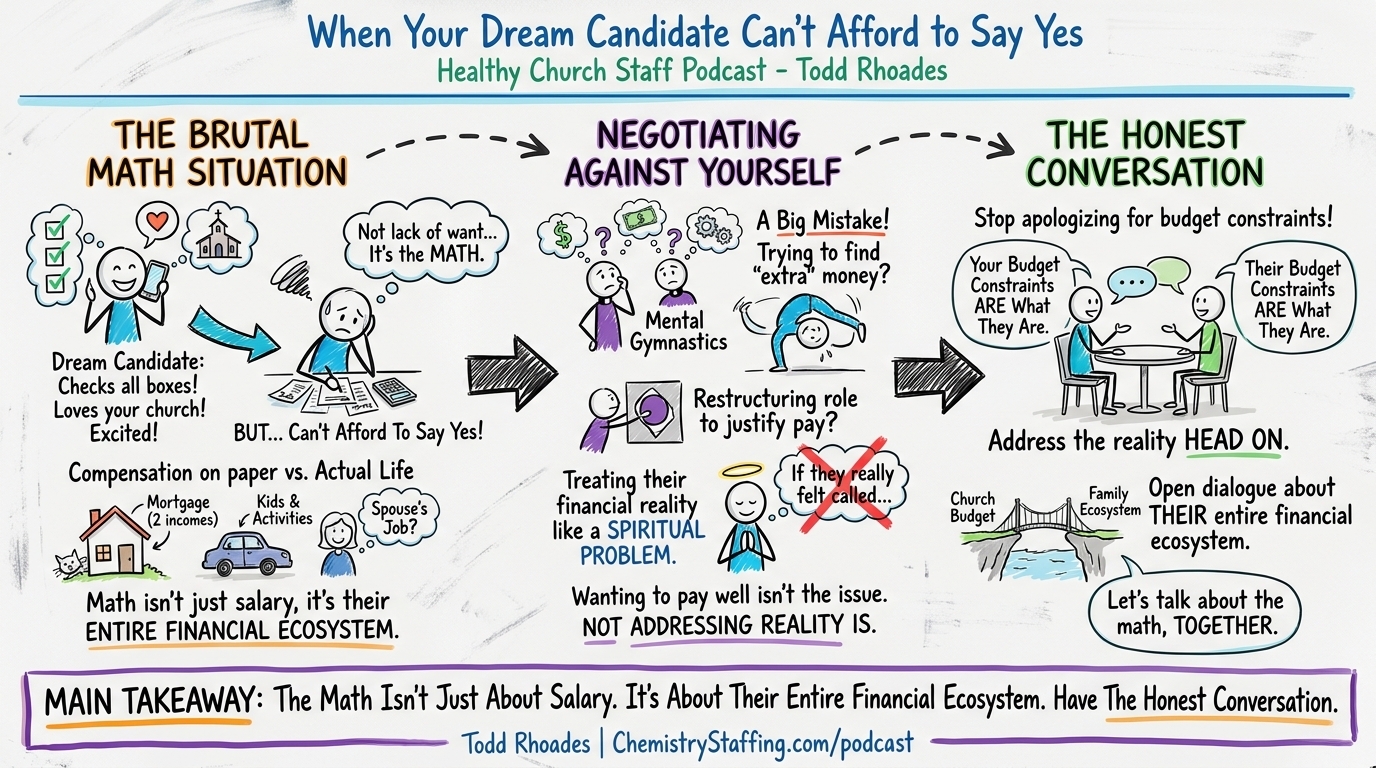
They've got a mortgage that reflects two incomes. They have kids in activities that cost real money. They have a spouse who would need to find new work in your city—probably at a lower salary than they're making now. Maybe they're still paying off student loans from seminary. Perhaps they're caring for aging parents.
The math isn't just about the salary you're offering. It's about their entire financial ecosystem. And when those two realities collide, good people have to make hard decisions.
The Critical Mistake Most Churches Make
When faced with this situation, I see churches fall into what I call "the desperation drift." It looks like this:
You start negotiating against yourself. "Maybe we can find some extra money somewhere." You consider restructuring the role to justify more pay. You begin the mental gymnastics: "Well, if they really felt called here..."
Here's what's actually happening: You're treating their financial reality like it's a spiritual problem.
Listen, wanting to pay people well isn't the issue. The issue is when we don't address this reality head-on with honesty and wisdom.
What Scripture Says About Fair Compensation
1 Timothy 5:17-18: "The elders who direct the affairs of the church well are worthy of double honor, especially those whose work is preaching and teaching. For Scripture says, 'Do not muzzle an ox while it is treading out the grain,' and 'The worker deserves his wages.'"
Honoring ministry workers includes appropriate financial support. Good stewardship means investing in good leaders—but it also means being honest about what we can and cannot do.
The Honest Conversation You Need to Have
Instead of the desperation drift, here's what radical transparency looks like in a church hiring process:
First, stop apologizing for your budget constraints. They are what they are. Your church's financial capacity is a reality, not a moral failing. Own it with confidence.
Second, start with clarity. "Here's what we can offer. Here's why the offer is what it is. Here's the context for our compensation structure." Give them the full picture.
Third, ask directly. "Based on your family's situation—mortgage, spouse's work, kids' needs, student loans, all of it—can you make this work?" Then do something revolutionary: listen to their answer.
If they say no, believe them. Don't try to spiritualize their financial needs. Don't make them feel guilty for being responsible stewards of their own family's resources. Thank them for their honesty, affirm their gifts, and keep the relationship warm.
Why "Not Now" Doesn't Mean "Not Ever"
Here's what most churches don't realize: That candidate who can't say yes today might be perfect in eighteen months.
Life situations change. Maybe their kids will age out of expensive childcare. Perhaps their spouse will find remote work that travels anywhere. Student loans get paid down. Elderly parents' needs shift. And yes, hopefully your church's budget capacity grows too.
I've seen this happen repeatedly in my years of church staffing work. In fact, I've personally experienced it. Two of the jobs I eventually took, I initially turned down—one for a year and a half, the other for six months. I said no three times to one of them. But we kept the relationship healthy, and when the timing was right, God aligned everything.
The worst thing you can do is burn the bridge with guilt or pressure. The best thing you can do is stay connected and keep them in mind. Send them encouraging messages. Let them know when the position reopens. Keep them in your network.
Some of the strongest hires happen when timing finally aligns with calling.
The Dangerous Temptation to Stretch Too Far
Before we close, I need to address one more scenario I see regularly: churches that are $5,000 or $10,000 off from their dream candidate, and they stretch to make it work.
They find the extra money somewhere. They swing it this year. Everyone celebrates.
But here's what happens next year: That extra $10,000 isn't there. Now you've got a staff member who took the job based on a salary you can't sustain. You've created an impossible situation—for them and for you.
You've got to make sure that financially, you're able to do what you say you're able to do—not just this year, but for the foreseeable future. One-time bonuses are one thing. Unsustainable base salaries are another.
Discussion Questions for Your Team
- On a scale of 1-10, how flexible and creative do we currently think when it comes to compensation and benefits? What mindsets or policies might be limiting our imagination?
- How do we balance these three values: stewardship of church resources, fair compensation for workers, and faith that God will provide? When these seem to conflict, how do we discern the right path forward?
- If we have an open position right now (or will soon), what are three creative solutions we haven't yet considered that could make the role more accessible to the right candidate?
The Bottom Line: Good Stewardship Sometimes Means Saying No
Here's the truth that every church leader needs to hear: The right person at the wrong financial time is still the wrong hire—for both of you.
It's not failure to acknowledge financial limitations. It's not a lack of faith to be honest about budget constraints. It's not poor leadership to keep a relationship warm while waiting for the right timing.
In fact, good stewardship sometimes means saying no to good people. That's not the system failing. That's the system working.
It's wisdom. It's integrity. It's honoring both your church's resources and your candidate's legitimate needs. And it keeps the door open for God to work in His timing, not just yours.
Action Steps for This Week
- Audit your current compensation practices: Review your last 2-3 hires and honestly assess whether you were as transparent and creative as you could have been.
- Create a "candidate care" protocol: Develop a standard practice of asking candidates directly, "What would it take for this to work for your family?" early in the process—and really listening to their answers.
- Identify your true constraints: Have a finance meeting to clarify what is genuinely non-negotiable versus what is just "the way we've always done it."
You Don't Have to Do This Alone
Maybe you're right in the middle of this situation right now. Maybe you've got a dream candidate who's hesitating because of the numbers. Or maybe you're preparing for a hiring season and want to get ahead of these challenges.
If there's any way my team and I can help you—whether it's with compensation benchmarking, creative benefits structuring, or just thinking through your specific situation—we'd love to hear from you. This is what we do every day with churches all across the country at Chemistry Staffing.
Reach out to me at podcast@chemistrystaffing.com. I'd love to hear your story and see if we can offer support when you need it most.
Remember: honesty isn't harsh. Transparency isn't unspiritual. And sometimes the most faithful thing you can do is wait for God's timing while stewarding your resources with wisdom.
You've got this. And we're here for you.
Need Help With Your Church Staffing Challenges?
Our team at Chemistry Staffing works with churches every day on hiring, compensation, and team development.
Let's Talk About Your Situation