

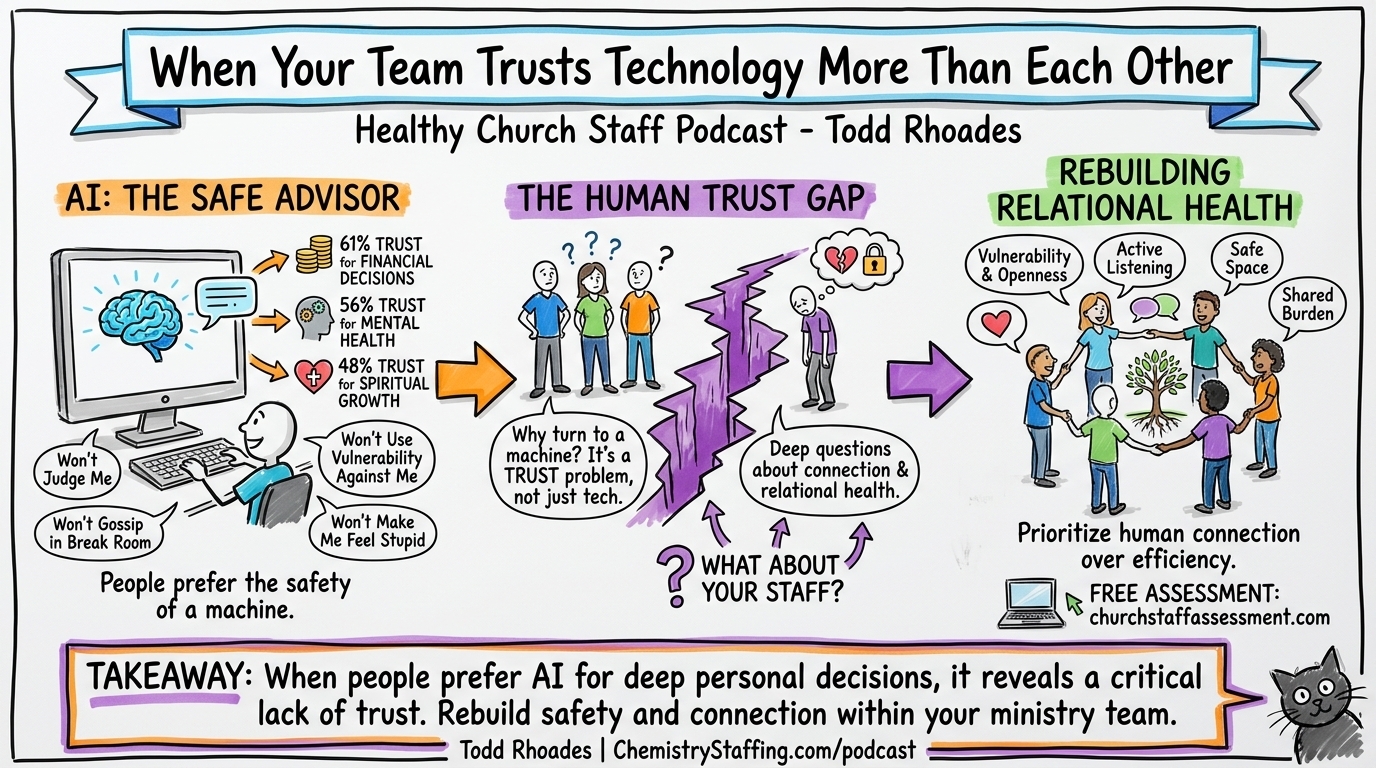
Recent research from Barna revealed something that stopped me in my tracks: 61% of practicing Christians would trust AI to help them make financial decisions. 56% would trust it for mental health advice. But here's the statistic that should concern every church leader: 48% would trust AI to guide their spiritual growth.
🎧 Listen to this episode:
Let that sink in for a moment. Nearly half of your congregation would rather ask a chatbot about their soul than another human being.
And if your congregation is moving in that direction, there's a strong likelihood your staff team is headed there too.
Why People Choose AI Over People (And What It Says About Your Team)
People aren't turning to AI because it's smarter. They're turning to it because it's safer.
Think about it:
- AI won't judge you
- It won't gossip about your question in the break room
- It won't use your vulnerability against you later
- It won't make you feel stupid for asking
- It's available 24/7 without requiring emotional energy from someone else
When people prefer a machine over a person for deeply personal decisions, that's not a technology problem—that's a trust problem.
"As iron sharpens iron, so one person sharpens another." - Proverbs 27:17
True spiritual growth happens in the friction and honesty of real relationships, not in the comfort of isolated interactions.
The Hard Question Every Church Leader Must Answer
When was the last time somebody on your team was truly vulnerable in a meeting?
Not surface-level "pray for my busy week" vulnerable. I'm talking about raw, honest, messy, "I don't know if I'm cut out for this" kind of vulnerable.
If you can't answer that question—or if you can't remember—that silence might be your answer.
What Happens When Trust Erodes
Here's the progression I've observed in countless church staff teams:
- People stop asking real questions in person. The hard, messy, "I'm not sure what to do here" questions move from staff meetings to Google searches.
- They stop admitting real struggles. Everyone performs competence while privately wrestling with doubt.
- They start managing image instead of leading from authenticity. Meetings become performances rather than collaborations.
- Eventually, they'd rather ask ChatGPT or suffer in silence. Because at least the algorithm won't fire them for being human.
Five or ten years ago, we didn't have this option. If we had a dilemma and didn't want to ask someone on our team, we'd have to find a mentor or peer from another church. But now? We start with AI. And that's where everything shifts.
Your Staff Is Mirroring Your Leadership
Here's the uncomfortable truth: Your staff isn't just mirroring the culture. They're mirroring you.
If you never admit you're struggling, they won't either. If you always seem to have the right answers, they'll stop asking questions. And if you punish doubt or reward performance over honesty, you're training them to trust algorithms over people.
Because here's the deal: at least the algorithm won't fire them for being human. It won't poke fun at them. It won't use their vulnerability against them in the future.
"Two are better than one, because they have a good return for their labor: If either of them falls down, one can help the other up. But pity anyone who falls and has no one to help them up." - Ecclesiastes 4:9-10
How to Build a Team That Trusts Each Other More Than Tech
I'm not anti-AI. I love what AI can bring to the table. But we cannot let AI replace our relationships or our trust in the people we work with. So how do we rebuild—or protect—genuine trust on our teams?
1. Model the Vulnerability You Want to See
Not by oversharing. Not by trauma-dumping. But through real, appropriate honesty about where you're growing or struggling. When leaders normalize the journey—not just the destination—teams learn it's safe to do the same.
2. Create Space That Isn't Just Tactical
Your meetings can't all be about tasks and timelines. Build in moments for questions like:
- "What's draining you right now?"
- "Where do you feel stuck?"
- "What would you ask AI if you knew no one would find out?"
If you don't create space for these conversations, your staff will take them to ChatGPT instead.
3. Listen Without Fixing, Judging, or Weaponizing
This is critical. When someone risks honesty, don't immediately fix it. Don't judge it. And absolutely don't weaponize it later in a review or a meeting.
Just listen. Affirm. Validate.
Trust isn't built in a retreat or a training. It's built in a hundred small moments where someone risks honesty and doesn't get punished for it.
Discussion Questions for Your Team
- If you could ask AI one question about your ministry role without anyone knowing, what would it be? What does that reveal?
- When you face a challenge, do you reach out to a team member first or turn to Google/ChatGPT? What influences that choice?
- On a scale of 1-10, how safe do team members feel bringing half-formed ideas, doubts, or failures to staff meetings?
- What's one barrier preventing deeper trust on our team right now?
The Jesus Model of Team Building
Jesus didn't just teach about trust—He modeled it with a ragamuffin team of doubters, deniers, and hotheads. He let Peter fail. He let Thomas question. He let James and John embarrass themselves. And He didn't replace them with a more competent algorithm.
Why? Because the goal wasn't efficiency. It was transformation. And that transformation happened through relationships.
If we're leading teams where people prefer AI over each other, we've traded the incarnational model for something safer and faster—but far less powerful.
"Because we loved you so much, we were delighted to share with you not only the gospel of God but our lives as well." - 1 Thessalonians 2:8
The Bottom Line
If your team trusts technology more than they trust each other, you don't have a tools problem. You have a safety problem.
The good news? Safety can be rebuilt. Trust can be restored. But it requires leaders who are willing to go first—to model vulnerability, create space for authenticity, and respond to honesty with grace.
Take Action This Week
- Schedule a "no-agenda" team connection time where work topics are off-limits
- Identify one team member who may be carrying a burden alone and reach out with specific support
- Audit your staff meeting agendas: What percentage focuses on relationships versus logistics?
- Share something vulnerable in your next team gathering—model what you want to see
Want to assess how healthy your church staff team really is? Take our free 2025 Church Staff Health Assessment and get personalized insights for your team.
What's your experience with this trend? I'd love to hear your thoughts—email me at podcast@chemistrystaffing.com.
About the Author: Todd Rhoades is co-founder of Chemistry Staffing and host of the Healthy Church Staff Podcast, where he helps church leaders build thriving teams. With decades of experience in church ministry, Todd provides practical wisdom for the real challenges church staff face every day.