
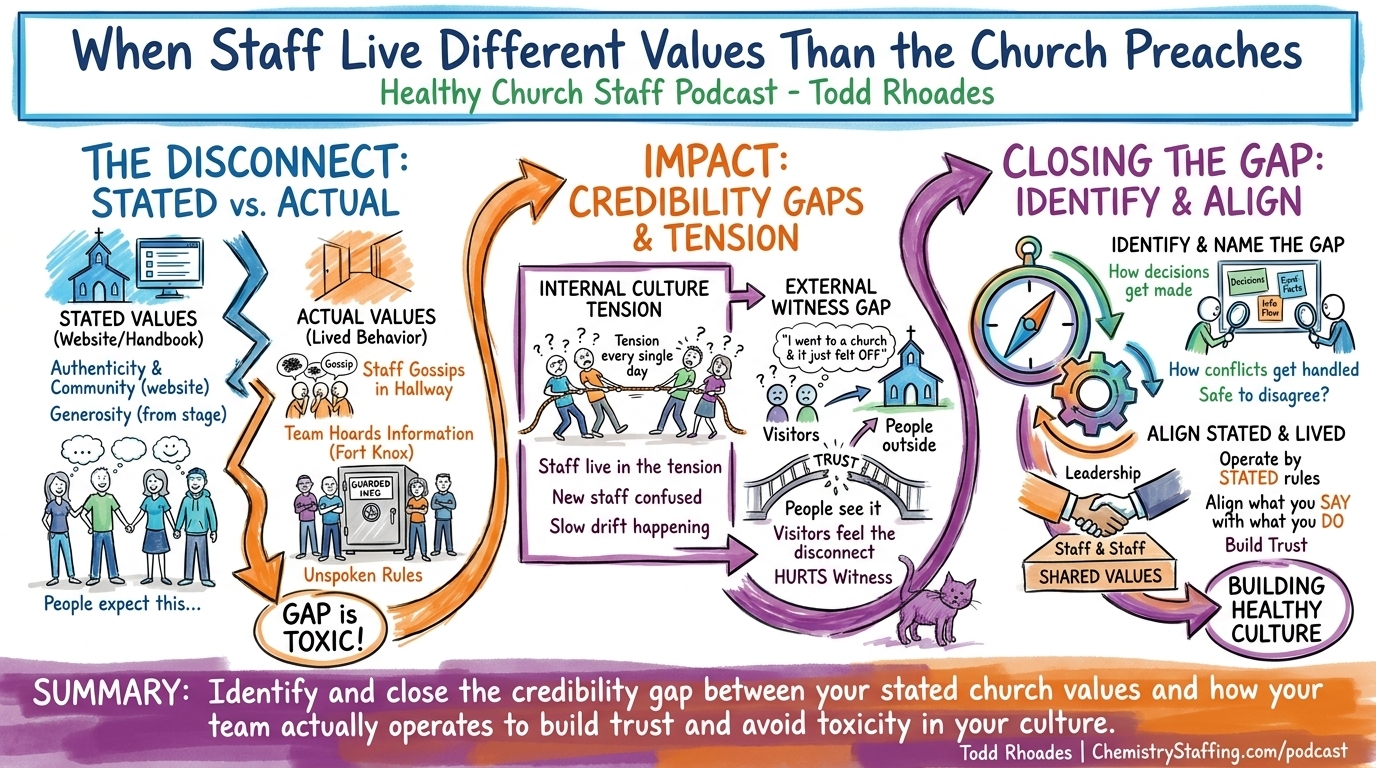
Your church website says you value authenticity and community. But your staff gossips in the hallway after difficult conversations.
🎧 Listen to this episode:
You preach generosity from the stage every Sunday. But your team hoards information and guards their turf like it's Fort Knox.
The disconnect isn't subtle anymore.
Your people see it. Your visitors feel it—that "something's off" sensation they can't quite put their finger on. And your staff? They're living in the tension every single day.
If this sounds familiar, you're not alone. I was reading some research from Barna recently, and it hit me: most churches have this gap between stated values and lived values. And in many churches, that gap is wider than leadership realizes.
The Values Gap Is Wider Than You Think
Here's the thing about church values: your stated values live on your website and in your staff handbook. They're the aspirational words you use during interviews and the inspiring phrases printed on your lobby walls.
But your actual values? They show up in completely different places:
- How decisions actually get made when the pressure is on
- How conflicts get handled (or avoided)
- How information flows—or doesn't flow—through your organization
- Whether people feel safe to disagree or ask hard questions
- What behaviors get rewarded and what behaviors get overlooked
The gap between stated and lived values isn't just confusing for your team. If that gap grows too wide, it becomes toxic.
James 1:22 - "Do not merely listen to the word, and so deceive yourselves. Do what it says."
The Slow Drift Nobody Talks About
Here's what happens in most churches experiencing this disconnect:
Staff see the contradiction first. It starts small—so small they don't even know how to name it. But they begin operating by unspoken rules that emerge in the culture instead of the stated ones everybody reads in the handbook.
New staff get confused. What they were told during the interview process doesn't match what they experience in their first 90 days. They thought they were joining a team that valued one thing, but the daily reality reveals something completely different.
People outside the church feel it before you do. Visitors sense the misalignment. They experience the vibe as "off" without being able to articulate exactly why. This is that gut-level disconnect that keeps people from coming back.
Now listen—your team isn't trying to be hypocritical. Most leadership teams aren't either. They're just following the culture you've accidentally created through a thousand small decisions and unchallenged behaviors.
Three Ways to Close the Gap
If your church is experiencing this growing gap between what you say your values are and what you're actually living out day to day (particularly behind the scenes), here are three ways to start closing it:
1. Audit Your Actual Values, Not Your Stated Ones
Stop looking at your website and your staff handbook. Instead, look at your last five difficult decisions—the ones that made at the elder level or senior leadership level.
What did those decisions reveal about what you really value?
Ask yourself:
- When budget got tight, what did we protect and what did we cut first?
- When someone on staff messed up, how did we actually treat them?
- When there was a conflict between efficiency and relationships, which won?
- When we had to choose between transparency and looking good, which path did we take?
Your answers to these questions reveal your actual operating values—not the ones you wish you had.
2. Have the Awkward Conversation With Your Staff
My mom always said, "Don't ask questions you don't want to hear the answers to." But if you're serious about closing this gap, you need to ask this question:
"What do you think our real values are based on how we actually operate around here?"
Here's the critical part: Don't defend when you hear their answers. Don't explain. Don't justify. Just listen.
The defensive reflex is strong, especially when you hear things that sting. But your willingness to sit in the discomfort of honest feedback without pushing back is itself a demonstration of living out values like humility and authenticity.
Discussion Question for Your Team:
Where do you see the biggest gap between our stated values and our actual team culture? For example: We say we value rest, but reward overwork. We say we value community, but operate in silos. We say we value generosity, but complain about budget needs.
3. Pick One Value and Get Obsessive About It for 90 Days
Don't try to fix everything at once. That's a recipe for overwhelm and failure.
Instead, choose the biggest area where you found the biggest gap, and close it with intentional, consistent action for the next 90 days.
What does "obsessive" look like?
- Talk about it in every staff meeting
- Make it part of your decision-making filter
- Celebrate when you see someone living it out
- Name it when you see the old pattern creeping back in
- Let it guide how you spend time, money, and attention
Your staff is watching how you handle this more than you know. If you can model what it looks like to align your words with actions, most of the time your staff will follow.
But if you ignore the gap and hope it goes away? It won't. Your staff will simply learn to live with the contradiction, and the credibility drain will continue.
Titus 2:7-8 - "In everything set them an example by doing what is good. In your teaching show integrity, seriousness and soundness of speech that cannot be condemned, so that those who oppose you may be ashamed because they have nothing bad to say about us."
Why This Matters More Than You Think
Your credibility as a leader hangs on this alignment between stated and lived values. But it's bigger than just your personal leadership influence.
The gospel you preach deserves better than a staff that lives it differently.
When there's alignment between what your church proclaims and how your team operates, something powerful happens:
- Your staff feels the integrity and freedom that comes from not living in contradiction
- Your congregation experiences consistency that builds trust
- Your visitors encounter authenticity that draws them in rather than pushing them away
- Your community sees a witness that actually matches the message
People don't follow your stated values. They follow your lived values.
Take Action This Week:
Values Visibility Audit: Each staff member identifies one stated church value and tracks how many decisions they make with that value consciously in mind. Report findings at your next meeting.
Remove One Contradiction: Identify one policy, practice, or expectation that directly contradicts a stated value and commit to changing it within 30 days.
Your Next Step
Here's your challenge for this week: Ask one trusted staff member this question:
"What's one area where you think we don't live what we say we value?"
Don't defend their answer. Just say thank you and sit with it. That's your starting point.
Your team wants alignment more than you think they do. They're just waiting for you to lead the way.
The gap between your stated values and lived values isn't permanent. But closing it requires honest assessment, difficult conversations, and consistent action. It requires leadership that's willing to go first in living out the very values you're calling your team to embrace.
The good news? When you start closing that gap, everything changes—your staff culture, your congregational trust, and your community witness.
What values gap have you noticed in your church? I'd love to hear your story and how you're working to close it. Reach out anytime at podcast@chemistrystaffing.com—I read and respond to every email.
This post is based on Episode 653 of the Healthy Church Staff Podcast. Listen to the full episode and subscribe for daily encouragement for church leaders at chemistrystaffing.com/podcast.