

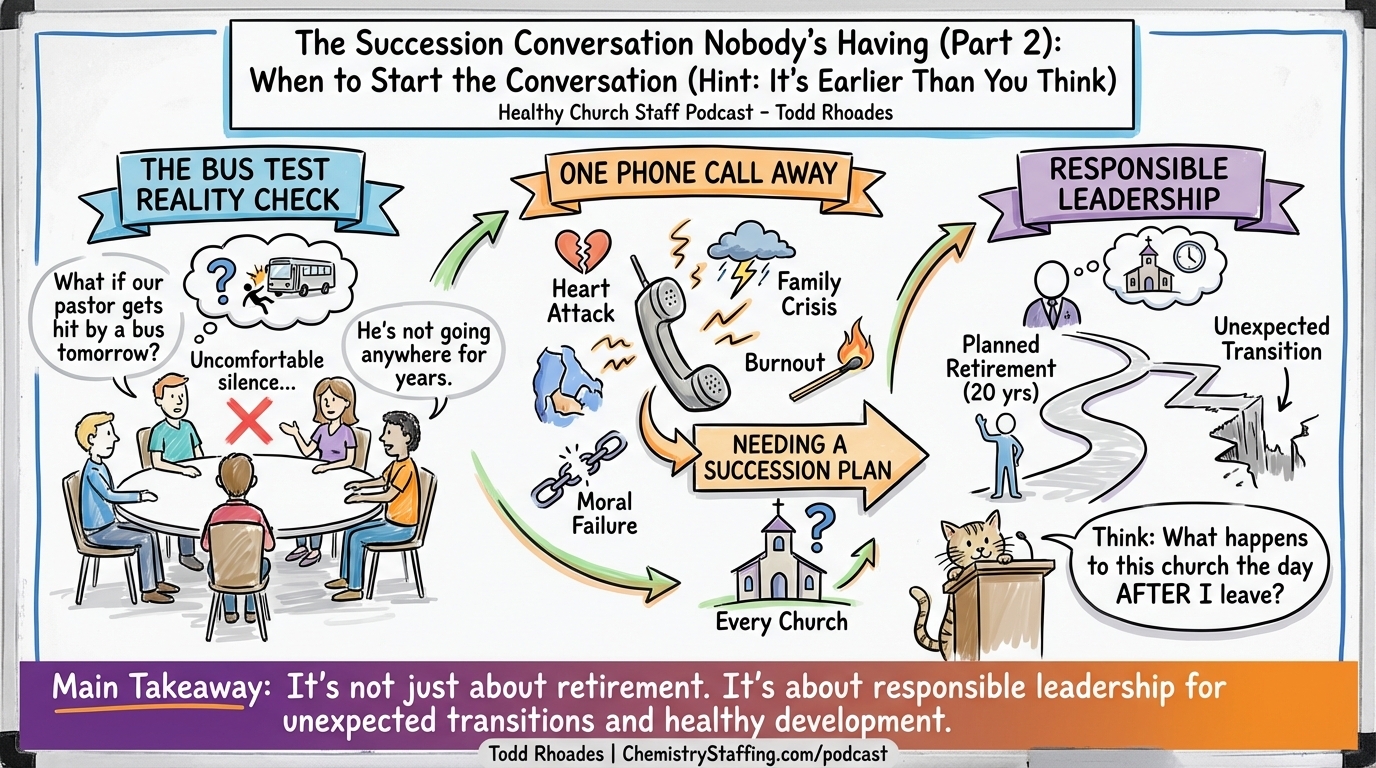
Picture this: You're sitting in a board meeting when someone asks that question: "What happens if our pastor gets hit by a bus tomorrow?"
🎧 Listen to this episode:
The room goes silent. Everyone shifts uncomfortably. Someone quickly chimes in with, "Oh, he's not going anywhere for years," and the conversation dies faster than a cell phone battery.
Sound familiar? If you've lived this awkward moment, you're not alone. It's what I call the "bus test reality check" – and it reveals an uncomfortable truth that most church leaders would rather avoid.
The Phone Call That Changes Everything
Here's what keeps me up at night as someone who works with churches in transition: Every church is one phone call away from needing a succession plan.
I know that sounds dramatic, maybe even morbid. But think about it – heart attacks don't send calendar invites. Family crises don't wait for convenient timing. Burnout doesn't check your strategic planning timeline. And unfortunately, moral failures certainly don't consider your church's readiness.
If you're a senior pastor reading this and feeling a little nervous, good. That means you care about your church's future. But if you're a board member thinking, "Our pastor is only 40 – we have time," I need you to keep reading.
"Then Moses summoned Joshua and said to him in the presence of all Israel, 'Be strong and courageous, for you must go with this people into the land that the Lord swore to their ancestors to give them, and you must divide it among them as their inheritance.'" - Deuteronomy 31:7
The Retirement Trap That's Killing Churches
Most churches approach succession planning like it's a retirement party – something you worry about when the pastor hits 60 and starts talking about "slowing down a little."
But here's the problem: By then, it's not planning. It's scrambling.
When churches wait until retirement discussions begin, several devastating things have already happened:
- Your best internal candidates have already left for other opportunities
- Your systems are built entirely around one person and their unique gifting
- Institutional knowledge exists nowhere but in the pastor's head
- The congregation has never seen transition modeled well
What should be a triumph becomes a trauma. What could be a celebration becomes a crisis.
At Chemistry Staffing, most of our succession work comes from churches in scramble mode: "Our pastor wants to retire in November. What do we do?" That's not succession planning – that's emergency response.
The Year 3 Sweet Spot
So when should you start succession conversations? Year three.
I can already hear the protests: "Todd, I'm only 35! I don't want to start succession planning when I'm 38!"
But here's what you're missing – smart leaders start succession conversations early not because they're checking out, but because they're truly leading. They understand that loving your church means preparing for your eventual absence, whether that's planned or unplanned.
The Questions That Start Everything
Beginning in year three, start asking yourself these critical questions:
- Who else can preach when I'm gone? Not just fill the pulpit, but truly shepherd through God's Word.
- What crucial information exists only in my head? Donor relationships, board dynamics, staff quirks, building systems (yes, even the alarm code!).
- What happens to staff morale if I'm out for six weeks? Medical emergencies, family crises, or sabbaticals shouldn't derail your team.
- Who's being developed for greater leadership? Not just trained for tasks, but grown for responsibility.
Real-Life Reality Check
I remember a church where the fire alarm went off during service. The fire department was en route, and no one – not the board chair, not the executive pastor, not the facilities manager – knew the code to shut it off. Only the senior pastor had that information, and he wasn't available. It was embarrassing and completely avoidable.
What critical information is trapped in your head right now?
From Replacement Thinking to Development Mindset
Here's where most leaders get succession planning wrong: they immediately jump to replacement thinking. "Who's going to take my job when I'm gone?"
Stop. Reframe. Start with development thinking instead.
Your goal isn't to find your replacement – it's to create leadership depth before you need it.
This means:
- Every staff meeting becomes a leadership development opportunity
- Every decision builds institutional knowledge across your team
- Every crisis teaches others how to lead because they're watching how you handle it
- Every process gets cross-trained and documented
You're not planning your exit – you're planning their growth.
"And the things you have heard me say in the presence of many witnesses entrust to reliable people who will also be qualified to teach others." - 2 Timothy 2:2
What Changes When You Start Early
When you begin succession conversations in year three instead of year twenty, transformation happens at every level:
Your Staff
They stop being totally dependent on you and start being developed by you. Instead of constantly running to you for every decision, they begin exercising judgment and taking initiative.
Your Board
They stop getting nervous about "what if" scenarios and start feeling confident about the future. Board meetings become about vision and growth, not anxiety and crisis management.
Your Church
The congregation stops feeling fragile and starts becoming sustainable. They see leadership development happening naturally, and it builds their confidence in the church's future.
Discussion Questions for Your Team
- If each of us took a surprise sabbatical next month, what would happen to our key ministries and processes?
- Where do we see natural mentoring relationships already happening on our team?
- What's one area of your role where you could start identifying and training someone else this year?
- How might our ministries actually grow stronger through intentional leadership development?
Your First Step This Week
Feeling overwhelmed? Don't be. Succession planning doesn't start with a massive strategic overhaul. It starts with one simple step.
This week, I want you to pick one thing – just one thing – that only you can do right now.
Maybe it's reconciling the monthly budget. Maybe it's managing a key donor relationship. Maybe it's knowing where the building keys are hidden. It doesn't have to be major – it just has to be exclusive to you.
Now teach someone else how to do it.
Start small. Start simple. But start.
The Legacy You're Really Building
Here's the bottom line that every church leader needs to understand: Succession planning isn't about when you're leaving. It's about how well you're leading right now.
When you begin thinking about succession in year three, you're not planning your exit – you're maximizing your impact. You're ensuring that the ministry God has entrusted to you doesn't rise and fall with your presence, but continues to flourish long after you've moved on to your next calling.
Your church deserves to thrive long after you're gone. That legacy starts with the decisions you make today.
Ready to Start the Conversation?
What's your biggest challenge when it comes to succession planning? What questions are keeping you up at night? I'd love to hear from you.
Send your thoughts to podcast@chemistrystaffing.com
And if you found this helpful, share it with a church leader who needs to hear it. Sometimes the most important conversations are the ones nobody wants to have.