

It's 7:12 on a Sunday morning, and your phone buzzes. It's your kids director. She's sick—not "I'll push through it" sick, but really sick. She's not coming in.
🎧 Listen to this episode:
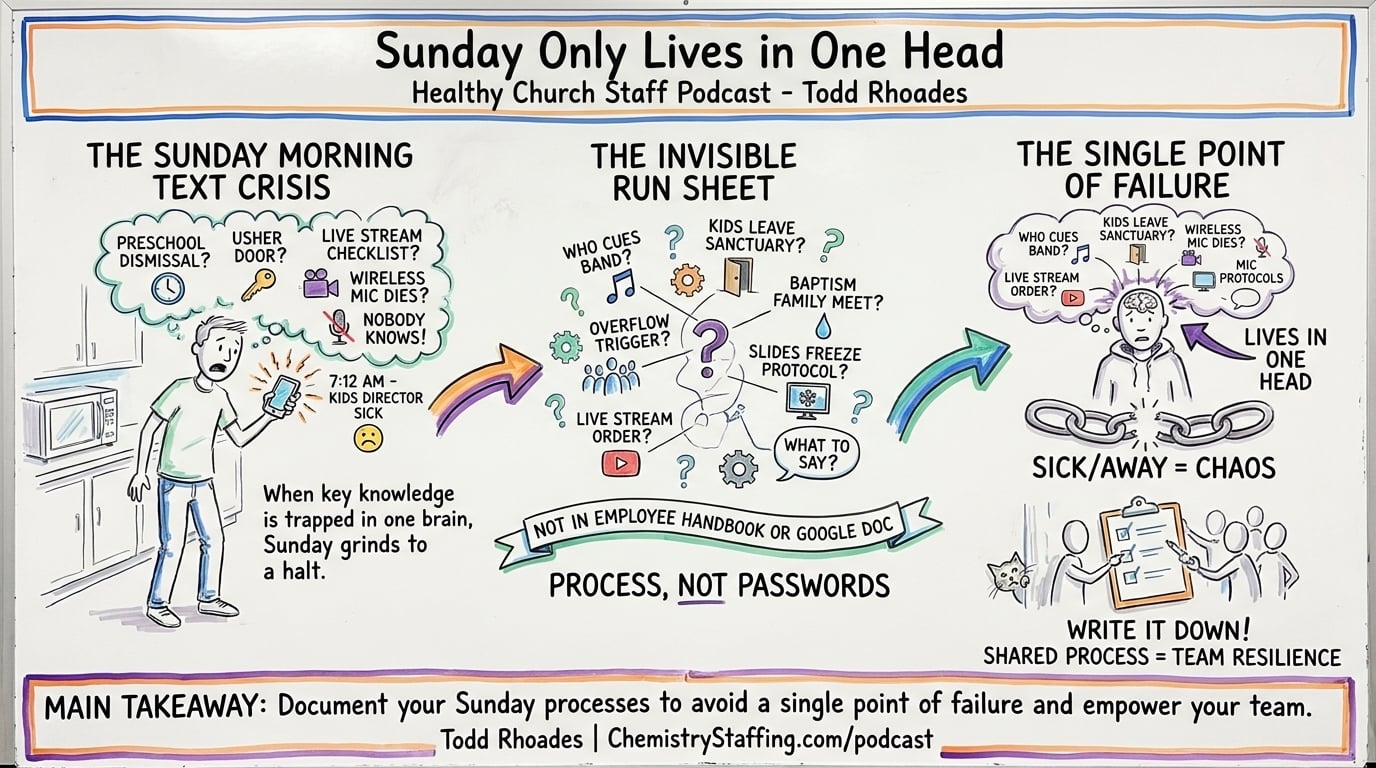
You're standing in your kitchen staring at that text, and it slowly hits you: Nobody else knows when preschool dismisses. Nobody else knows which door the ushers unlock first. Nobody else knows the order of the livestream checklist, or what you do when the wireless mic dies halfway through the sermon.
Sunday only lives in one head. And that head isn't walking through the doors today.
Sound familiar? If you've felt that sinking feeling—that moment when you realize your entire Sunday morning operation depends on one person's presence—you're not alone. And you're not a bad leader. But we need to talk about it.
This Isn't About Passwords—It's About Process
This isn't another reminder to make sure everybody has all the passwords (though that matters too). This is about the invisible run sheet that every church has but almost nobody has written down.
I'm talking about all the little things that make Sunday work:
- Who cues the band after announcements?
- When do the kids leave the sanctuary?
- Who meets the baptism family at the side door?
- Which volunteer opens the overflow room if attendance spikes?
- What order does the livestream get fired up in?
- What do you say when the slides freeze?
None of that is in your employee handbook. None of it is in a shared Google Doc. It lives in one person—maybe your worship leader, maybe your associate pastor, maybe your admin or kids director. And everybody else just follows their lead.
Until they can't.
And you know exactly when that cost shows up. It shows up the morning they're gone.
The Sunday Morning Scavenger Hunt
You've seen this movie before. The person who always knows calls in sick. Or they take a week of vacation. Or they resign and give you two weeks' notice. And somehow, in all that time, Sunday still never gets written down.
So now the service turns into a scavenger hunt. The ushers are guessing. The tech team is improvising. A volunteer walks up to you in the hallway and asks, "Hey, when do the kids come out?" And you, the leader, give them a shrug that you hope looks like calm.
Here's the thing: That's not an understaffing problem. And it's not that you don't care. It's that the process never left one person's brain.
When all the know-how lives in one person's head, your whole church is borrowing its calm from that person's presence. Take that person away for one Sunday—or permanently—and you find out real quick what you never built.
This Happens to Trusting Leaders, Not Careless Ones
I don't think this happens to careless leaders. I think it happens to trusting ones.
You hired somebody who just "gets" Sunday. They showed up early. They fixed problems before you ever saw them. And at some point, you stopped asking how they did it because it worked. Every single week, it worked.
That trust felt like wisdom. Honestly, in a lot of ways, it was. But it was also fragile. Because when all the know-how lives in one person, you don't have a system—you have a single point of failure that just happens to have a name badge.
"Write down the revelation and make it plain on tablets so that a herald may run with it." — Habakkuk 2:2 (NIV)
Vision—and process—must be written down and made so clear that anyone can run with it, not kept solely in the leader's head.
The One-Page Solution (Not a Three-Ring Binder)
Now listen—I'm not asking you to turn Sunday into a three-ring binder that nobody's ever going to read. I'm not telling you to micromanage every volunteer on your team. Your motive here was good. You trusted a capable person. Keep doing that.
Just don't let Sunday stay locked inside one person's skull.
Write it down, and then walk one other person through it. That's it. Not a forty-page operations manual. One page. A run sheet with cues, timing, doors, and what you do when things go sideways.
Here's What This Looks Like Practically
Picture your associate pastor (or whoever owns Sunday morning) sitting down with one sheet of paper and writing out the Sunday flow:
- Doors
- Kids check-in and dismissal
- Worship flow
- Announcements
- Communion setup
- Tech cues
- Closing
And then underneath that, the what-ifs:
- What happens if the mic dies?
- What happens if the livestream goes down?
- Who gets to decide if we cut a song because we're running long?
And then—this is the important part—they don't just email it to somebody. They walk a second person through it. Not a lecture. A walkthrough. "Here's what I do. Next time I'm out, you try doing this."
All of a sudden, Sunday doesn't evaporate when one person gets sick. It transfers to the person who now knows the ins and outs of what actually happens.
Discussion Questions for Your Team
- Where do we see evidence that "Sunday only lives in one head" on our staff team? Are there areas where team members are working with incomplete information?
- What's one recurring task in your role where others might not understand the "why" behind it?
- If you couldn't be here next Sunday, who would you hand your responsibilities to? Do they know enough to execute?
Heroes Burn Out. Systems Scale.
Here's the punch line I really want you to hear: If your church can't run a normal Sunday without one specific human being, you don't have a system. You've got a staff hero.
And heroes burn out. Heroes leave. Heroes get the flu on Easter weekend.
When that happens, your congregation will feel the scramble—even if nobody ever says a word about it from the stage.
The leaders who really love their people are the ones who get Sunday out of one person's head before the crisis forces them to.
Your Action Plan This Week
Here's my challenge to you this week:
- Sit down and write a one-page Sunday run sheet. Include cues, who does what when, when kids dismiss, which doors open when, the livestream checklist, and what to do when common things go wrong.
- Pick one person and walk them through it. Don't just email it. Walk through it together. Make it conversational.
- Make this a staff-wide exercise. Have every key leader and department head do the same for their area. Everyone has things in their head that only live there.
- Identify who the "second person" would be for each critical role. If you can't name them today, that's your starting point.
This stuff is absolutely fixable. You're not a bad leader because nobody's written it down yet. You're a good leader if you write it down this week.
"Again, if the trumpet does not sound a clear call, who will get ready for battle?" — 1 Corinthians 14:8 (NIV)
Our communication as leaders must be crystal clear, or our teams won't know how to prepare or engage effectively.
Let's Keep the Conversation Going
If this one hits home, I'd love to hear from you. What does "Sunday in one head" look like at your church? What systems have you put in place that actually work? Or what's holding you back from documenting the process?
Send your thoughts, questions, or stories to podcast@chemistrystaffing.com. I read every email, and your real-world experiences often shape future episodes.
And if you know another church leader who's carrying Sunday around in their head all by themselves, share this post with them. They'll thank you.
Listen to the Full Episode
This post is based on Episode 736 of the Healthy Church Staff Podcast. Listen to the complete episode for even more insights on building sustainable systems in your church.
Todd Rhoades is the co-founder of Chemistry Staffing and host of the Healthy Church Staff Podcast. With over two decades of experience helping churches build healthy teams, Todd provides practical wisdom for church leaders navigating the complexities of staff culture, leadership development, and organizational health.