

You hired a worship pastor.
🎧 Listen to this episode:
But somewhere along the way, you got a facilities director who also leads worship sometimes.
Your kids director? They were hired for check-in, curriculum, and parent engagement. But now they're writing the weekly newsletter and posting Instagram reels.
And at the bottom of every job description—buried in small print—sits that infamous line: "Other duties as assigned."
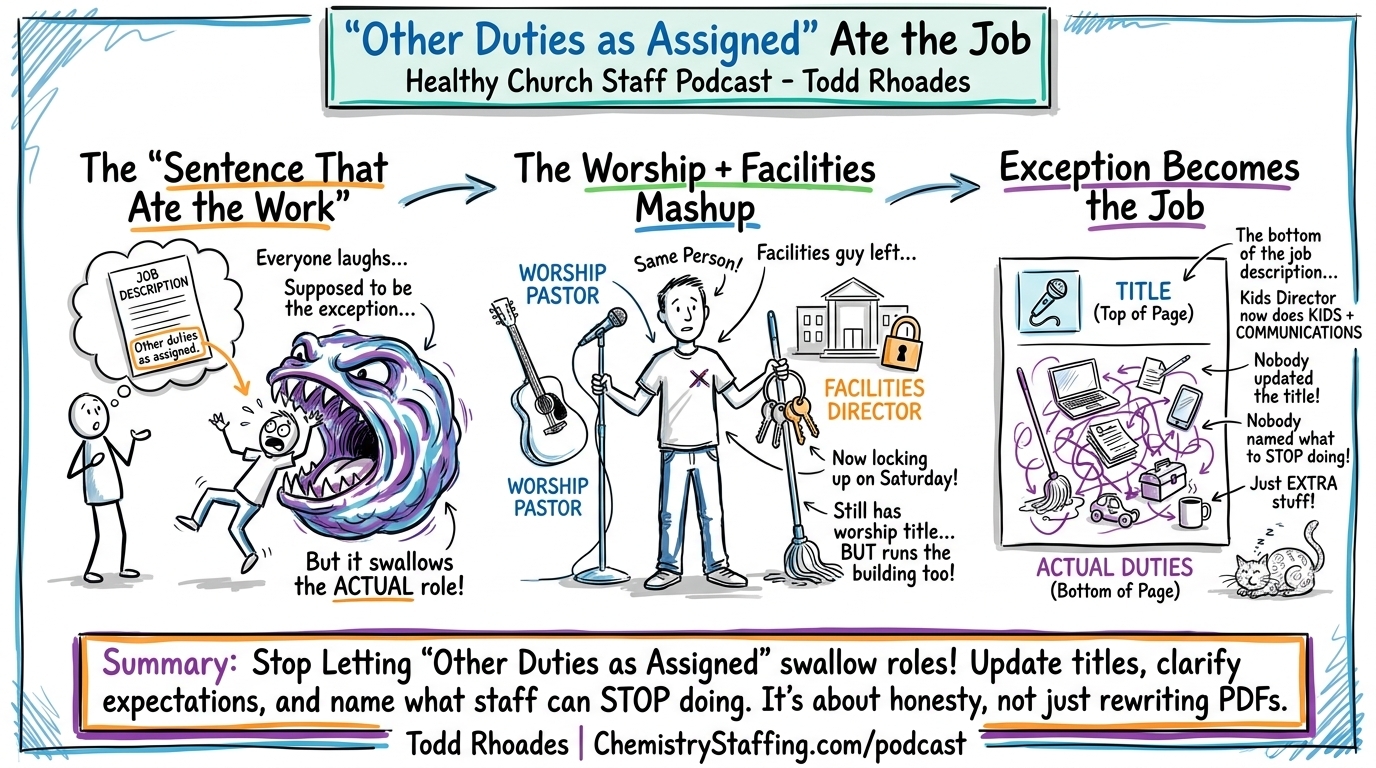
You know the one. Everyone laughs about it during the offer meeting. It was supposed to be the exception to the rule, a safety valve for when things change. Instead, it became the job.
The top of the page still has a title. The bottom of the page describes what they actually do.
If this sounds uncomfortably familiar, you're not alone. And you're in the right place.
The Sentence That Ate the Work
Let's be honest: you didn't add that line to be deceptive. You put "perform other duties as assigned" on every job description so you wouldn't get trapped. Ministry is unpredictable. Seasons change. Needs shift. It made sense to leave some flexibility.
But over time, that exception didn't just expand—it consumed the original role.
And now you can see it playing out in real time across your staff team.
The Worship Pastor Running the Building
You hired them to lead worship—to craft setlists, develop volunteers, and create environments where people encounter God through music.
Then your facilities person left. Or maybe there never was one. Either way, someone had to lock up on Saturday nights. Someone had to field the voicemails about the leaky roof and the broken HVAC.
So you gave the keys to the person who was already there on weekends. It seemed logical. Practical, even.
They said yes because they love the church and wouldn't let Sunday fail.
But here's what happened: you heard "yes" as capacity. Capacity is not love.
Love will keep saying yes until the role you hired for becomes a hobby they squeeze in after handling the "real" job. The songs still have to happen. The roof still leaks. And guess which one is getting the panicked text at 6:47 on Saturday night?
The Kids Director Now Doing Communications
Same story, different department.
You hired someone to shepherd families, recruit volunteers, and create a thriving environment for children's ministry. Then your communications person moved on.
So your kids director started writing a few announcements. Then the bulletin. Then the newsletter. Now they're the one posting content, managing social media, and editing video clips.
The job description still says children's ministry. The salary still reflects children's ministry. But the week says captions and carousels.
Nobody sat down and said, "This is now two jobs." You just... added. And kept adding.
Exodus 18:17-18 (NIV): "Moses' father-in-law replied, 'What you are doing is not good. You and these people who come to you will only wear yourselves out. The work is too heavy for you; you cannot handle it alone.'"
You Didn't Do This to Be Cruel
Let me say this clearly: I know your heart.
You didn't dump the building and the content calendar on someone to be cruel or careless. You were in a pinch. You asked the person who cared most—the one who wouldn't let the ball drop.
That's not malicious. It's how churches survive tight seasons.
But it's also how a really good hire becomes a dumping ground for leftover work.
They said yes because they're faithful. Because they love the mission. Because they wanted to help.
You assumed that "yes" meant they had margin. But capacity is not the same as willingness.
And now, six years after COVID (when so much of this started), they're still doing work that was never part of the plan. The salary didn't change. The title didn't change. The pile just got a lot bigger.
The Problem: A Title That Lies
Here's the issue most church leaders don't want to name:
If the work changed, the title should have changed. What they're allowed to stop should have changed too.
You can't expect a full-time children's pastor to also be a full-time communications director and deliver both roles at the level your website promises. It's not possible. Something will slip—and it's usually the thing they were actually hired to do.
If your worship pastor runs the building, stop introducing them as only the worship pastor. If your kids director owns communications, stop acting surprised when follow-up in kids ministry falls through the cracks.
A title that doesn't match reality isn't humility. It's a cover for work you're unwilling to name, fund, or redistribute.
Discussion Question for Your Team
How clear are we as a team about each person's primary zone of genius? Can everyone at the table articulate what each team member was primarily hired to accomplish?
The Path Forward: Name What They Can Stop
Now, I'm not asking you to blow up the budget tonight and hire four new people. This isn't a math episode.
But I am asking you to stop pretending the PDF is still true.
Here's your gut check—and it's simple:
Sit down with one person on your team this week.
Not for a performance review. Not for a heavy conversation. Just to make a list.
Ask them to name three things they're currently doing that weren't part of the job you hired them for. The building responsibilities. The newsletter. The graphic design requests. The tech troubleshooting.
Write them down where you can both see them.
Then pick one thing they can stop doing this month.
Not "we'll revisit this later." Not "when we hire someone new." Stop. This month.
Maybe someone else picks it up—a volunteer, a vendor, maybe even you. Maybe the church lives without it for 30 days and discovers it wasn't the hill you thought it was.
If you can't name something they can stop, you're not managing a role. You're managing a pile.
1 Corinthians 12:18 (NIV): "But in fact God has placed the parts in the body, every one of them, just as he wanted them to be."
If You're the One Drowning
Maybe you're not the supervisor. Maybe you're the worship pastor with the building keys. The kids director writing the newsletter at midnight.
You're tired. You're close to burnout. And every time someone leaves, more gets added to your plate—because you're competent and you care.
Here's what I want you to hear: you're allowed to name this.
It's okay to sit down with your supervisor and say:
"I love my role. I love this church. I love serving here. But I've got a lot on my plate right now, and I don't think I'm doing any of it well. Can we talk about what I can stop or hand off?"
Most pastors and supervisors—if they're healthy—will hear that and want to help. And if they don't? That's information too.
Action Item: The One-Week Time Audit
Track how you actually spend your time this week. Compare it to your job description. What percentage is core work? What percentage is "other duties"? Bring that data to your next one-on-one. You can't fix what you won't name.
Bottom Line
"Other duties as assigned" was never supposed to eat the job.
You hired a worship pastor. If they're now running the building, update the title—or name what they can stop.
You hired a kids director. If they're doing communications, make it official—or take something else off their plate.
The cruelty isn't the initial ask. It's the extra work piled on without ever removing anything.
You hired them for a real job—not a leftover pile.
So this week, sit with one person. Make the list. Pick one thing they stop. And start rebuilding clarity, one role at a time.
Want to talk through what this looks like on your team? We'd love to hear from you. Send your thoughts, questions, or frustrations to podcast@chemistrystaffing.com.
And if you haven't yet, take our free Church Staff Health Assessment. Your input helps us understand the real challenges facing church teams today—and how we can better serve you.