

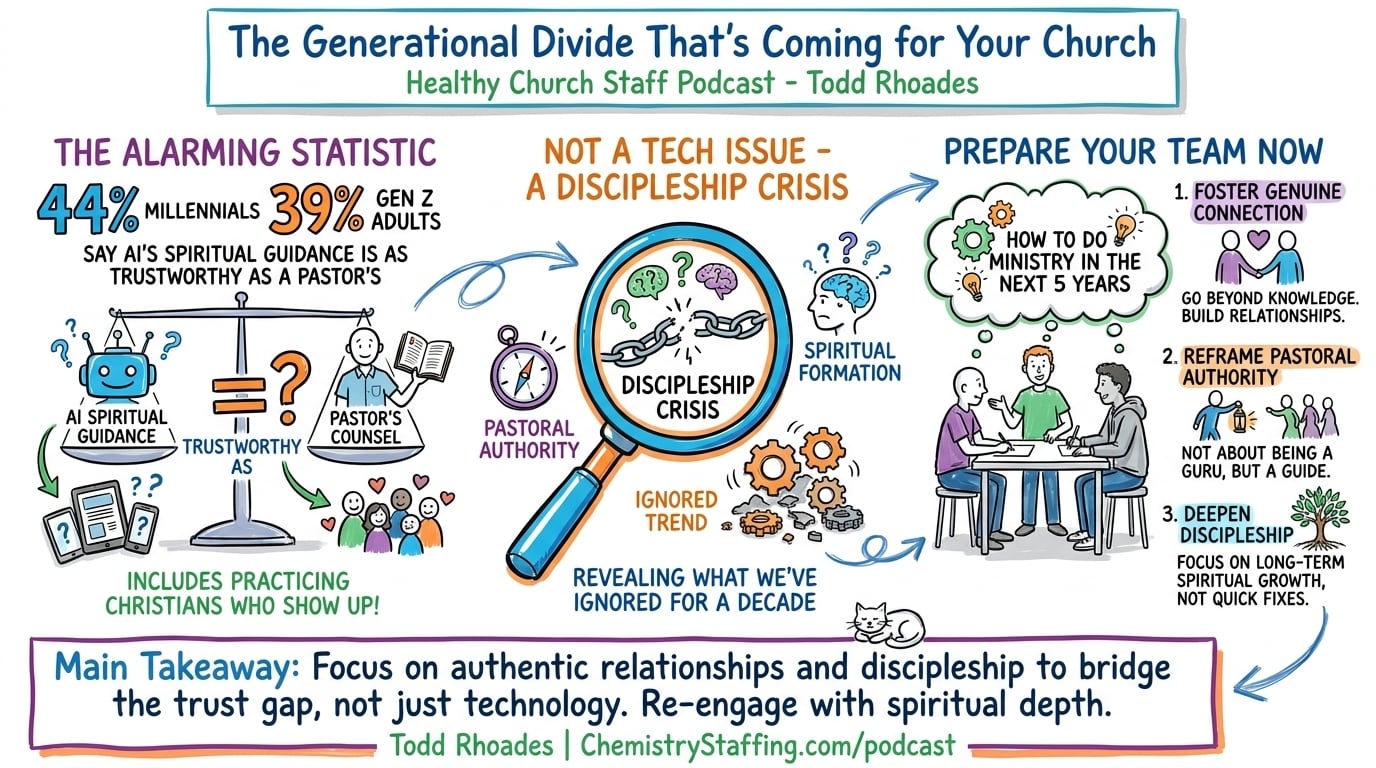
I came across some Barna research this week that honestly kept me up at night. Nearly half of Millennials—44% to be exact—say that AI spiritual guidance is just as trustworthy as their pastor's advice. And 39% of Gen Z adults feel the same way.
🎧 Listen to this episode:
Before you think, "Well, that's probably just the unchurched crowd," here's the kicker: this includes practicing Christians. Not the ones who left your church. Not the ones who haven't darkened your doorway in years. These are the people showing up on Sunday mornings two or three times a month at your church right now.
If you're on church staff, this isn't a conversation about whether you should get a ChatGPT account. This is about something far bigger—and it's been building for more than a decade.
This Isn't About AI Being Good—It's About Pastoral Authority Being Weak
Let me be clear: when half of your congregation trusts an algorithm as much as they trust you, that's not a tech endorsement. That's a relationship gap.
They're not saying AI is amazing and revolutionary. They're saying we haven't given them anything better. Ouch. I know that stings, but stay with me.
Before we start blaming culture, phones, TikTok, or the general degradation of society, let's take an honest look at what's happened over the past 20-25 years in the American church.
The Drift We Didn't See Coming
Here's what happened, and I'm oversimplifying a bit, but follow me: We spent two decades building incredible weekend experiences. Lights, music, graphics, sermon series with killer branding. And none of that is bad—it's actually quite good.
But somewhere along the way, we made a dangerous assumption: we assumed discipleship would just happen.
We thought people would naturally connect the dots between what they heard on Sunday and how they lived on Tuesday morning. But they didn't. And we didn't create the structures, relationships, or rhythms to help them bridge that gap.
So when AI showed up and offered personalized spiritual advice at 2:00 AM on a Tuesday when someone was lying awake with anxiety, it felt more accessible than anything we'd given them at church. Not deeper—don't hear me say that—just closer and available 24/7.
"As iron sharpens iron, so one person sharpens another." —Proverbs 27:17This reminds us that spiritual growth happens through human relationship and friction, not algorithmic efficiency.
The Weekend Still Matters (But It's Not Enough)
Now listen—I'm not saying the weekend doesn't matter. It matters more than ever. That community aspect, the corporate worship, the gathered body—it's all incredibly valuable.
And I'm not saying your sermons are failing. But here's the diagnostic question that should concern every church leader: If people can't name a single person on your staff they would call with a real spiritual question, that's a problem.
That's THE problem.
We've got to figure out how to shift from content delivery to relational discipleship. And that doesn't mean creating another small group signup form or launching a new app with Bible reading plans.
It means something much more fundamental: Your staff needs to know 10 people deeply, not 100 people shallowly.
What People Are Really Asking
When someone opens their phone at midnight and asks AI, "Is this a sin?" they're not really looking for a theological dissertation. They're asking something far more human: "Who can I trust with the mess of my life?"
And if the answer isn't a real person at your church—someone with a name, a face, a phone number they actually have saved—you've lost them before the app even loads.
Here's the truth I want you to hear today: AI can give information. We all use it. I use AI every single day in my work. But AI can't sit with someone in grief. It can't pray over them after a miscarriage. It can't show up with groceries when their marriage is falling apart.
That's your edge. That's what church is for. That's what your staff was absolutely made for.
"Because we loved you so much, we were delighted to share with you not only the gospel of God but our lives as well." —1 Thessalonians 2:8Ministry effectiveness isn't measured by information transferred but by lives shared—something AI fundamentally cannot do.
How to Lead Your Team Through This Reality Check
So what does this look like practically? How do you lead your team through this conversation?
It starts with actually having the discussion. Bring this up in your next staff meeting. Don't treat it as a threat—treat it as a reality check.
Ask this question: "If someone in our church has a spiritual crisis at midnight, who do they text?"
If the honest answer is "no one" or "probably Google," that's not a condemnation—that's your starting point.
Shift From Program Management to People Development
This requires rethinking your staff's job descriptions from program management to people development.
Your worship pastor shouldn't just plan setlists—they should know their band members' prayer requests by heart.
Your youth pastor shouldn't just run events (though yes, they need to do that too)—they should have students who actually confide in them about what's really happening in their lives.
Your children's ministry director shouldn't just manage volunteers—they should know which families are struggling and which kids need extra attention.
This is about accessibility and trust. Because Gen Z isn't asking, "Is your doctrine sound?" They're asking, "Are you safe? Are you real? And are you available?"
Discussion Questions for Your Team
- On a scale of 1-10, how well could someone in our congregation answer this question: "Who in this church knows my story well enough to give me personalized spiritual guidance?" What does our average score say about our ministry?
- As a staff, are we accidentally training people to see us as "information providers" rather than "life-on-life disciples"? What in our programming or communication might reinforce that?
- What would need to change in our ministries if our primary metric shifted from "attendance" to "percentage of people in meaningful discipleship relationships"?
Your Competition Isn't AI—It's Anonymity
Here's the bottom line: AI isn't your competition. Anonymity is.
The next five years are going to define what it means to pastor people again. And your team gets to lead the way. This is an absolutely incredible time to be in ministry—you're not too late, and the opportunity has never been greater.
But it starts today, and it starts with closing the accessibility gap between your staff and your people.
Action Steps to Take This Week
- Conduct a relationship audit: Each ministry leader identifies 3-5 people in their area who seem spiritually isolated and creates a plan to initiate deeper connection this week.
- Schedule "walk alongside" time: Each staff member blocks 3-5 hours next week specifically for unstructured time with congregation members—coffee, walks, meals—not meetings with agendas.
- Model vulnerability: Each staff member shares one area where they're currently seeking wisdom, demonstrating that even leaders need relational input.
- Create mentorship pathways: Develop a simple process for connecting congregation members with mature believers for spiritual friendship—not formal programs, but organic relationships.
Let's Keep This Conversation Going
I hope this has been helpful to you. This isn't meant to discourage—it's meant to wake us up to an opportunity we can't afford to miss.
What's your take? How is your church addressing the discipleship gap? What's working in your context? I'd genuinely love to hear from you.
Email me at podcast@chemistrystaffing.com—I read every email, and if you're facing specific challenges with staff health or discipleship culture, I've got people on my team who specialize in helping churches work through exactly these issues.
And before you go, we've just opened the 2026 Church Staff Health Assessment. It's completely free and takes about 10 minutes. The data we collect helps us create a comprehensive report on the state of church staff health in America. Take the assessment here—your input matters more than you know.
You've got this. Your church needs you to lead through this shift. Let's do it together.
—Todd Rhoades
Co-founder, Chemistry Staffing