

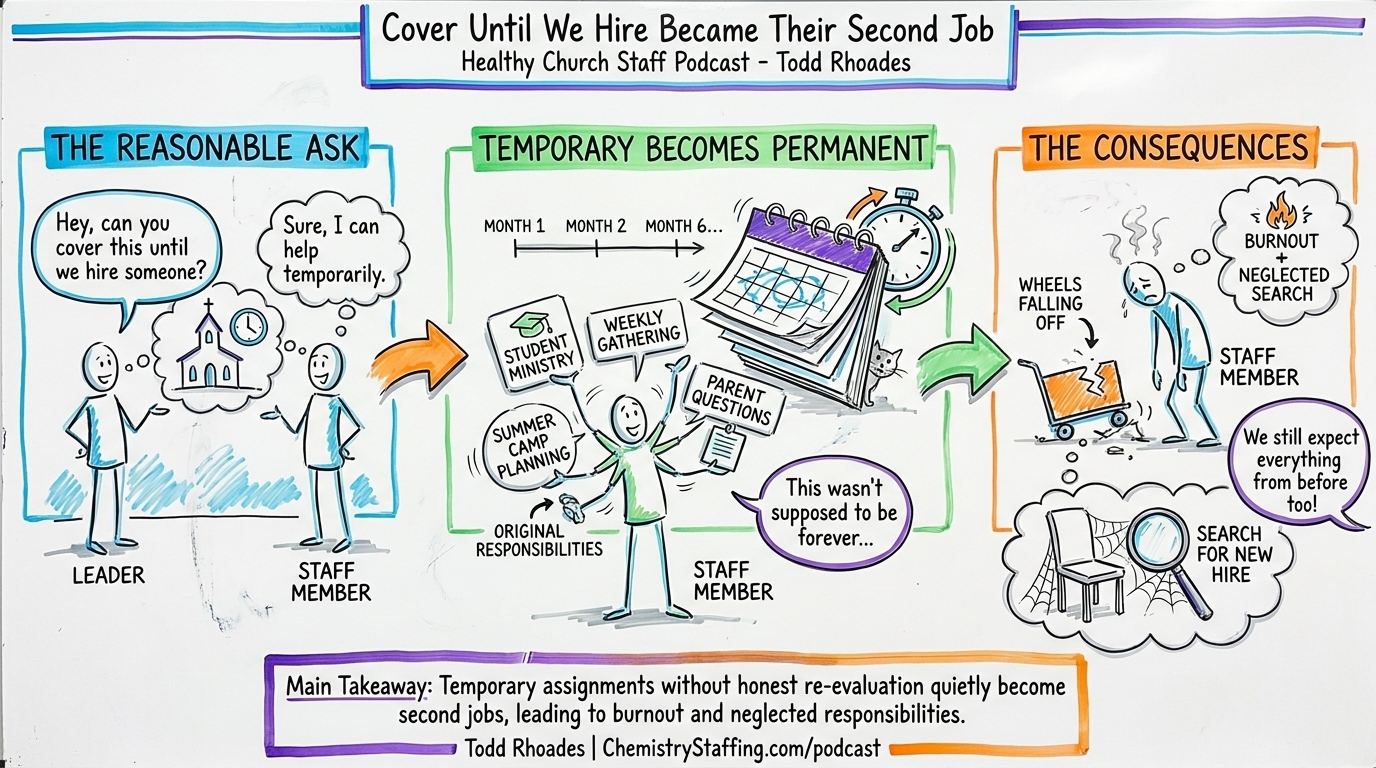
It started with a simple question: "Can you cover this until we hire someone?"
🎧 Listen to this episode:
It's a reasonable request. A staff member leaves, Sunday is coming, and somebody needs to step up. So you ask someone you trust—someone who knows the church, cares about the people, and has proven themselves reliable. And thankfully, they say yes.
The only problem? That conversation happened six months ago.
They're still covering. Their original responsibilities haven't changed. And that search you were going to prioritize? Well, you've been meaning to get back to it.
If this scenario sounds familiar, you're not alone. Today, let's talk about what happens when a temporary assignment quietly becomes someone's second job—and what you can do about it before you lose a great team member.
When Necessary Help Becomes an Unsustainable Burden
Asking for help during a transition is often necessary. The problem comes when the arrangement keeps going and going without another honest conversation. Before you know it, six months have passed, and that person is still carrying double the load.
Picture this: Your associate pastor agrees to oversee student ministry after the youth pastor leaves. Initially, the assignment seems manageable. Keep the weekly gathering going, support the volunteers, handle urgent questions. Just keep the wheels from falling off until you find someone new.
But then summer camp needs planning. A key volunteer steps down. Parents start asking what's happening in the fall. Pretty soon, your associate pastor isn't just "keeping things moving"—they're leading the ministry.
And here's the kicker: you still expect everything they were doing before, too.
The Hidden Costs of "Getting It Done"
Because your team member is dependable and servant-hearted, most of it gets done. And that's where even good leaders can misread the situation.
We see that the ministry is functioning, and we assume the arrangement is working. But work getting done doesn't tell you what it's costing the person doing it.
Exodus 18:17-18 - "Moses' father-in-law replied, 'What you are doing is not good. You and these people who come to you will only wear yourselves out. The work is too heavy for you; you cannot handle it alone.'"
Maybe they're preparing lessons after their kids go to bed. Maybe their original ministry is getting less attention than it deserves. Maybe their day off has become the only place to fit the extra planning.
These are the tradeoffs you may not see—even if you're a really attentive leader—unless you specifically ask. And if it's been six months since your last conversation, you're probably not asking.
When Reliable Coverage Makes Problems Disappear (From Your View)
Here's another issue: reliable coverage can make a vacancy feel less urgent.
The service still happens. Parents aren't complaining. Volunteers have someone to call. Nothing appears to be breaking down. From the leadership team's perspective, the immediate crisis has passed.
From your covering staff member's perspective? The extra work keeps arriving every single week.
Nobody intends for this to happen. It develops one postponed decision at a time. One more month turns into another quarter. Before long, what was supposed to be temporary has become the new normal—for everyone except the person doing the work.
How to Handle Temporary Coverage Fairly
So how do you navigate this well? How do you get the help you need during transitions without burning out your best people? Here are three essential steps:
1. Define the Assignment Clearly
What exactly are you asking this person to do?
There's a substantial difference between supporting a volunteer leader for a month and taking responsibility for an entire ministry for several months. Be specific about:
- The essential work that must get done
- The decisions they're authorized to make
- What can legitimately wait
Here's the reality: your staff member cannot physically, mentally, or spiritually do two full-time jobs. If you don't set clear parameters, you're setting them up to fail.
Next, look at their existing responsibilities—the ones you actually hired them to do. If you're adding something significant, you need to decide what you'll remove, postpone, or give to someone else.
Don't leave your staff member to quietly choose which expectations they're going to disappoint. You need to help make those decisions.
2. Discuss Support and Compensation
A brief emergency assignment and several months of additional leadership deserve different conversations.
Depending on the situation, appropriate support might include:
- A temporary stipend or bonus to acknowledge the extra responsibility
- Additional administrative help or outside assistance
- A temporary hire or remote employee to handle administrative tasks
- A substantial reduction in other responsibilities
An extra paycheck can acknowledge the added responsibility, but it still won't create more hours in the week. You have to address the workload head-on.
Discussion Question for Your Team:
How do we inadvertently punish our most competent, servant-hearted staff by continually adding to their plates? What message does this send about how we value people?
3. Give the Arrangement a Timeline You Can Actually Manage
I get it—you don't know exactly when you'll find the right person. It might take six months, a year, or even longer to hire a new youth pastor.
But you need to put a timeline on the coverage arrangement.
You may not be able to promise when the right candidate will accept the job. Searches have uncertainties. But you can commit to:
- A review date
- Clear next steps
- A decision about how long the current arrangement can reasonably continue
For example: "Let's plan for this coverage through the end of June. We'll meet every two weeks to check in, and by June 1st, we'll decide together what happens if we haven't hired someone."
Then actually do it. Meet every two weeks and conduct that June 1st assessment. That meeting needs to include real choices: adjust the coverage, bring in additional help, simplify the ministry, or discuss a different permanent role with the person carrying it.
An automatic extension isn't much of a review. And avoiding the conversation altogether is no review at all.
Ecclesiastes 3:1 - "There is a time for everything, and a season for every activity under the heavens."
Your Action Step This Week
If you're in this situation right now, here's what I want you to do:
List every vacant position someone on your team is covering.
Write down:
- When the arrangement started
- What they've taken on
- What's come off their plate (if anything)
- When you last reviewed it together
If those answers are unclear, schedule the conversation now.
Start with something like this: "You stepped up when we needed help, and I genuinely appreciate that. I want to make sure what we're asking is reasonable and sustainable."
Then listen. Really listen. Before defending the arrangement or explaining why it has to continue, just listen.
Their willingness to help deserves thoughtful leadership in return.
Action Items for Your Leadership Team:
- Conduct a "Coverage Audit" - Each staff member lists all responsibilities they're covering that aren't part of their original role
- Set Expiration Dates - For any current "temporary" situations, establish a firm deadline (30-90 days) to either hire, reassign, or eliminate
- Identify One Thing to Stop - Choose at least one program or responsibility to discontinue rather than continue covering indefinitely
- Establish a Coverage Policy - Develop a team agreement about maximum coverage duration before requiring a structural decision
The Bottom Line
When someone says yes to carrying an extra responsibility, give them clarity, give them support, and give them a plan they can trust.
We tend to ask the people we really trust to take on extra responsibilities. It's the competent people who always get more added to their plate. But they can only do that for so long.
If the church has decided it won't fill the vacancy, say so. Have an honest conversation about your staffing structure instead of continuing to describe it as temporary.
Your team deserves better than perpetual uncertainty and unsustainable workloads. And your ministry will be healthier when people can focus on what they do best rather than constantly covering gaps.
What about you? Are you navigating a situation like this right now? Do you need guidance on how to have this conversation or structure a fair coverage arrangement? I'd love to hear from you and help if I can. Send your thoughts or questions to podcast@chemistrystaffing.com.
This post is based on Episode 729 of the Healthy Church Staff Podcast. For more resources on building healthy church teams, visit chemistrystaffing.com.