

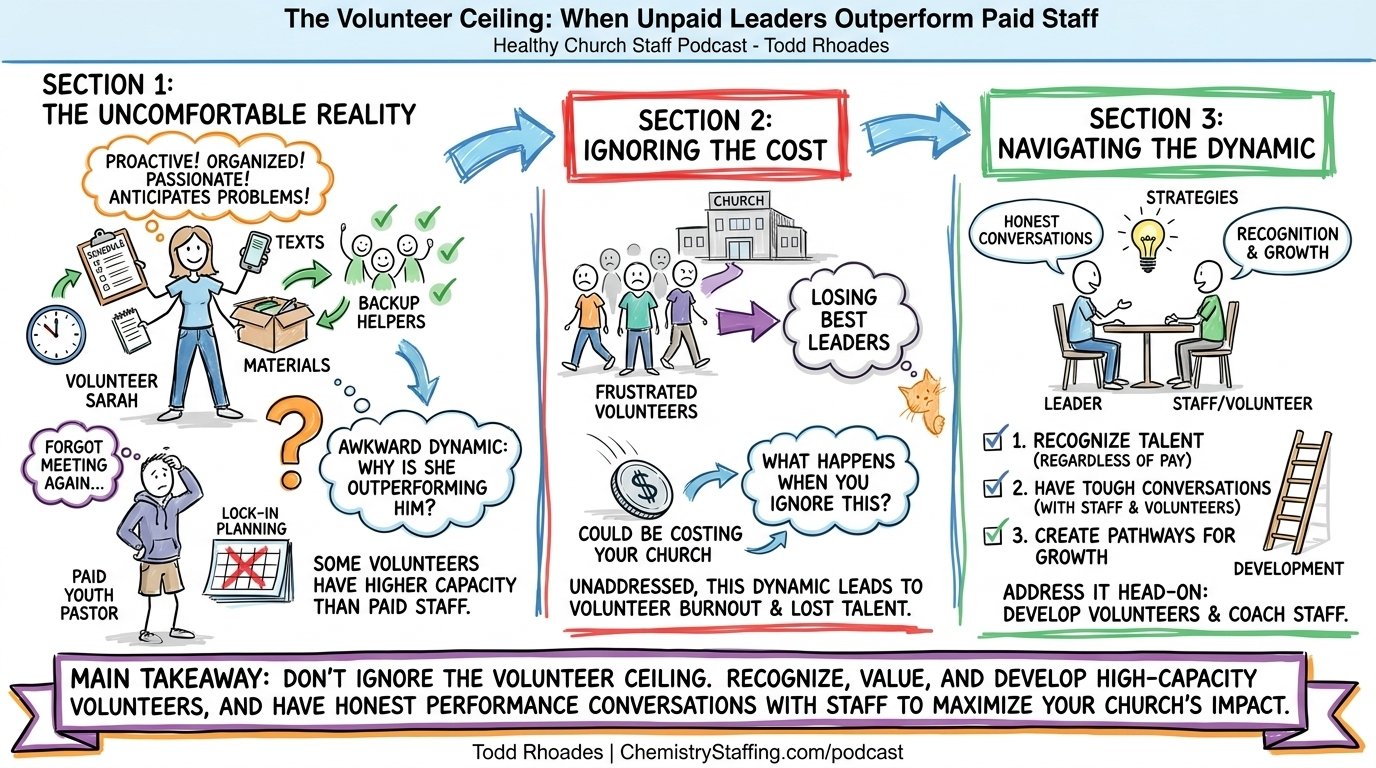
Your children's pastor calls in sick again. But Sarah, your volunteer coordinator, has already rearranged the schedule, texted parents, prepped materials, and recruited backup helpers. Meanwhile, your paid youth pastor forgot about the lock-in planning meeting—again.
🎧 Listen to this episode:
And you're sitting there thinking: "Sarah would absolutely crush this job."
But she's not getting paid, and he is.
Sound familiar? If this scenario made you squirm a little in your chair, you're not alone. This uncomfortable dynamic is happening in churches everywhere—large and small, urban and rural—and nobody really wants to say it out loud.
But here's what we need to acknowledge: sometimes volunteers have higher capacity than paid staff. And ignoring this reality could be costing your church its absolutely best leaders.
The Uncomfortable Reality Nobody Talks About
Let's be honest about what's happening here. Some volunteers are simply more organized, more proactive, and more passionate than your paid team members. They anticipate problems before they happen. They communicate better with teams. They execute with excellence. And if we're being completely transparent, they're making your paid staff look bad.
This isn't about volunteers being perfect or paid staff being incompetent. It's about recognizing a structural dynamic that many church leaders face but few know how to navigate.
"There are different kinds of gifts, but the same Spirit distributes them. There are different kinds of service, but the same Lord. There are different kinds of working, but in all of them and in everyone it is the same God at work." - 1 Corinthians 12:4-6
Why This Happens More Than You Think
Before we jump to solutions, let's understand the root causes. Most of the time, this isn't actually a people problem—it's a structure problem.
You Hired for Availability, Not Capacity
Be honest: how many times has the person who said "yes" fastest gotten the job? When you're desperate to fill a position, availability often trumps capability. Your volunteers, on the other hand, chose to be there. They weren't looking for a paycheck—they were drawn by passion and calling.
Marketplace Skills vs. Ministry Experience
Many of your volunteers bring sophisticated skills from their professional careers. That marketing executive volunteering in your communications ministry? She's been managing million-dollar campaigns all week. Your paid staff member might have a ministry degree but lack the practical experience your volunteer has in spades.
Fresh Energy vs. Ministry Burnout
Here's a hard truth: your volunteers aren't burned out from ministry pressure yet. They're bringing fresh energy and perspective, while your paid staff might be running on fumes from trying to prove themselves or manage unrealistic expectations.
And here's the kicker—volunteers often aren't trying to prove themselves the same way paid staff are. They're free to lead from their strengths without the weight of job security concerns.
Where Most Churches Go Wrong
When faced with this dynamic, most churches make predictable mistakes that end up hurting everyone involved:
- They protect feelings over mission. We prioritize the paid person's comfort over the church's effectiveness.
- They assume volunteers can't handle "real" responsibility. After all, if they were really that good, wouldn't they be on staff?
- They avoid difficult conversations. It's easier to work around the problem than address it directly.
- They pile more work on the volunteer without compensation. This is how you lose your best people fastest.
Key Insight
Great volunteers shouldn't be held back by mediocre staff. Your church deserves leaders who can actually lead, regardless of whether they're paid or unpaid.
A Healthier Approach to High-Capacity Volunteers
So what does a healthy response look like? It starts with shifting your perspective from protecting the status quo to optimizing for mission effectiveness.
Create Clear Pathways from Volunteer to Staff
Stop treating volunteer and staff roles as completely separate universes. Some of your best staff members started as volunteers, and some of your current volunteers should become staff. Create intentional pathways that allow high-capacity volunteers to grow into paid roles when it makes sense.
Pay People for Value, Not Just Title
Consider compensation structures that reflect actual contribution rather than just job titles. This might mean offering part-time paid positions, consulting fees, or other creative arrangements that honor the value high-capacity volunteers bring.
Move Underperforming Staff to Better-Fitting Roles
Maybe your underperforming staff member isn't actually underperforming—maybe they're just in the wrong seat on the bus. Before you write someone off, consider whether their gifts might be better suited to a different role on your team.
Stop Letting Org Charts Prevent Obvious Leadership Moves
Your organizational structure should serve your mission, not the other way around. When your org chart prevents you from empowering your most effective leaders, it's time to redraw the chart.
"So Christ himself gave the apostles, the prophets, the evangelists, the pastors and teachers, to equip his people for works of service, so that the body of Christ may be built up." - Ephesians 4:11-12
Remember Your First Responsibility
Here's what this all comes down to: your first responsibility is to the mission, not to the payroll.
This doesn't mean you should be callous about people's livelihoods or feelings. But when the mission is being compromised by protecting underperformance, you can't keep kicking that can down the road indefinitely.
The goal isn't harmony—it's effectiveness. And sometimes the most loving thing you can do for an underperforming staff member is help them find a role where they can truly thrive, even if that means they need to leave your team.
This Week's Challenge
Think about your highest-capacity volunteer—the one whose name came to mind as you read this post. Schedule a conversation about whether there's a role that actually fits their abilities. Stop wasting talent just because of titles.
Discussion Questions for Your Team
- How can we as a staff team celebrate high-capacity volunteers without diminishing the value of our paid roles?
- What's the difference between a volunteer who complements your ministry versus one who competes with it?
- When a volunteer outperforms us in certain areas, what can we learn about our own role clarity and unique contributions?
- What specific steps can we take to create better collaboration between high-capacity volunteers and staff?
Moving Forward
Remember, this isn't about volunteers versus staff. It's about putting the right people in the right seats to advance God's kingdom most effectively. Some of your volunteers should become staff. Some of your current staff might be better suited elsewhere. And that's okay.
Your church's mission is too important to let organizational charts or payroll considerations get in the way of great leadership. When volunteers consistently outperform staff, that's not a volunteer problem—that's a staffing opportunity.
The question isn't whether this dynamic exists in your church. The question is: what are you going to do about it?
Want to Continue This Conversation?
This topic hits close to home for many church leaders. If you're wrestling with these dynamics on your team, I'd love to hear about it.
Send me your thoughts and questions at podcast@chemistrystaffing.com
Looking for daily leadership insights delivered to your inbox? Check out my new Church Leadership Radar newsletter at churchleadershipradar.com for curated resources you can scan in 90 seconds with your morning coffee.