

You're interviewing a really sharp young leader for your worship team. Great theology, she loves Jesus, killer references. Then she asks: "How does your church handle political stuff?"
🎧 Listen to this episode:
And you just freeze.
Because you know what she's really asking.
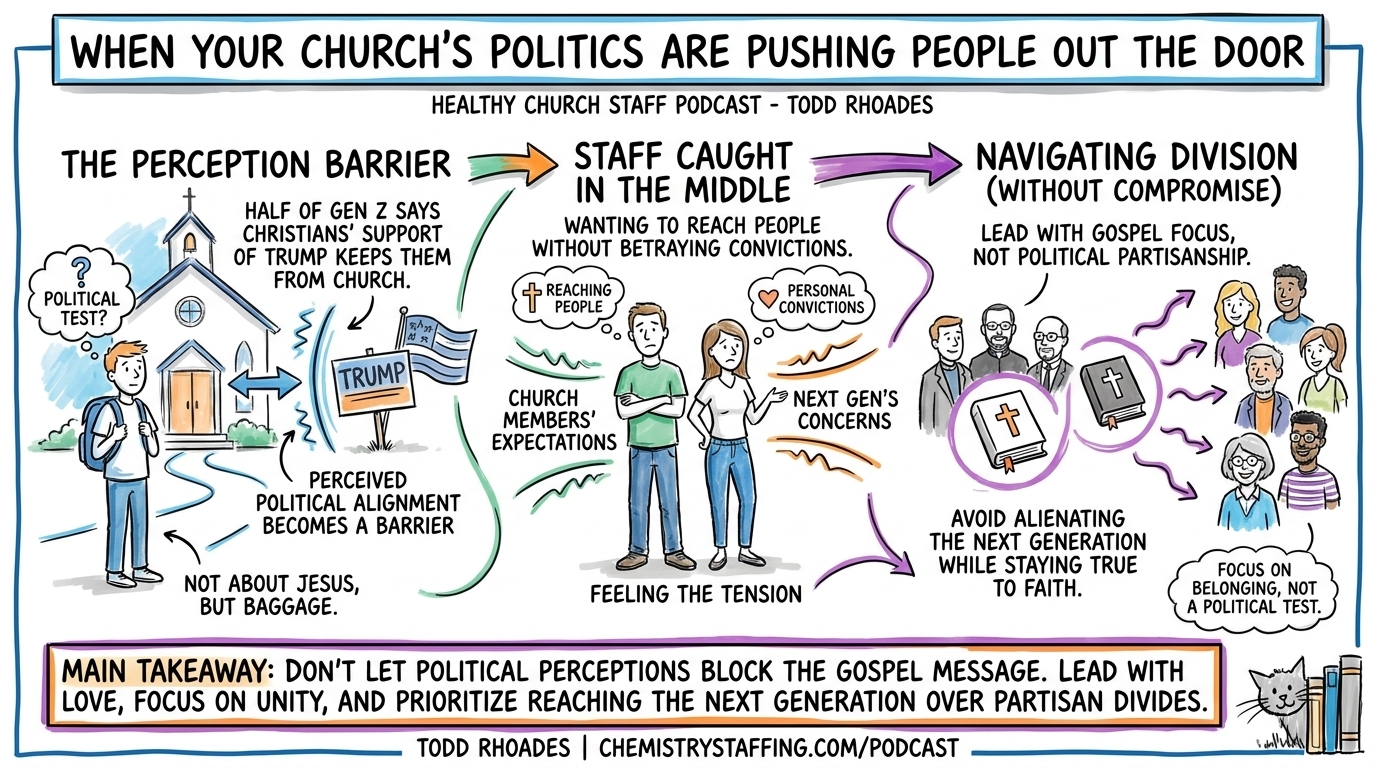
According to a recent Religion News Service survey, half of Gen Z Christians say that Christians' support of Trump keeps them from church. Half. Now listen—this isn't about Trump or Biden or any other politician. This isn't a partisan podcast episode or blog post.
But it is about what happens when the people you're trying to reach think they have to pass a political test to belong. And if that's rearing its ugly head in your church, you're in the right place, because we need to talk about how this affects your staff team.
The Invisible Political Barrier Your Staff Is Navigating
Here's what's happening, and it could be affecting your staff a lot more than you think.
Your church might not be "political" from the inside. You're not endorsing candidates from the pulpit. You're not preaching partisan sermons. But perception isn't always reality.
Maybe there's a flag in the lobby. Maybe a meme that somebody on your staff shared. Maybe it's the way certain issues get airtime and other issues don't. Young leaders see that. They're looking for it, they feel it, and they're making decisions based on it.
Your staff—particularly your Gen Z staff—feels caught in the middle, wanting to reach people without betraying their convictions.
What Happens When You Ignore the Political Elephant in the Room
Here's where it gets tricky for your team:
- You lose people before they even walk in—not because of Jesus, but because of the baggage they think comes with Jesus
- Your younger staff members feel it the most—they're fielding questions from friends that you never hear, constantly defending the church
- Your older members wonder why you're even talking about this—they don't see the problem
- Your staff is exhausted from being the bridge—caught between generations, perspectives, and expectations
Silence doesn't protect unity. It just pushes the tension underground where it festers and eventually explodes.
"My prayer is not for them alone. I pray also for those who will believe in me through their message, that all of them may be one, Father, just as you are in me and I am in you. May they also be in us so that the world may believe that you have sent me." — John 17:20-21
What Your Staff Needs to Hear From You (That You've Probably Never Said)
Now, I'm not saying that your church needs to apologize for its theology or compromise the gospel in any way. But I do think your staff—particularly your younger staff—needs to hear something different from you. Something you may have never even thought about saying.
They need permission to lead with clarity, not tribalism.
Help them articulate what the church IS for, not just what it's against. Train them to say: "We don't require you to vote a certain way to follow Jesus here."
That's not compromise. That's the actual gospel.
Give Your Staff Language for the Difference
Your team needs language for the difference between biblical conviction and cultural allegiance. Because here's the truth: when people can't tell the difference, you lose them.
Create space in staff meetings to talk about this—without fear, without judgment, without it getting all political. Your team is navigating this whether you acknowledge it or not. It's better to equip them than leave them alone with it.
Discussion Questions for Your Staff Team
- When you honestly assess our church, how do you think someone visiting for the first time would perceive our political leanings? What specific things might contribute to that perception?
- Have you personally ever felt tension between your political convictions and your role as a church staff member? How have you navigated that?
- What is one area where we might be unconsciously allowing political culture to shape our ministry more than kingdom culture? Consider: language we use, issues we emphasize or ignore, assumptions we make.
What This Looks Like Practically
Okay, so you get it conceptually. But what does this actually look like on a Tuesday afternoon when you're leading your team?
You don't have to become politically neutral to be spiritually clear. I'm not asking you to give up your personal political beliefs. Everyone has them. I have mine—I just don't share them here, and I wouldn't share them from the pulpit either.
Teach Your Staff to Major on What Jesus Majored On
That's justice AND mercy. Truth AND grace. Conviction AND humility.
When political assumptions become barriers to the gospel, your job is to remove the barrier—not to defend it.
Ask yourself and your staff: "What are people assuming about us even before they meet us?"
Then ask: "Is that assumption true? And if it is, is it worth it?"
Now, sometimes your answer is honestly going to be yes. But sometimes your answer is going to be no, it's not worth it. But you can't lead from what you won't name.
"Since, then, you have been raised with Christ, set your hearts on things above, where Christ is, seated at the right hand of God. Set your minds on things above, not on earthly things." — Colossians 3:1-2
Your Younger Staff Aren't Asking You to Abandon Convictions
They're asking you to help them reach people who think they already know what you believe before they ever hear about Jesus. And that's totally different.
Action Steps You Can Take This Week
- Conduct a "first-timer audit": Have 2-3 team members experience this Sunday as if visiting for the first time. What political signals do they notice? Report findings at your next meeting.
- Review recent communications: Look at the last month of sermons, social media, and announcements. Ask: "Would someone who votes differently than me feel welcomed here?"
- Create team ground rules: Develop agreements about how political topics will (and won't) be discussed in staff meetings, public settings, and on personal social media when identified as church staff.
- Plan a bridge-building initiative: Identify one practical way to serve your community that brings together people across political divides—food distribution, neighborhood cleanup, tutoring program. Take the first step to launch it.
The Bottom Line for Church Leaders
Your church's reputation—political or otherwise—is either opening doors to the gospel or closing them. And your staff is the one standing in the gap.
You're not called to be a political leader. You're called to lead people to Jesus. And sometimes that means clearing away the stuff that's blocking the path.
I realize this might be controversial for some of you reading. And that's okay. I'd love to have a conversation with you about it.
At Chemistry Staffing, we work with churches every day. And I can tell you, in the last 10 years, some parts of the church have become incredibly political—to the point where it's changed the way we onboard churches and the questions we ask, because we find that many churches, while they don't say they have a political agenda, actually do. And the people they're trying to reach see right through it.
You've got to lead with the gospel. Not with political allegiance that masquerades as gospel faithfulness.
Let's Continue the Conversation
What's your experience been? Are you seeing this dynamic play out on your team? What questions are your younger staff members asking that maybe your older leaders aren't hearing?
I'd genuinely love to hear from you. Email me at podcast@chemistrystaffing.com and let me know what you're seeing in your context. How are you helping your team navigate these waters?
And if there's any way our team at Chemistry Staffing can help you build a healthy, unified staff team that keeps the gospel central, reach out. We're here to serve you.
Looking for more practical leadership resources? Subscribe to the Healthy Church Staff Podcast for daily encouragement and insights for church leaders.