
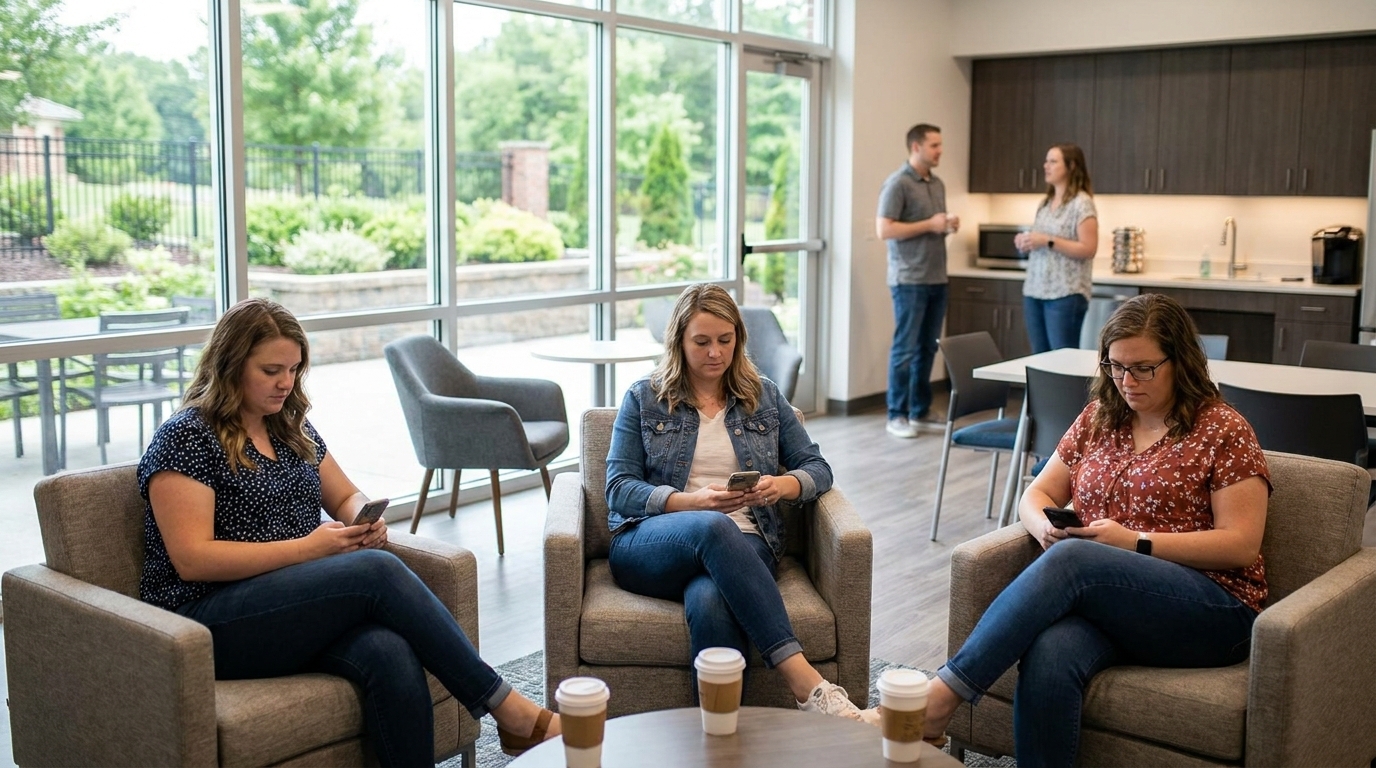
I came across a stat from RELEVANT Magazine this week that stopped me cold.
🎧 Listen to this episode:
The average person is now spending nine hours a day on screens.
Nine. Hours.
And look—I'm not about to shame anyone or pretend I've got this figured out. I work online, so I'm probably in front of my computer or phone for nine hours a day too. But here's what hit me: it's not the screen time itself that's the problem. It's what the screens are replacing.
Because something's gotta give when you're staring at a device for half your waking life.
And if you lead a church staff? You need to know what's disappearing—and why it matters more than you might think.
Four Things Your Staff Has Stopped Doing (Without Even Realizing It)
Over the past several weeks on the Healthy Church Staff Podcast, we've been talking about accountability and accessibility, and how both are changing with technology. This conversation fits right into that stream because the shifts happening aren't neutral—they're reshaping your team in ways that impact ministry effectiveness, personal health, and spiritual vitality.
Let me name four specific things that are quietly disappearing from your staff culture:
1. They've Stopped Reading
Not articles. Not posts. Not captions. They're still reading those.
I mean actual books. Long-form thinking. Deep ideas.
Your staff used to read theology, leadership books, biographies. They used to engage ideas that stretched them, challenged them, and shaped their thinking over weeks and months, not seconds and swipes.
Now? They scroll snippets.
And here's the thing—you can't lead people deeper than you've gone yourself.
If your team isn't reading, they're not growing. They're recycling the same thoughts, preaching the same sermons, deploying the same strategies. There's no fresh input, no intellectual challenge, no expanding perspective.
"Whatever you do, work at it with all your heart, as working for the Lord, not for human masters." — Colossians 3:23
Our full presence—including our mental engagement—honors both God and the people we serve. But shallow, snippet-based thinking can't fuel deep ministry.
2. They've Stopped Moving
Phones and computers are sedentary by design.
And your staff—who used to take walks, hit the gym, play pickup basketball, or even just pace while thinking—are now sitting. All. Day. Long.
Sitting in meetings. Sitting at desks. Sitting in cars scrolling between appointments.
I've experienced this myself. In the last six months, I've been working on a deep thinking project that requires hours of focused computer time. I'd get zoned in and suddenly realize two hours had passed and I hadn't moved. My body was stuck. And over time, I noticed something else: my soul got stuck too.
Physical movement isn't just about health—it's about mental clarity and emotional resilience. When your body's stuck, your soul gets stuck too.
We wonder why our teams are tired, anxious, and burned out. Could part of the answer be as simple as: they're not moving their bodies anymore?
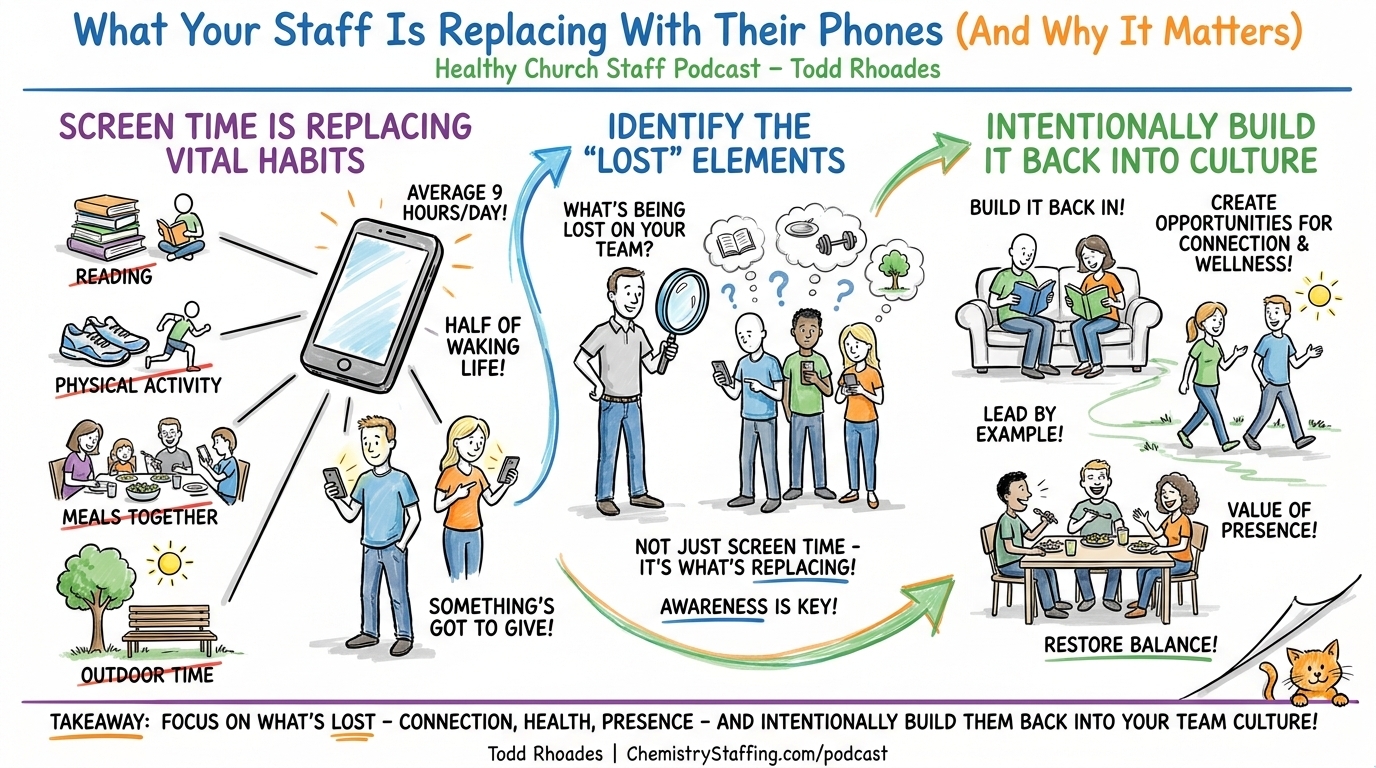
3. They've Stopped Eating Together
This one hit me hard.
Meals used to be where teams connected. Where you'd laugh, vent, process, bond. Where the real conversations happened—the ones that didn't fit neatly into meeting agendas.
Now? Lunch is at the desk with a phone in hand. Or it's a quick drive-thru alone in the car, scrolling Instagram while waiting in line.
You're losing one of the most ancient, sacred rhythms of human connection.
Breaking bread together isn't just nice—it's formative. It's where trust gets built. Where you actually see each other as humans, not just roles on an org chart. It's where you get to laugh and cry, where you share intimate details about what's really going on in your life and family.
"Two are better than one, because they have a good return for their labor: If either of them falls down, one can help the other up. But pity anyone who falls and has no one to help them up." — Ecclesiastes 4:9-10
Physical presence and real community matter. Screens create false connection—they can't replace the embodied experience of sharing a meal.
4. They've Stopped Going Outside
I know this sounds small. But it's not.
Sunlight. Fresh air. Trees. Silence without your phone.
Recent research suggests we should get 10-30 minutes of sunlight every morning as we start our day. These aren't luxuries—they're necessities. They're actually the way God built us.
God literally put Adam in a garden, not a fluorescent-lit office with Wi-Fi.
When your staff spends all day indoors staring at screens, something in them—maybe not today, maybe not tomorrow, but over time—will start to wither. Their creativity dries up. Their perspective narrows. Their anxiety climbs.
Nature resets us in ways we don't even realize until it's gone.
"Be still, and know that I am God; I will be exalted among the nations, I will be exalted in the earth." — Psalm 46:10
Ministry effectiveness requires intentional stillness, which constant phone use interrupts.
What You're NOT Hearing Me Say
Before you think I'm on some anti-technology crusade, let me be clear:
I'm not saying phones are evil.
I'm not saying your staff is lazy.
They're not scrolling because they don't care. They're scrolling because we all are. This is a cultural drift, not a character flaw.
But as a leader? You can't just hope it gets better. You have to be intentional about what you're rebuilding.
Here's Where You Start
You have to name it.
In your next staff meeting, have this conversation: "What are our phones replacing? What have we lost?"
Don't shame anyone—that will get you absolutely nowhere. Just get it on the table.
Then build back one small rhythm at a time:
Practical Next Steps for Your Team
- Start a monthly staff book club. Read something together that causes deep thinking. Make it consistent, not just a one-time thing.
- Block out one lunch a week to eat together. No phones. Just people. Protect this time like you would any other important meeting.
- Take a 15-minute team walk after your weekly staff meeting. Get outside. Move your bodies. Talk about anything except work if you want.
- Create a "first 15" practice. Challenge your staff to spend the first 15 minutes of their workday without phones—prayer, Scripture, planning, or simply stillness.
- Designate phone-free zones. Identify one or two places in your building where phones don't go—spaces reserved for prayer, reading, or quiet reflection.
These aren't radical overhauls. They're small, achievable steps that rebuild what matters.
The Bottom Line
Your staff isn't just busy. They're not just tired. They're being slowly reshaped by patterns they didn't consciously choose.
Reading, movement, shared meals, time in nature—these aren't "nice to haves." They're foundational to human flourishing and ministry effectiveness.
"Therefore encourage one another and build each other up, just as in fact you are doing." — 1 Thessalonians 5:11
Your staff culture should actively build spaces for real connection, not digital distraction.
So here's my question for you: What will you name? And what will you rebuild?
This isn't about going back to some pre-smartphone golden age. It's about being intentional leaders who recognize what's being lost and have the courage to reclaim it.
Discussion Questions for Your Next Staff Meeting
- Without judgment: What's the first thing you typically reach for during a break or transition time in your day?
- Personal reflection: Think back 5-10 years: What practices, hobbies, or habits have decreased in your life as phone use has increased?
- Team dynamics: How do we as a staff model phone use—both positively and negatively—to each other and to our congregation?
- Application: What's one realistic boundary or practice each person could commit to this week that would reclaim something valuable that phones have replaced?
What About You?
I'd love to hear how this conversation lands with you and your team.
What have you noticed disappearing from your staff culture? What small rhythms have you tried to rebuild? What's working? What's not?
Send me your thoughts at podcast@chemistrystaffing.com. I read every email, and your stories often fuel future episodes of the Healthy Church Staff Podcast.
And hey—if you haven't yet, I'd love for you to take our 2026 Church Staff Health Assessment. It takes about 10 minutes, it's completely free, and it gives us crucial insight into what's really happening in church staff culture right now. Your input helps fuel the content for this podcast and our work at Chemistry Staffing.
Take the assessment at churchstaffassessment.com
Let's rebuild what matters—together.
— Todd Rhoades
Co-founder, Chemistry Staffing
Host, Healthy Church Staff Podcast