

When a well-known pastor announces a succession plan, the first question everyone asks is obvious: "Who's taking over?"
🎧 Listen to this episode:
That's completely understandable. But for church leaders watching from the outside, there's a more useful question—one that can actually transform your ministry: What happened before the announcement that made this transition possible?
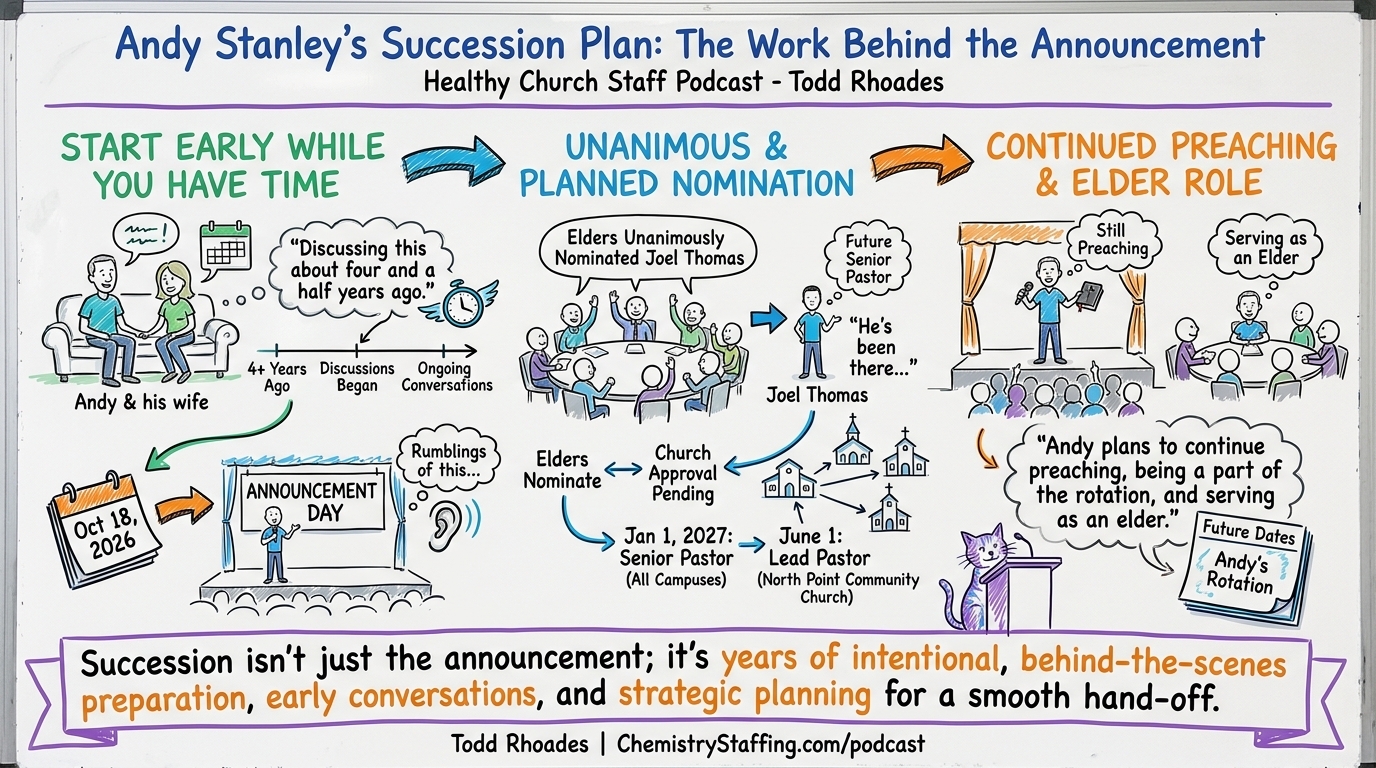
On October 18th, Andy Stanley announced plans to hand off his leadership responsibilities at North Point. The elders unanimously nominated Joel Thomas to succeed him as senior pastor of North Point Ministries on January 1, 2027, and lead pastor of North Point Community Church on June 1st. Andy plans to continue preaching in rotation and serving as an elder.
Now, full disclosure: we're outsiders here. We don't know every conversation, every concern, or every detail of their arrangements. A public announcement doesn't tell us how a transition will ultimately turn out. But the public explanation gives us some incredibly useful things to think about—and that's what we need to unpack today.
Lesson 1: Start Your Succession Planning While You Still Have Time to Prepare
Here's what caught my attention: Andy said he and his wife Sandra started discussing this transition about four and a half years ago.
Think about that timeline. Four and a half years.
That matters because—and I see this all the time at Chemistry Staffing—a church can spend years knowing a transition is coming without actually preparing for it. We get calls from pastors who say, "I want to talk about succession planning. What's your timeline?" And they respond, "I just turned in my resignation and I'm leaving at the end of the year. It's already October."
That's a transition. That's not succession planning.
"And the things you have heard me say in the presence of many witnesses entrust to reliable people who will also be qualified to teach others." — 2 Timothy 2:2
The reality is that everybody knows the pastor won't stay forever. But nobody wants to make the elder meeting awkward by bringing it up. So the conversation gets postponed. And postponed. And postponed again. Meanwhile, critical questions remain unanswered:
- Who will actually lead the staff?
- What will the church look like in the next season?
- What will the church need from its next pastor?
- How will the board even go about making that decision?
Here's what I want you to hear: You don't have to announce a retirement date tomorrow. Don't put yourself under that kind of pressure. But your board should be able to discuss the church's future without treating the conversation as a vote of no confidence in the current pastor.
Key insight: Planning for the next leader is part of caring for the church you're leading today.
Lesson 2: Develop Leadership Before You Need to Name a Successor
Joel Thomas became North Point Ministries' Executive Director in 2023. That was a promotion. According to Andy's explanation, that meant leading the organization while still reporting to Andy.
There's a lesson here that applies well beyond a church of North Point's size.
If you're considering an internal successor, ask yourself: What meaningful responsibility have they actually carried?
- Have they led through conflict?
- Have they developed people?
- Have they helped make difficult decisions, or at least been in the room when those decisions were made?
- Have they earned the staff's trust through more than just being likable?
Being a familiar face on Sunday helps people recognize someone. It doesn't, by itself, tell you whether that person can lead the church through its next chapter.
"Moses' father-in-law replied, 'What you are doing is not good. You and these people who come to you will only wear yourselves out. The work is too heavy for you; you cannot handle it alone... But select capable men from all the people... and appoint them as officials.'" — Exodus 18:17-18, 21-22
And here's something important: sometimes, after an honest assessment of that kind of responsibility, the right answer might be to look outside the church. That's okay. The goal isn't to hand the baton to whoever's been around the longest. The goal is to understand what the church needs and then evaluate people—internal or external—against that responsibility.
Lesson 3: Get Crystal Clear About What Happens After the Handoff
Andy's continued involvement raises a question every church should address when a former pastor stays connected: How will the next pastor have room to lead?
I don't know North Point's private boundaries in this succession plan, and you probably don't either. But I'd be willing to bet they've thought this through carefully. Andy's been a student of leadership long enough to know the pitfalls of a poorly executed succession.
In your church, those boundaries need to become explicit:
- Who supervises the staff?
- Who sets the direction?
- What happens when someone approaches the former pastor because they dislike a decision the new pastor made?
Imagine a staff member hearing this: "Your new pastor approved this, but your former pastor thinks we should wait."
That staff member now has a problem they didn't create. And it's a problem that will undermine your entire transition.
Critical warning: You can't use the trump card after you've handed over the responsibility. A continuing role can be valuable, but it requires clarity about authority, accountability, and how disagreements will get handled.
Write down those expectations while everyone is getting along. Don't wait until things start to go south.
Remember the People Living Through This
A longtime pastor may be letting go of responsibilities that have shaped decades of life. A successor may be carrying enormous expectations. Staff members might be wondering whether they still have a place in the new chapter.
A transition plan needs room for those realities alongside the dates and job descriptions.
"He must become greater; I must become less." — John 3:30John the Baptist models the heart posture required for healthy succession—decreasing so others can increase.
The truth is, for most pastors going through succession, this is the first time they've ever done it. They've transitioned before, but they've never done a succession plan. Same thing for most boards. So you don't know what you don't know. And you're going to be surprised by some of the things that come up.
Three Questions for This Week
Here's something practical you can do: Put succession on an upcoming board agenda and work through these three questions. You can do this whether your retirement is at the end of this year (hopefully you're giving it more time than that), or the end of next year, or five or ten years from now.
This is a conversation that's never too early to have with your board. Actually, it's better the earlier you can have it because then there's no pressure of an immediate timeline. You can say, "Hey, no timeline here. Let's just start asking these questions."
Three Questions to Discuss with Your Board
- If our pastor became unavailable tomorrow, who would lead immediately? (At Chemistry Staffing, we call this the "Todd got hit by a bus" conversation. Not pleasant, but necessary.)
- What preparation would our church need to make now to ensure a healthy transition later? This includes both structural things (policies, systems) and relational things (trust, communication).
- What does our church need from its next season of leadership that might be different from what it needs today? Churches change. Communities change. The leadership that got you here might not be what gets you there.
Your Next Step
Succession planning isn't just for megachurches or famous pastors. It's for every church that wants to steward its future well. It's for every leader who cares more about the mission continuing than about maintaining control.
Action Items for Your Team
- Identify Your Successors: Each staff member writes down 2-3 people who could potentially grow into their role or key responsibilities
- Create a "Let Go" List: Every team member identifies one significant responsibility they're holding that could be delegated to develop someone else
- Schedule the Conversation: Put "succession planning discussion" on your next board or elder meeting agenda—even if it's just to start the conversation
- Audit Your Calendar: Review your last month of meetings and activities. What percentage could only be done by you? (It should be 10% or less.)
Planning for succession isn't about doubting the current leader. It's about loving the church enough to prepare it for a future you might not see.
And that's leadership worth following.
What's your experience with succession planning? Have you seen it done well—or poorly? I'd love to hear your story. Send your thoughts to podcast@chemistrystaffing.com.
This article is based on episode 726 of the Healthy Church Staff Podcast. Listen to the full episode here.