

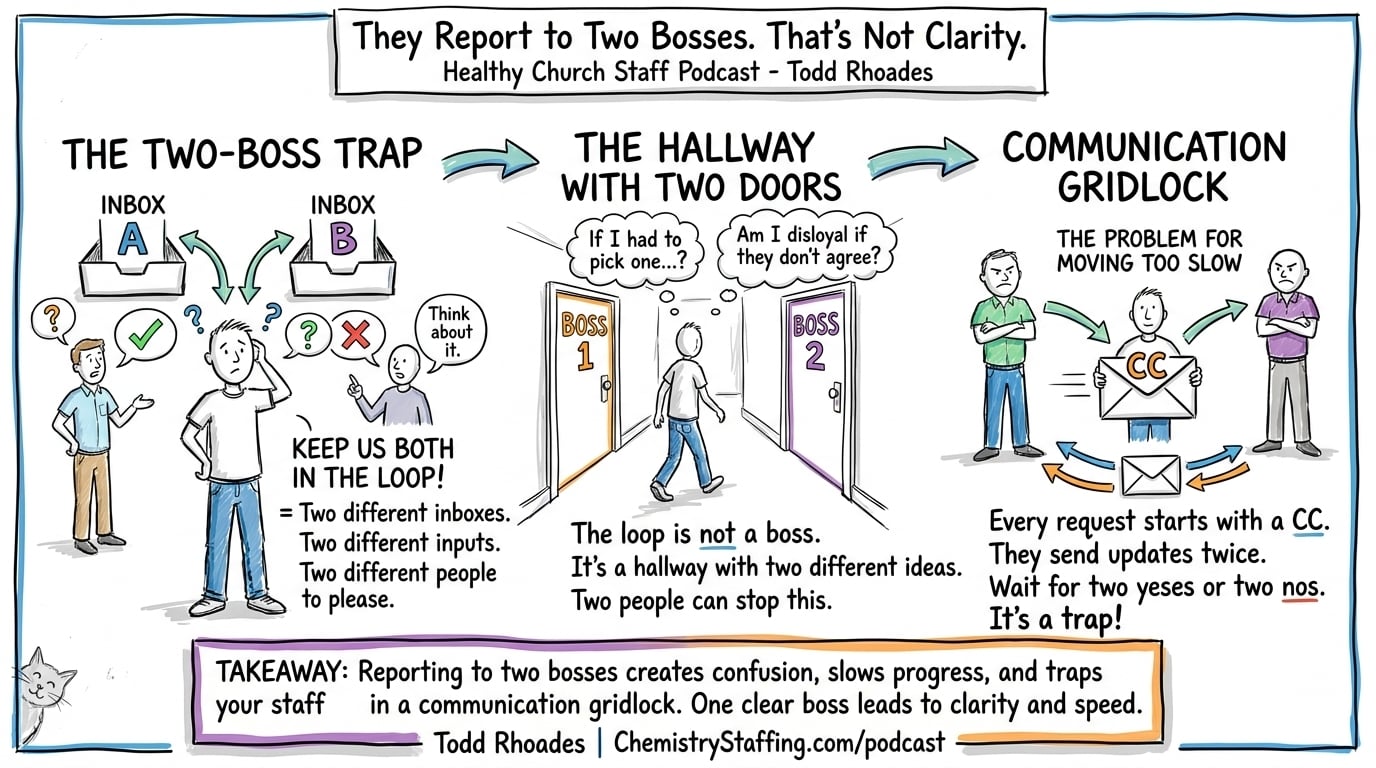
You've seen it happen. A staff member sends an email update to two different leaders. They wait. One responds with "yes, move forward." The other says "let me think about it." Days pass. The project stalls. And somehow, the staff member becomes the problem for "moving too slow."
🎧 Listen to this episode:
Sound familiar?
If you've ever told someone to "keep both of us in the loop," you might have accidentally created something far worse than a communication channel. You've built a trap with two inboxes—and no clear path to a decision.
The "Loop" That's Actually a Trap
Here's what you meant: Let's stay connected. Let's avoid silos. Let's make sure no one feels left out.
Here's what your staff member heard: I have to satisfy two different bosses with two different priorities, and if I pick one, I'm being disloyal to the other.
This isn't about being a control freak or micromanaging. This is about a person on your team who cannot get a clean "yes" to move their ministry forward. And that's costing you more than you realize.
When you tell someone to keep both of you in the loop, you're not creating collaboration. You're creating self-defense. Every email gets carefully worded to avoid picking a side. Every decision gets delayed because they're waiting for alignment that may never come. They spend their week managing you instead of leading their ministry.
"For God is not a God of confusion but of peace. As in all the churches of the saints." —1 Corinthians 14:33 (ESV)
Where This Shows Up on Your Team
Let me paint two scenarios you might recognize:
Scenario 1: The Kids Pastor with Two Bosses
Your kids pastor reports to the executive pastor for day-to-day operations. But they also report to the senior pastor because "kids ministry is too important to have just one line" and "we both care deeply about it."
The org chart got drawn in a meeting and never finished.
So now your kids pastor gets notes from both of you. Different priorities. Different timelines. Different definitions of what a "good Sunday" looks like. When they follow the executive pastor's direction, the senior pastor feels skipped. When they follow the senior pastor, the XP feels undermined.
Your kids pastor isn't confused because they're weak or immature. They're confused because you built two yeses into one job.
Scenario 2: Worship Caught Between Campus and Creative
Your worship leader reports to both the campus pastor and the creative arts director. "Keep both in the loop—we're a team!"
But here's where it gets messy: One wants the room to serve the campus culture. The other wants the room to serve the overall church brand. The worship leader is stuck in the middle, translating between two visions that don't quite align.
They can't satisfy both. So they delay. Or they pick whichever inbox was louder that week.
You call that a maturity issue. It's not. It's a design issue.
Key Principle
When both people can say "yes," both people can also stall. When both can say "no," the staffer never knows which "no" is the real one. Nobody owns the yes. Everybody owns the follow-up.
Why Good Leaders Create This Problem
I know your heart. You weren't trying to create confusion. You were trying to:
- Stay connected across the team
- Avoid ministry silos
- Show care for the person
- Create alignment for the church
- Honor important relationships
Those are decent motives. But dual reporting is not how you accomplish them.
When you split the "yes" between two leaders, you don't create better care—you create paralysis. Your staff member isn't leading kids or worship or students. They're refereeing you. And that's not the teamwork you planned. That's a trap you keep calling collaboration.
"No one can serve two masters, for either he will hate the one and love the other, or he will be devoted to the one and despise the other." —Matthew 6:24 (ESV)
While Jesus was talking about ultimate allegiance, the principle applies here too: divided loyalty creates internal conflict. And that conflict doesn't just frustrate your staff—it stalls your mission.
What Clarity Actually Looks Like
Clarity is one name. Not a committee of two with a shared calendar.
Clarity means one person owns the "yes." One person sets priorities. One person has the authority to say "move forward" without checking with someone else first.
That doesn't mean the other leader gets shut out. It means they don't get a second veto.
Here's the difference:
- Reports to: This is your direct supervisor. They set your priorities, approve your decisions, and evaluate your performance.
- Collaborates with: You work closely with this person. You keep them informed. You value their input. But they don't have authority over your work.
One relationship has decision-making authority. The other has information and influence. Both are important. But they're not the same thing.
Your Action Step This Week
Pick one person on your team with two bosses and end the split.
Don't just promise to "communicate better." Don't schedule another meeting to "get on the same page." Do this:
- Write one sentence: "[Name] reports to [one specific person] who owns decision-making authority for this role."
- Tell both bosses what you've decided and why.
- Tell the staffer the same sentence, same day.
- Clarify collaboration for the other leader: "You're still in the conversation. You don't have veto power."
If you cannot name one decision-maker, you've already named the trap: two inboxes, zero owner of the yes.
Discussion Questions for Your Team
- Does anyone on our team currently have two people they consider their "boss"? What challenges does that create?
- Are there roles where we've created dual reporting "to be fair" or "to honor relationships," even though it might be creating confusion?
- For any unclear reporting relationships, who should be the one supervisor with authority? What other relationships need to be maintained, and how?
- What's one specific step we can take this week to bring clarity to our organizational structure?
The Bottom Line
"Keep both of us in the loop" is not a reporting line. It's not an org chart. It's a trap with two inboxes and nobody who owns the yes.
I know this feels structural. Maybe even uncomfortable. But here's what I also know: you actually want people who can get a clean yes and move their ministry forward. That's why you're reading this.
Your staff aren't slow. They're not immature. They're not avoiding responsibility. They're stuck in a structure that guarantees confusion.
This week, give someone the gift of clarity. Name one decision-maker. Write it down. Tell everyone involved.
Watch what happens when someone can finally move forward without managing two inboxes.
Take the Next Step
Is your church staff structure creating clarity or confusion? Take our free Church Staff Assessment—it takes about 10 minutes and will help you identify areas where your team needs better organizational health.
Got questions about dual reporting or organizational structure at your church? Email me at podcast@chemistrystaffing.com—I'd love to hear your story and help you think through next steps.
—Todd Rhoades
Co-Founder, Chemistry Staffing
Host, Healthy Church Staff Podcast