

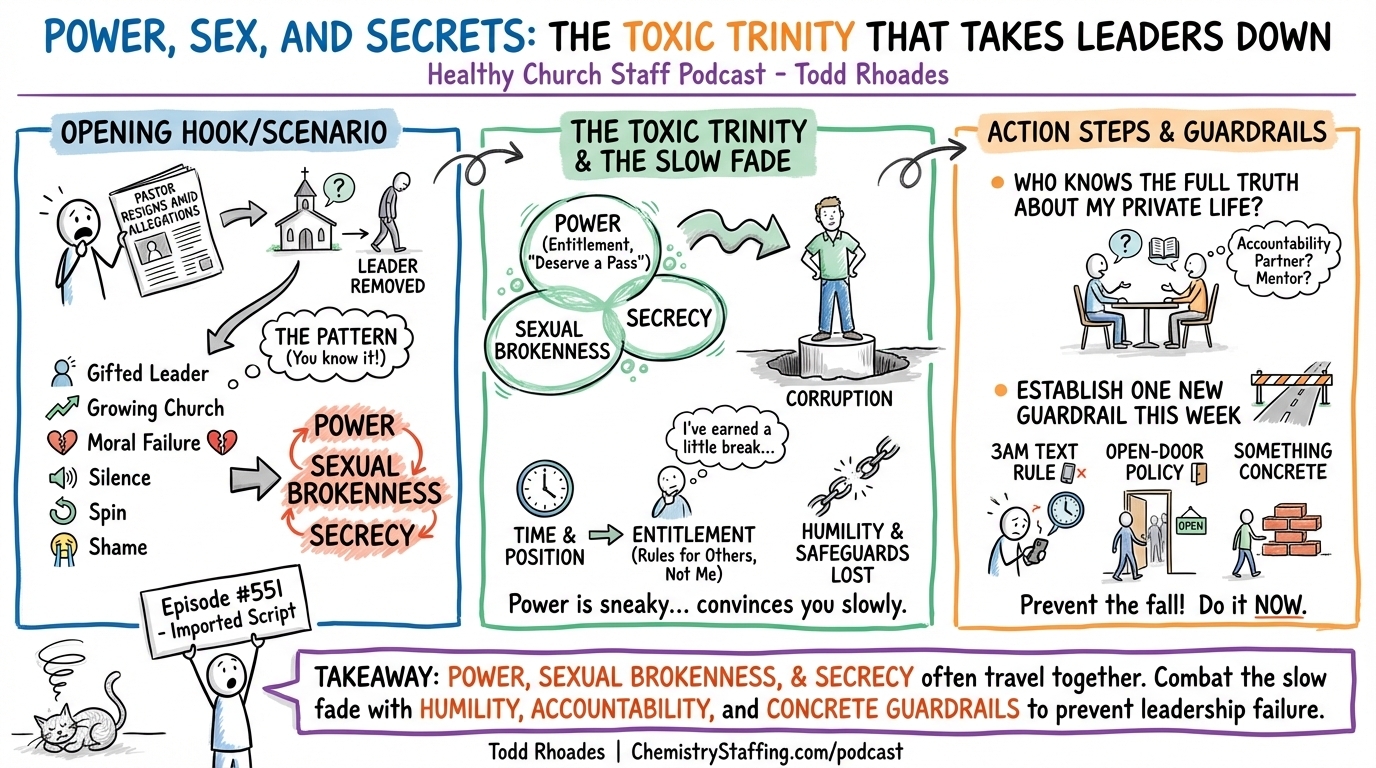
It always feels the same when the headline breaks: "Pastor Resigns Amid Allegations" or "Church Leader Removed After Investigation." You don't need to read the whole article—you already know the pattern.
🎧 Listen to this episode:
A gifted leader. A growing church. A moral failure. Then silence, then spin, then shame on everyone involved.
And underneath it all: power, sexual brokenness, and secrecy. They always travel together like a toxic trinity, leaving destruction in their wake.
As someone who has walked alongside churches through these devastating seasons, I've seen this pattern repeat itself far too often. But here's what I've learned: these failures don't happen overnight. They're the result of a slow erosion that starts with small compromises and grows in the darkness of isolation and unchecked authority.
The good news? This toxic trinity can be stopped before it takes root. Let me show you how.
The First Element: Power Doesn't Corrupt All at Once
Power corruption doesn't happen with a dramatic moment of decision. It's sneaky, convincing you slowly as a leader that maybe you deserve a pass.
Church leadership comes with legitimate spiritual authority, but without humility, safeguards, and accountability, that power quickly transforms into dangerous entitlement. I've watched it happen over and over again.
The longer you're in your position as a pastor or church leader, the more this erosion will stalk you. You'll start thinking, "I've been doing this a long time. I've earned a little break." Suddenly, the rules that apply to everyone else feel like they're meant for other people—or maybe they were necessary in another season, but not where you're at now.
That's the beginning of entitlement, and it's the first crack in your foundation.
"So, if you think you are standing firm, be careful that you don't fall!" - 1 Corinthians 10:12
Scripture never shies away from the danger of unchecked power. When David fell with Bathsheba, the headlines focused on lust, but if you peel back the layers, it was really about entitlement, cover-up, and abuse of position. David had convinced himself that the rules didn't apply to him anymore.
The Second Element: It Rarely Starts With Sex
Here's something that might surprise you: most moral failures don't actually start with sexual sin. That's the headline—the sensational part that gets attention—but it's rarely the beginning of the story.
Instead, these failures start with emotional drift: a little loneliness, a growing ego, hidden pain, an unmet desire to feel truly seen and understood.
The warning signs are often subtle:
- Flirtation that you rationalize as "just being friendly"
- Private messages that feel emotionally intimate
- Sharing marriage frustrations with someone who isn't your spouse
- Seeking validation and comfort in inappropriate relationships
These small steps don't feel scandalous in the moment. They feel natural, even justified. But over time, they quietly build a path toward destruction.
James 1:15 puts it perfectly: "Desire, when it has conceived, gives birth to sin." What starts as an emotional need slowly transforms into something that will cost you everything you've worked to build.
Nobody ever wakes up thinking, "Today's the day I'm going to destroy my family, lose my job, and derail the faith of people who trust my spiritual leadership." But that's exactly where this path leads when left unchecked.
The Third Element: Secrecy Is Always a Warning Sign
In almost every church scandal I've studied, the real issue wasn't just what happened—it was what was allowed to stay hidden.
Churches often protect the wrong person when they say things like:
- "We didn't want to hurt the ministry."
- "We handled it quietly to protect the work God is doing."
- "We thought it was better to deal with this privately."
But protecting the work at the cost of truth isn't wisdom—it's complicity. We've seen this pattern play out repeatedly in high-profile cases where leadership teams knew about problems but chose silence over transparency, thinking they were protecting the ministry.
The more you try to hide something you're doing, the more secrecy should serve as a red flag. When you find yourself thinking, "I hope no one finds out about this," you've already crossed a line.
Scripture Reflection
Proverbs 27:5-6: "Better is open rebuke than hidden love. Wounds from a friend can be trusted, but an enemy multiplies kisses." True accountability requires honest, sometimes difficult conversations from those who care about us.
Breaking the Cycle: Temptation Isn't Disqualifying, But Hiding It Is
Here's something I want you to understand: experiencing temptation isn't a sin, and it's not disqualifying for ministry. Scripture nowhere suggests that being tempted makes you unfit for leadership.
What is dangerous—and potentially disqualifying—is hiding your struggles and trying to handle them alone.
The bravest thing you can do isn't deliver a powerful sermon or lead a successful building campaign. It's telling the truth to someone you trust before the headlines write themselves.
Healthy leaders bring temptation into the light. They build their guardrails now, not after they've already fallen. If you wait until tomorrow to establish boundaries, there might not be a tomorrow—it may already be too late.
Your Action Plan: Building Guardrails That Actually Work
Sin grows in the dark, and so does entitlement and hypocrisy. Here's the bottom line I want you to remember: You are not immune. Neither am I.
Here are your immediate action steps:
This Week's Challenge
- Ask yourself honestly: Who knows the full truth about my private life? Who really knows me—not just my public persona?
- Establish one new guardrail this week: Maybe it's the 3 a.m. text rule, an open-door policy for meetings, or a monthly accountability check-in. Make it concrete and specific.
- Evaluate your current relationships: Are there any connections that have become emotionally inappropriate? Address them now, before they go further.
- Create transparency systems: Build structures that make secrecy difficult and accountability natural.
Remember, the goal isn't perfection—it's protection. We want your private character to match your public ministry, and that happens through intentional safeguards, not willpower alone.
Moving Forward With Hope and Humility
I've shared these hard truths not to discourage you, but to equip you. The church desperately needs leaders who finish well, who maintain their integrity from start to finish, who model what healthy leadership looks like for the next generation.
That can be you, but only if you're willing to acknowledge your vulnerability and build the systems necessary to protect what God has entrusted to your care.
"Therefore confess your sins to each other and pray for each other so that you may be healed. The prayer of a righteous person is powerful and effective." - James 5:16
The toxic trinity of power, secrets, and sexual compromise has taken down too many good leaders. But it doesn't have to take down another one. Not if we're willing to do the hard work of building guardrails, embracing accountability, and choosing transparency over self-protection.
What's your next step? I'd love to hear from you. Send your thoughts, questions, or commitments to podcast@chemistrystaffing.com. Let's work together to help leaders finish well.
Want to Go Deeper?
Take our free leadership vulnerability assessment to identify potential blind spots in your ministry.