

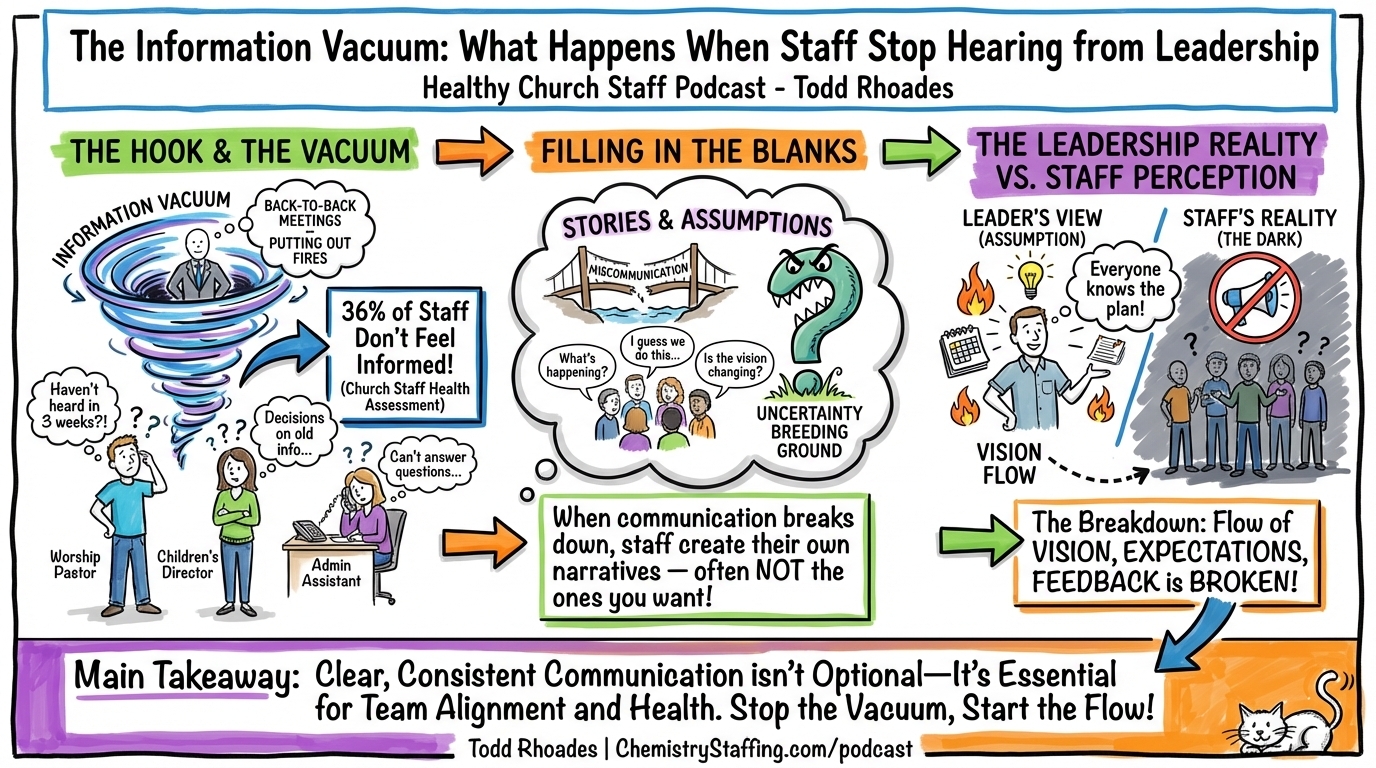
Your worship pastor hasn't heard from you in three weeks. Your children's director is making decisions based on a conversation from two months ago. Your administrative assistant is fielding questions she can't answer because she doesn't know what you're thinking.
🎧 Listen to this episode:
Meanwhile, you're in back-to-back meetings, putting out fires, assuming everyone knows what's happening. But here's what you don't see: they're filling in the blanks themselves, and the stories they're creating aren't the ones you'd want them to tell.
If this scenario sounds painfully familiar, you're not alone. Our annual Church Staff Health Assessment revealed a startling discovery: 36% of church staff don't feel they're kept informed about important decisions affecting their church. That's more than one in three team members operating in an information vacuum.
The Dangerous Vacuum Effect
Here's a truth that might surprise you: information doesn't just disappear—it gets replaced. When your staff don't hear from leadership, they don't sit quietly waiting for updates. Instead, they start connecting dots that may not actually connect, filling the silence with assumptions that can be far more damaging than the reality you're navigating.
Think about it from their perspective. That budget conversation from last month where you mentioned finances were "tight"? Without follow-up communication, they're still wondering if their position is safe. The vision casting meeting from January where you outlined ambitious plans? If nothing's been said since, they're questioning whether those dreams have quietly died.
"Where there is no revelation, people cast off restraint; but blessed is the one who heeds wisdom's instruction." - Proverbs 29:18 (NIV)
This is where communication breakdowns become dangerous. In the absence of clear information, your team starts writing their own stories: "If it was important, they would have told us." "They must not trust us with the real information." "Maybe the church is in worse shape than we thought."
Your staff aren't being dramatic—they're being human. And here's the kicker: silence feels like secrecy, even when it's just busyness.
Why Good Leaders Create Communication Voids
Now, before you start feeling defensive, let me be clear: most church leaders aren't intentionally keeping their staff in the dark. You're not trying to create anxiety or uncertainty. The reality is simpler and more relatable—you're drowning.
You're drowning in decisions, drowning in details, and drowning in the daily demands of leadership. You have genuinely good intentions when it comes to communication. You think about updating your team. You plan to send that email. You mean to circle back after that board meeting.
But here's the hard truth: your good intentions don't change their reality. Their reality is they haven't heard from you.
The Stories They Tell Themselves
In our assessment responses, we heard from staff who shared their internal narratives during communication droughts:
- "I wonder if they're planning to cut staff and just haven't told us yet."
- "That big initiative must have failed since no one's mentioned it in months."
- "Leadership probably thinks we can't handle the truth about our financial situation."
- "I must not be important enough to be kept in the loop."
These aren't unreasonable conclusions—they're predictable human responses to information scarcity. When people don't know what's happening, they assume the worst-case scenario to protect themselves emotionally.
Discussion Question
Think about the last month—when did you feel most "in the loop" about what's happening in your church, and when did you feel most disconnected? What made the difference?
The Information Flow Fix
So how do you bridge this communication gap? It's simpler than you might think, but it requires intentionality. Here's what I call the Information Flow Fix:
1. Over-Communicate the Obvious Stuff
This bears repeating: what feels repetitive to you feels reassuring to them. That budget update you shared last month? Your team would benefit from hearing it again. The vision you cast in January? It needs to be reinforced regularly, not just announced once.
Don't assume your staff remember everything you've communicated. They're juggling their own full plates of responsibilities and concerns. Regular reinforcement of key messages isn't redundancy—it's leadership.
2. Share the Why Behind Decisions
Don't just communicate what you've decided; help your team understand your reasoning. When staff understand the "why" behind changes, they're far more likely to support and effectively implement those changes.
Instead of: "We're adjusting the worship service schedule."
Try: "We're adjusting the worship service schedule because we've noticed families with young children struggling with the later service time, and we want to better serve their needs while maintaining our community focus."
3. Give Them Intel on Your Thinking
Here's a game-changer: communicate about decisions you're considering, not just decisions you've made. This approach builds trust and helps your team feel included in the process rather than just informed of outcomes.
Try something like: "Hey team, I'm exploring some budget adjustments for next quarter. Nothing's decided yet, but I wanted you to know it's on my radar. I'll keep you updated as things develop."
"For God is not a God of disorder but of peace—as in all the congregations of the Lord's people." - 1 Corinthians 14:33 (NIV)
4. Create Predictable Communication Touchpoints
Consistency matters more than frequency. Whether it's a weekly email, monthly huddle, or quarterly vision check, establish regular communication rhythms and stick to them. Your staff need to know when they can expect to hear from leadership.
These touchpoints don't need to be lengthy or formal. Even a brief weekly update covering current priorities, upcoming decisions, and general organizational health can dramatically improve your team's sense of connection and clarity.
The Power of Connected Teams
When you get communication right, the transformation is remarkable. Staff who know what's happening make better decisions in real-time. They can anticipate needs instead of constantly reacting to surprises. They feel trusted with the mission, not just tasked with their job descriptions.
Connected staff stop spending mental energy on uncertainty and redirect that energy toward ministry impact. They become proactive rather than reactive, confident rather than anxious, aligned rather than confused.
Remember: information isn't power you hoard—it's fuel you distribute. When you share context, reasoning, and vision with your team, you're not giving up control; you're multiplying your leadership impact.
Action Items for This Week
- Schedule a brief weekly "pulse check" meeting (15-20 minutes) for leadership to share current priorities
- Create a shared digital space for quick updates between formal meetings
- Establish regular "communication office hours" when staff can ask questions
- Identify the last meaningful update you gave your team—if it's been over two weeks, schedule 30 minutes for an information download
The Bottom Line
Here's what our research confirmed: silence from leadership doesn't create peace—it creates anxiety. And anxious staff make decisions from fear, not faith.
Your team wants to be on mission with you, but they can't follow a leader they can't hear from. They're not asking for perfect communication or constant updates on every minor detail. They're asking to be trusted with the information they need to serve effectively and to feel valued as partners in ministry rather than just employees executing tasks.
Communication isn't just about preventing problems—though it certainly does that. It's about unleashing the full potential of your team by giving them the context, confidence, and clarity they need to excel in their roles.
Your Challenge This Week
Take an honest inventory of your recent communication patterns. When did you last meaningfully update your team on vision, budget, or organizational direction? If it's been more than two weeks, don't wait for a crisis to prompt communication. Schedule time this week to give your team an information update—not because something's wrong, but because connection requires intentional communication.
Keep that information flowing, and watch how it transforms not just your staff's confidence, but their contribution to your church's mission.
This insight about communication breakdown is just one of ten key discoveries from our annual Church Staff Health Assessment. Over the past three years, more than 3,000 church staff members have participated, giving us unprecedented insight into what's really happening in church staff culture across the country.
What's your experience with communication challenges on your team? Have you seen the vacuum effect in action? What communication strategies have worked best in your context? I'd love to hear from you—send your thoughts to podcast@chemistrystaffing.com.