

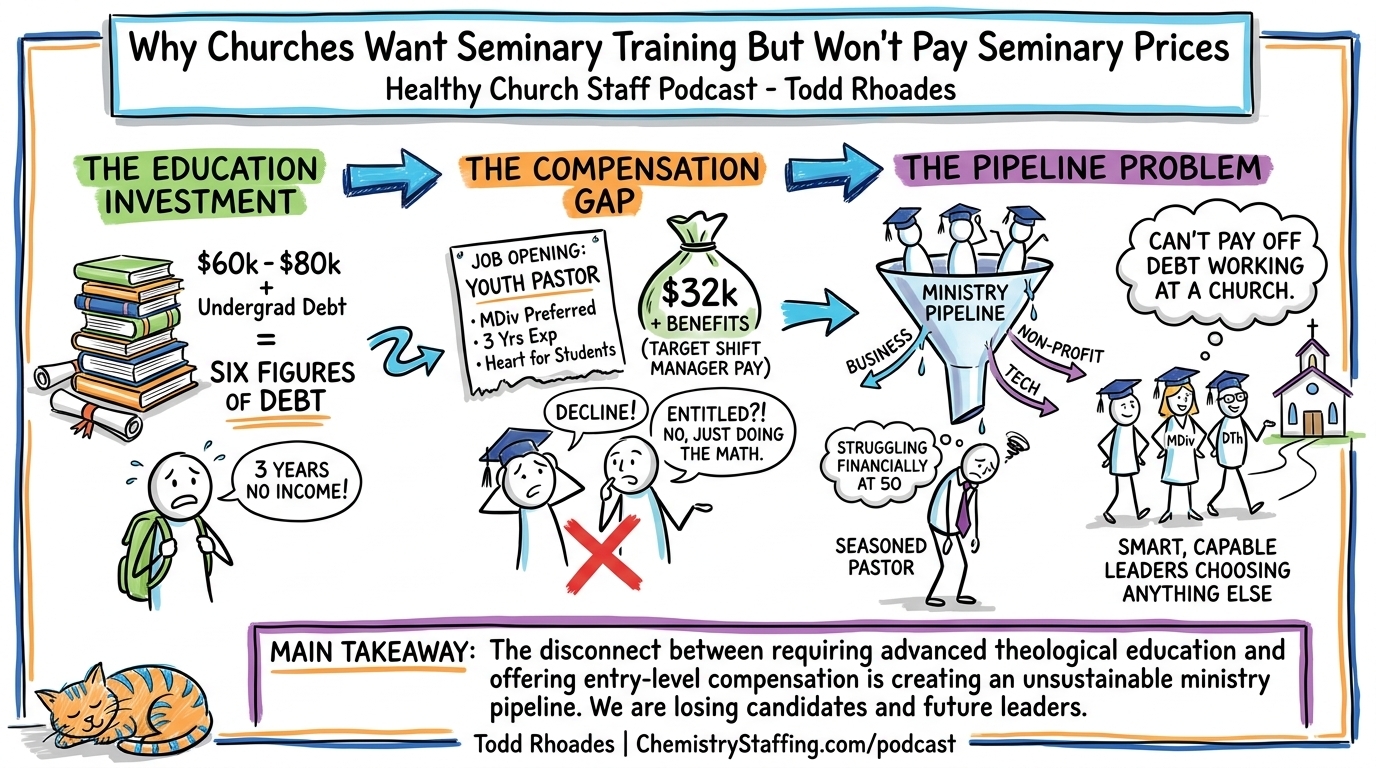
You post a job opening for a youth pastor. The requirements seem reasonable: Master of Divinity preferred, three years of experience, and a genuine heart for students. The salary? $32,000 plus benefits.
🎧 Listen to this episode:
You get twelve applications. Two candidates are actually qualified. Both decline your offer.
You're frustrated. Maybe even a bit annoyed. They seemed entitled, right? They just don't have the servant's heart your church needs.
But what if I told you the problem isn't their attitude—it's your math?
The Seminary Math That Doesn't Add Up
Let's talk about what you're actually asking for when you require or prefer a seminary degree.
The average seminary degree today costs between $60,000 and $80,000. That's three years of intensive study—three years when most students earn little to no income, or perhaps cobble together part-time work while carrying a full academic load.
And here's the kicker: most seminary students aren't starting from zero. They're bringing undergraduate debt with them. We're talking six figures of educational debt, easily, before they ever step into their first ministry role.
Then you offer them what a shift manager at Target makes and wonder why they're not jumping at the opportunity.
I'm not trying to be harsh here. I know your heart. You want qualified leaders who can handle Scripture well, who understand theology, who've been trained to shepherd God's people. Those are good desires.
But we've created an impossible equation.
The Pipeline Problem You're Creating
Here's what keeps me up at night: You're not just losing individual candidates. You're losing an entire generation of future leaders.
These are smart, capable people who have genuinely been called to ministry. They've invested years preparing to serve churches just like yours. They've sat through Greek and Hebrew classes, studied systematic theology, learned pastoral counseling techniques, and developed their preaching skills.
But they're also doing the math.
They're watching seasoned pastors struggle financially at age 50. They're seeing ministry families choose between paying the electric bill and buying groceries. They're calculating how long it would take to pay off $100,000 in debt on a $35,000 salary.
And increasingly, they're choosing business. Or nonprofit work. Or tech. Or literally anything else.
The people you most want in ministry are often the ones smart enough—and responsible enough—to avoid it under current conditions.
1 Timothy 5:17-18 - "The elders who direct the affairs of the church well are worthy of double honor, especially those whose work is preaching and teaching. For Scripture says, 'Do not muzzle an ox while it is treading out the grain,' and 'The worker deserves his wages.'"
The Reality Check Your Church Actually Needs
Now listen—I know your heart is right. You want qualified leaders for your church. Your budget is what it is. I get it. I really do.
But somewhere along the way, we need to get honest about what we're asking for and what we're willing to offer. Here's what that reality check looks like:
Stop Requiring Degrees You Won't Fund
If you want an M.Div, you need to pay M.Div prices. It's that simple.
If you can't pay M.Div prices (and many churches genuinely can't), then hire for character and calling, and coach up the skills. Potential over pedigree. Always.
I'd rather see you bring on someone with a bachelor's degree who's hungry to learn, who loves Jesus, and who has a genuine calling to your ministry context, than require credentials you can't properly compensate.
Create Apprenticeship Pathways
What if instead of requiring expensive degrees, your church developed its own training pipeline?
Partner with other churches to fund internships that actually pay a living wage. Create mentorship programs where your seasoned leaders pour into emerging leaders. Invest in online training and certificate programs that cost a fraction of traditional seminary.
The early church didn't have seminaries. They had Paul and Barnabas taking Timothy and John Mark under their wings. Sometimes the old ways have something to teach us.
Have the Hard Conversation With Your Congregation
Here's something I've learned after years in church staffing: Your congregation has no idea what seminary costs.
Most church members assume getting a ministry degree is like getting a teaching certificate or a nursing credential—a year or two of school, maybe $20,000 tops. When you actually explain the real numbers to your search committee or your board, they're genuinely shocked.
And here's the good news: Most would rather fund the right person than require the wrong degree. But they need you to lead that conversation. They need you to paint the picture of what you're actually asking young leaders to sacrifice.
Questions for Your Leadership Team
- What educational credentials do we currently require or prefer for ministry positions?
- How does our compensation structure reflect the investment we're asking people to make?
- If we audited our church budget, what does it reveal about our actual priorities regarding staff development and compensation?
- Are our current requirements unintentionally limiting the diversity of our leadership or excluding qualified candidates?
The Bottom Line
You can't demand Lexus qualifications and offer Honda compensation. Eventually, you'll end up driving alone.
I was on the phone recently with a church leader who was preparing to hire a youth pastor. I told him straight up: "The days of hiring a $35,000 youth pastor are over."
He nodded along. We talked about it for ten minutes. Then I asked him, "So what's your budget for this role?"
"$35,000," he said.
Friends, if you find someone who's willing to take a full-time ministry role at that salary—especially with educational debt—it's probably not going to be a long-term situation. Three months, six months, a year in, the math isn't going to work when they can't pay their bills. And you'll be back to square one, except now you've also disrupted your ministry and disappointed your people.
Your Challenge This Week
I want you to do something specific this week. Pull up every job description your church has posted in the past two years. Look at the educational requirements. Look at the compensation.
Then ask yourself this question: "If I were carrying the debt load we're requiring, would I take this job?"
If the answer is no, you need to change one of two things: the requirements or the pay. Don't blame the person for making a responsible decision.
Action Steps You Can Take Today
- Conduct a compensation audit: Compare your ministry position salaries against local cost-of-living standards and typical educational debt for your required credentials.
- Review position descriptions: Identify which educational requirements are truly essential versus preferential.
- Explore student loan assistance: Even $100-200/month in educational debt repayment can make a meaningful difference and shows you understand the burden.
- Research alternative training: Investigate apprenticeship models, online certificate programs, or seminary partnerships that provide quality education at lower cost.
- Present to your board: Schedule time in the next quarter to share these findings with your church leadership.
Make the Math Work, and the Ministry Will Follow
Your church deserves great leaders. And great leaders deserve honest compensation.
We can't keep asking people to make investments we're not willing to honor. We can't keep requiring credentials we won't properly fund. We can't keep wondering why the pipeline is drying up when we've made the entry point financially impossible for responsible adults.
This isn't about entitlement. It's about sustainability. It's about stewardship. And ultimately, it's about whether we're serious about raising up the next generation of ministry leaders or just paying lip service to the idea.
The good news? You can change this. Maybe not overnight, but you can start having different conversations. You can begin making different decisions. You can lead your church to a better way.
Luke 10:7 - "Stay there, eating and drinking whatever they give you, for the worker deserves his wages."
I realize I might have stepped on some toes today. Maybe you think I'm off my rocker. Or maybe you think I'm onto something, but you have no idea how to deal with this in your specific context.
Either way, I'd love to hear from you. Send me your thoughts at podcast@chemistrystaffing.com. And if you need help thinking through compensation strategy for your next hire, my team at Chemistry Staffing would be honored to walk alongside you.
Because at the end of the day, we're all after the same thing: healthy churches led by called, capable, and properly supported leaders.
Want to discuss these issues with your team? Email us for a free discussion guide based on this article.