

Jason never set out to build a platform.
🎧 Listen to this episode:
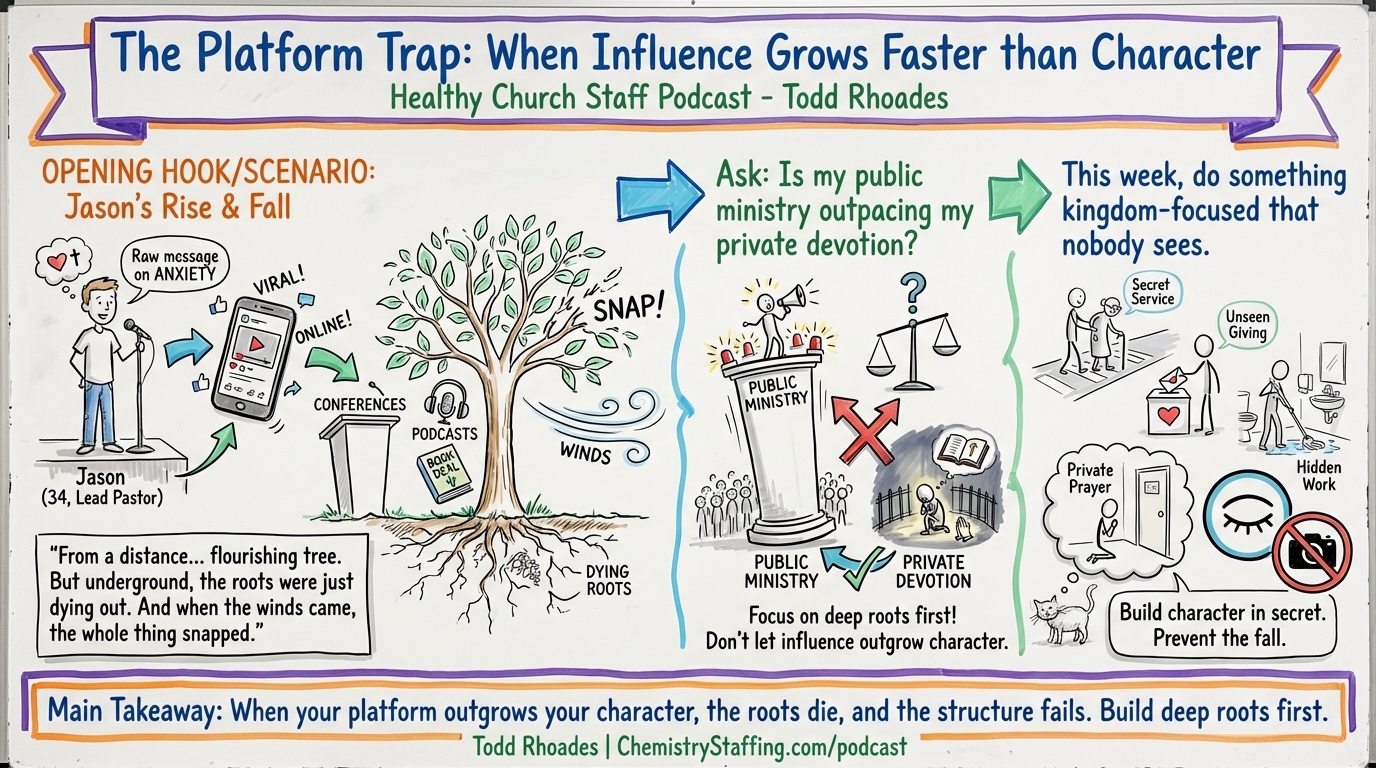
He was 34, a young lead pastor with decent communication skills. Then one Sunday, he preached a raw, vulnerable message about anxiety. Someone clipped it and posted it online. It went viral.
Suddenly, the invites started pouring in—conferences, podcasts, eventually a book deal. From a distance, it looked like a flourishing tree. But underground, the roots were slowly dying. When the inevitable winds came, the whole thing snapped.
If you've been in ministry for any length of time, you've probably seen this story play out. Maybe you've even felt the early warning signs in your own leadership journey. The uncomfortable truth is that some of ministry's most devastating failures happen not because leaders set out to fall, but because their influence grew faster than their character could sustain.
The Seductive Pull of the Ministry Spotlight
Here's what makes the platform trap so dangerous: the spotlight feels good, and that's exactly the problem.
Most pastors don't enter ministry dreaming of becoming spiritual celebrities. They genuinely want to serve Jesus and shepherd people. But once the attention starts—once you're seen, respected, and wanted—it becomes incredibly hard to look away.
If you've spent years quietly laboring in ministry, suddenly having people line up to hear you speak can feel like justice. Like you've finally "arrived." But here's the harsh reality: it's not arrival. It's a dopamine hit dressed in spiritual language.
What you end up with is affirmation without intimacy and applause without accountability—a toxic combination that can slowly erode the very foundations that should support sustainable ministry.
"The crucible for silver and the furnace for gold, but people are tested by their praise." - Proverbs 27:21 (NIV)
When Talent Becomes a Liability
Here's a hard truth that might sting: some leaders are simply too talented for their own good.
These are the pastors who can fill a room, move a crowd, and communicate with incredible power and clarity. Their messages go viral. Their conferences sell out. Their books become bestsellers.
But behind the scenes? They're often depleted, insecure, and completely isolated.
The tragedy is that because the external fruit looks so good—the big crowds, the viral clips, the growing influence—nobody thinks to check the soil. We have a dangerous tendency in church culture to elevate the most talented rather than the most tethered. We praise results while overlooking roots.
During my decade working with larger churches, I witnessed this pattern repeatedly. Some of the most gifted leaders I worked with are still thriving in ministry today. Others... well, their character simply couldn't keep pace with their platform, and when the winds came, everything collapsed.
The Celebrity Pastor Problem
Let's be honest about recent history: celebrity is a terrible pastor.
Look at the pattern over the last 15-20 years. Mars Hill. Hillsong. Willow Creek. Gateway. In each case, the leader became the brand, and once that brand cracked, everything around it crumbled.
These churches didn't just lose a pastor—they lost trust, momentum, and in many cases, people lost faith in the church entirely. The ripple effects are still being felt in communities around the world.
Here's what's particularly tragic: most of those fallen leaders didn't set out to become celebrities. They were simply gifted communicators who, over time, became unguarded.
Discussion Questions for Your Team:
- When you think about your current level of influence in ministry, do you feel your character is keeping pace? Where do you sense gaps?
- How do we as a staff team help each other stay grounded when ministry success or recognition comes our way?
- What are some practical warning signs we could watch for that might indicate influence is outpacing character?
Learning from Jesus: The Ultimate Platform Rejection
If you want to see how to handle a platform correctly, look no further than Jesus himself.
Jesus had crowds following him everywhere—so many that he had to get in a boat and speak from the middle of a lake. He had influence. He had a platform. But notice what he did with it:
- He regularly withdrew to lonely places
- He delegated authority to others
- He told people to keep quiet about his miracles
- He walked away from applause
Jesus didn't need to be seen to feel secure. So why do we?
"He must not be a recent convert, or he may become conceited and fall under the same judgment as the devil." - 1 Timothy 3:6 (NIV)
The Soul Wasn't Built for the Spotlight
Here's the bottom line that every church leader needs to hear: your soul wasn't built for the spotlight. You were called to shepherd, not to perform.
This doesn't mean you should never speak at conferences or write books or have influence beyond your local church. But it does mean you need to be incredibly intentional about maintaining the health of your inner life as your outer influence grows.
The question every leader needs to regularly ask themselves is this: Is my public ministry outpacing my private devotion?
Practical Steps to Avoid the Platform Trap
If you're sensing that your influence might be growing faster than your character, here are some immediate steps you can take:
Action Items for This Week:
- Do something kingdom-focused that nobody sees - Find a way to serve that only you and Jesus will know about
- Schedule monthly character check-ins - Meet regularly with an accountability partner or mentor
- Identify character development areas - Pick one specific area and find resources to address it
- Create team covenant - Establish how your staff will speak into each other's lives when concerning patterns emerge
- Practice "platform pause" - Take time to pray and reflect before accepting new speaking opportunities
Building Ministry That Lasts
The goal isn't to eliminate all platform or influence—it's to ensure that your character development keeps pace with your influence growth. Sustainable ministry requires deep roots, not just impressive fruit.
Remember, when church leaders fall, the consequences extend far beyond personal embarrassment or career loss. The damage to people's faith, to your church community, and to the broader witness of the gospel can be immeasurable.
But here's the encouraging news: these failures are largely preventable. With intentional character development, authentic accountability, and a commitment to the inner life, you can build ministry that not only grows but endures.
"So, if you think you are standing firm, be careful that you don't fall!" - 1 Corinthians 10:12 (NIV)
Your calling is too important and the stakes are too high to leave character development to chance. The people you serve deserve leaders whose private devotion matches their public platform.
What's your next step? I'd love to hear how you're working to keep your character development aligned with your ministry influence. Email me your thoughts at podcast@chemistrystaffing.com.
This post is part of a series based on my book "When the Church Falls." If you want to assess where you or your church might be vulnerable, grab the free assessment at whenthechurchfalls.com/assessment.