

You had the idea about three months ago. It was good—really good. Your team got excited, people started talking about it, and then something happened. It hit that invisible wall.
🎧 Listen to this episode:
You know the one I'm talking about. The place where good ideas go to die in your church.
It's not about the money. It's not about timing. It's something deeper—something systemic. And if you're honest, it seems like it happens every single time.
Most churches have an invisible system that's designed to kill new ideas. It's not intentional—nobody planned it. But it's there, and believe me, it's working perfectly. Every time innovation tries to breathe, that system suffocates it through the same three barriers, the same three choke points.
Your staff has learned to expect it, and they're making decisions about their future based on it.
The Hidden Architecture of "No"
What makes this so frustrating is that nobody woke up wanting to kill innovation. In fact, most church leaders would say they want more creativity, more fresh thinking, more solutions to the challenges they face every day.
But here's what I've learned after years of working with church staff: systems always win over good intentions.
While you're saying "We need more innovation," your church's invisible infrastructure is quietly communicating the opposite message. Your staff stops bringing ideas because they've learned that the system rewards safe, not innovative.
The Three Innovation Killers
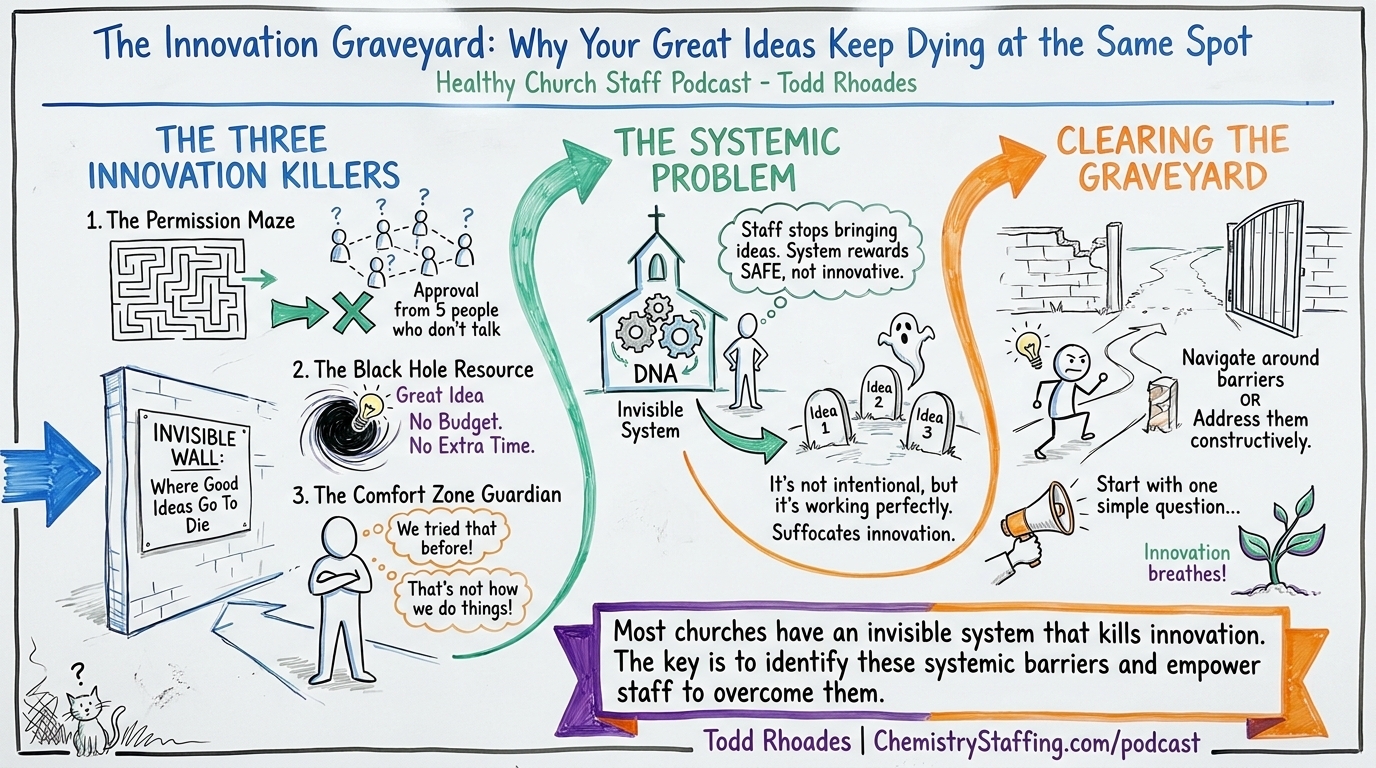
Let me show you the three barriers that are likely strangling creativity in your church right now:
1. The Permission Maze
Your idea needs approval from five different people who don't even talk to each other. There's the board member who needs to sign off on anything involving the building. The worship pastor who has to approve anything touching Sunday morning. The children's director who guards family programming. The treasurer who controls the purse strings. And the senior pastor who wants final say.
Each gatekeeper has legitimate concerns, but together they create a maze so complex that most ideas die from exhaustion before they ever get a fair hearing.
2. The Resource Black Hole
"Great idea! Now figure out how to do it with no budget and no extra time."
Sound familiar? This is where churches ask staff to be innovative while simultaneously removing every tool innovation requires. It's like asking someone to cook a gourmet meal with an empty pantry and no stove.
3. The Comfort Zone Guardian
There's always that one person who shows up to every brainstorming session armed with reasons why new ideas won't work. "We tried that before." "That's not how we do things." "Our people won't go for that."
Sometimes this guardian is a board member, sometimes it's a long-time volunteer, and sometimes (if we're being really honest) it's us.
Proverbs 15:22 (NIV): "Plans fail for lack of counsel, but with many advisers they succeed." Great ideas need the right support system to survive and thrive—not barriers that prevent them from getting proper counsel.
How to Clear Out the Graveyard
If you're recognizing your church in this description, don't panic. The same systematic approach that creates innovation graveyards can be redirected to create innovation gardens. Here's how:
Start with the Diagnostic Question
Ask yourself: "What's the last good idea that actually happened here?" If you can't answer that quickly, you probably have a systemic problem that goes deeper than you realized.
Map the Permission Maze
Take your last major initiative and write down every approval it needed. Who had to say yes? How long did each step take? Where did it get stuck? You'll be amazed at how complex your system has become without anyone planning it that way.
Ask Your Staff the Hard Question
"What stops you from suggesting new ideas?" Listen carefully to their answers. They've been navigating your system longer than you might think, and they can show you exactly where the barriers are.
Create One Innovation Pathway
Don't try to fix everything at once. Instead, create one clear path that bypasses the usual gatekeepers for small experiments. Give someone permission to say yes to pilot projects under a certain budget threshold.
Set a "What If" Budget
Even $500 can change everything. When staff know there's money available for testing ideas, they start thinking differently about what's possible.
Discussion Questions for Your Team:
- What's one great idea you've seen die in our church? Where did it get stuck?
- What are our top 3 systemic barriers that tend to kill good ideas?
- How can we become better "idea midwives"—helping birth and nurture innovations rather than accidentally killing them?
What's Really at Stake
Here's what keeps me up at night: your best staff members are watching this process. They're deciding whether your church is a place where ideas can live or where ideas go to die.
The innovative ones will leave if the graveyard keeps growing. You'll be left with people who have accepted that "we don't do new things here." That's not a staff culture—that's a staff cemetery.
Your church needs the ideas that your staff isn't sharing yet. They're holding back solutions to problems you don't even know you have. They're keeping quiet about improvements that could transform how you reach people, care for members, and make disciples.
Ecclesiastes 3:1 (NIV): "There is a time for everything, and a season for every activity under the heavens." Sometimes our timing or approach needs adjustment, not our vision.
Your Innovation Audit Challenge
This week, I want you to audit your innovation graveyard. Ask three staff members: "What's a good idea you had that never happened?" Then ask the crucial follow-up: "What stopped it?"
You'll discover that your church's invisible barriers are more visible than you think—you're just not naming them out loud.
Action Steps to Take This Week:
- Map your innovation process - Create a simple flowchart showing how ideas typically move through your church
- Establish idea champions - Assign staff members to help shepherd promising ideas through your system
- Start an "idea parking lot" - Create a place to capture good ideas that aren't ready now but shouldn't be forgotten
- Schedule monthly idea check-ins - Add 10 minutes to staff meetings for innovation health discussions
The Bottom Line
Innovation doesn't die from lack of ideas—it dies from systems that strangle them before they can breathe. But here's the encouraging truth: the same systematic thinking that creates graveyards can create gardens.
Your church has everything it needs to become a place where good ideas thrive. It starts with recognizing the barriers that have been hiding in plain sight and making the intentional choice to clear the path.
Your community needs the innovation your team isn't sharing yet. Clear the path and watch what happens.
What barriers have you identified in your church's innovation process? I'd love to hear about your experience clearing out the graveyard. Send your thoughts to podcast@chemistrystaffing.com—I read every email and your insights might help another church leader breakthrough their innovation barriers.