

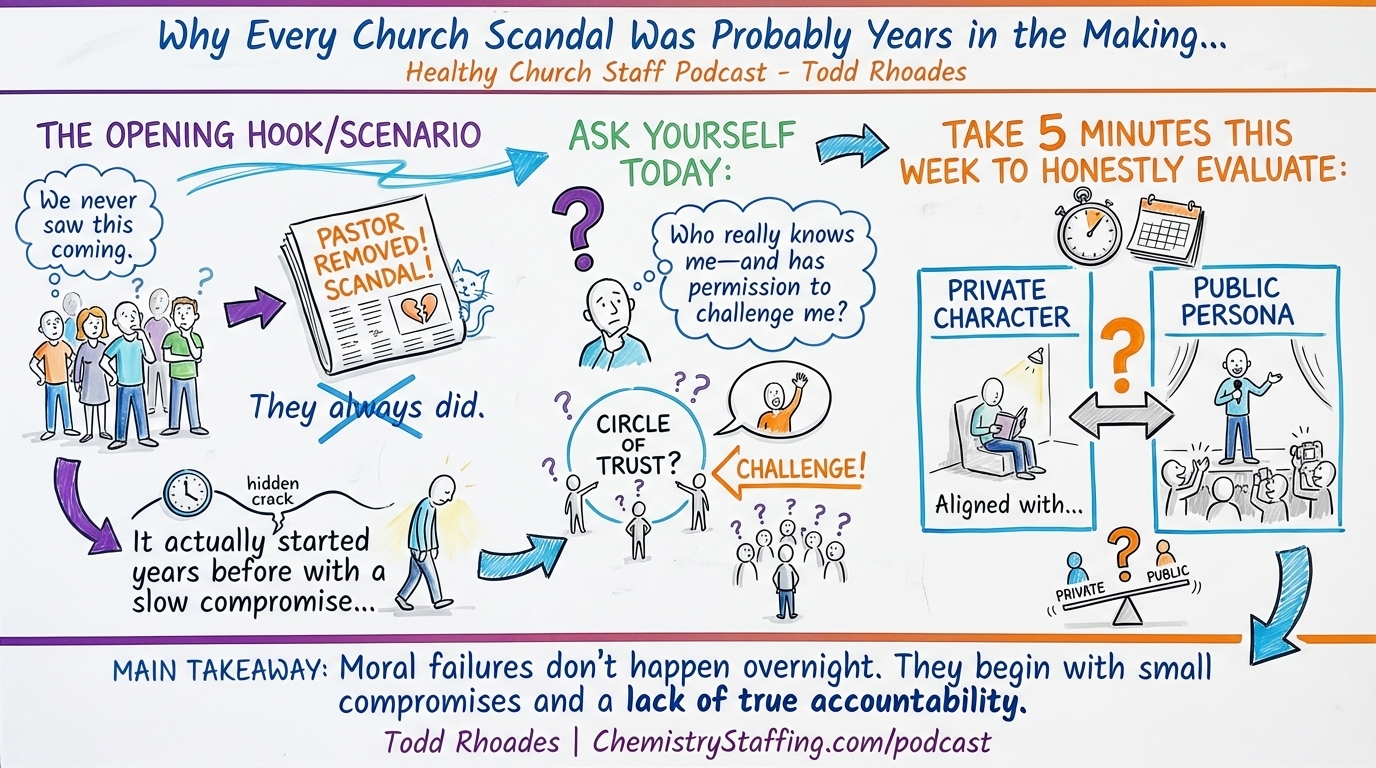
We never saw this coming.
🎧 Listen to this episode:
That's what they always say when another church leader falls from grace. But here's the uncomfortable truth: they did see it coming. They always did.
That headline you read last month about the pastor who was removed? That scandal that "shocked everyone"? It didn't start when the story broke. It actually started years before—with slow compromises that nobody wanted to name.
After 25 years in ministry and helping churches navigate these crises, I've learned something crucial: if we wait until there's a headline, we've already waited too long.
The Erosion Pattern: Why Leadership Failure Looks Like Geology, Not Lightning
We're naturally drawn to the drama—the explosive fall that seems to come out of nowhere after 30 years of faithful ministry. But the reality is that collapse rarely works that way.
Leadership failure happens more like erosion than lightning. It's slow. It's quiet. It's often almost invisible.
Here's how it typically unfolds:
- A leader gradually pulls back from real relationships
- Honest feedback stops flowing
- Rest becomes an unaffordable luxury
- Nobody asks how the pastor is really doing anymore
- Small compromises become patterns
Nobody wakes up as a pastor and says, "Today I'm going to do something really stupid." But over time, little decision by little decision, it happens. And that erosion, when it's happening behind the scenes, is hardly noticeable.
The Dangerous Paradox: When Success Masks Spiritual Decline
Here's the most dangerous part of this pattern: erosion often looks like success from the outside.
A ministry can be growing exponentially while a leader's soul is shrinking. There can be bigger crowds, bigger budgets, and more influence—all while the person at the center is quietly unraveling personally and spiritually.
This is the trap that catches so many leaders off guard. We mistake momentum for maturity, but they are absolutely not the same thing.
The Warning Signs: When external growth masks internal decline, look for leaders who seem increasingly isolated, defensive about feedback, or who measure success only in numbers rather than spiritual fruit.
The statistics are sobering. According to Barna research, only one in five pastors rate their mental and emotional health as excellent. That means four out of five ministry leaders are struggling—yet the shell often looks healthy while the roots are slowly drying out.
The Silence That Kills: Why We Don't Speak Up
In healthy environments, people name their concerns early and constructively. But too often, church cultures end up protecting the leader instead of protecting the people.
Here's what typically happens:
- Staff members fear being labeled as disloyal
- Board members assume the best without asking hard questions
- Congregation members don't want to believe anything could be wrong
Over time, any natural questioning that should happen between boards, staff, and leaders becomes viewed as disloyalty. The result is a slow drift toward collapse with nobody willing or able to stop it.
Scripture Reflection:
1 Corinthians 10:12 - "So, if you think you are standing firm, be careful that you don't fall!"
This reminds us that spiritual pride and overconfidence can lead to our downfall. The moment we think we're immune to failure is often when we're most vulnerable.
Pinpointing the Beginning: When Does It Really Start?
I've spent years analyzing leadership failures, trying to identify the precise moment when things begin to go wrong. While every situation is unique, I've noticed some common starting points:
It begins when a leader stops paying attention to their soul. This happens when self-awareness gives way to self-preservation, when being vulnerable feels too risky, and when image management becomes more important than integrity.
It accelerates when nobody feels safe enough to ask the hard questions. When challenging conversations become impossible, when accountability feels like attack, and when loyalty is defined as never disagreeing.
It becomes inevitable when a church mistakes momentum for maturity. When growth numbers become the primary measure of spiritual health, and when success metrics replace spiritual formation.
Creating a Culture of Healthy Accountability
Prevention is always better than crisis management. Here are practical steps every church can take:
For Individual Leaders:
- Regularly ask yourself: "Who really knows me and has permission to challenge me?"
- Evaluate honestly: Is your private character still aligned with your public persona?
- Create space for people to give you difficult feedback without fear of retaliation
For Church Boards:
- Ask hard questions regularly, not just during crises
- Focus on character development, not just ministry performance
- Create systems for early intervention, not just damage control
Discussion Questions for Your Team:
- How comfortable do we feel giving and receiving constructive feedback with each other?
- What are some "small compromises" that ministry leaders might be tempted to make?
- What systems do we currently have in place to catch problems early?
- If we wanted to create a culture where staff feel safe being vulnerable about struggles, what would need to change?
Taking Action Before the Headlines
The goal isn't to create a culture of suspicion or micromanagement. It's to build healthy environments where leaders can thrive spiritually while serving effectively.
Here are immediate steps you can take:
Action Steps:
- □ Each staff member identifies one trusted person for monthly personal accountability
- □ Schedule quarterly check-ins focused on spiritual health, not just performance
- □ Create clear policies around common temptation areas
- □ Establish confidential ways for concerns to be raised
- □ Plan a team retreat focused on personal spiritual formation
- □ Review and strengthen background check procedures
The Heart Behind the Warning
This isn't about creating fear or suspicion. It's about love—love for our leaders, our churches, and the Kingdom of God. I'm tired of reading the headlines. I'm tired of seeing churches pick up the pieces. And I'm tired of watching gifted leaders destroy their lives and ministries through preventable failures.
Proverbs 27:6 - "Wounds from a friend can be trusted, but an enemy multiplies kisses." True friends and colleagues will lovingly confront us when needed.
Every church scandal represents not just a leader who fell, but a family devastated, a congregation wounded, and a community's faith shaken. These aren't just statistics—they're real people whose lives are forever changed.
But here's the hope: most of these failures are preventable. With the right systems, the right culture, and the right commitment to accountability, we can catch problems early and provide help instead of having to clean up disasters.
The question isn't whether your church could face this kind of crisis—it's whether you're prepared to prevent it.
This is the first post in a series based on my new book, "When the Church Falls: What We Can Learn From Leadership Collapses, and How to Prevent the Next One." If you want to assess your church's risk and get practical tools for prevention, visit whenthechurchfalls.com for a free assessment tool.
What patterns have you noticed in leadership failures? What prevention strategies have worked in your context? I'd love to hear your thoughts—email me at podcast@chemistrystaffing.com.