

Picture this: A beloved pastor who never raises his voice, always seems humble, and has served faithfully for decades. The congregation adores him. Staff members speak of his gentleness. Board meetings are peaceful and collaborative.
🎧 Listen to this episode:
Yet somehow, decisions always go his way. Concerns are quietly dismissed. Staff walk on eggshells. And anyone who dares to question feels guilty, disloyal—maybe even sinful.
Sound familiar? You might be witnessing one of the most dangerous yet overlooked forms of pastoral dysfunction: the tyranny of nice.
The Myth of the Bully Pastor
When we think about pastoral failures and church collapses, our minds typically jump to the obvious culprits: the loud, domineering leaders who rule with an iron fist. The narcissistic personalities who demand unquestioning loyalty. The bullies who steamroll over anyone in their path.
But here's what I've learned after decades in ministry and watching far too many leadership failures: the most dangerous pastors aren't always the bullies.
Sometimes the most unaccountable leader isn't the bully in the boardroom—it's the "nice guy" in the pulpit.
"Better is open rebuke than hidden love. Wounds from a friend can be trusted, but an enemy multiplies kisses." - Proverbs 27:5-6
How Covert Control Actually Works
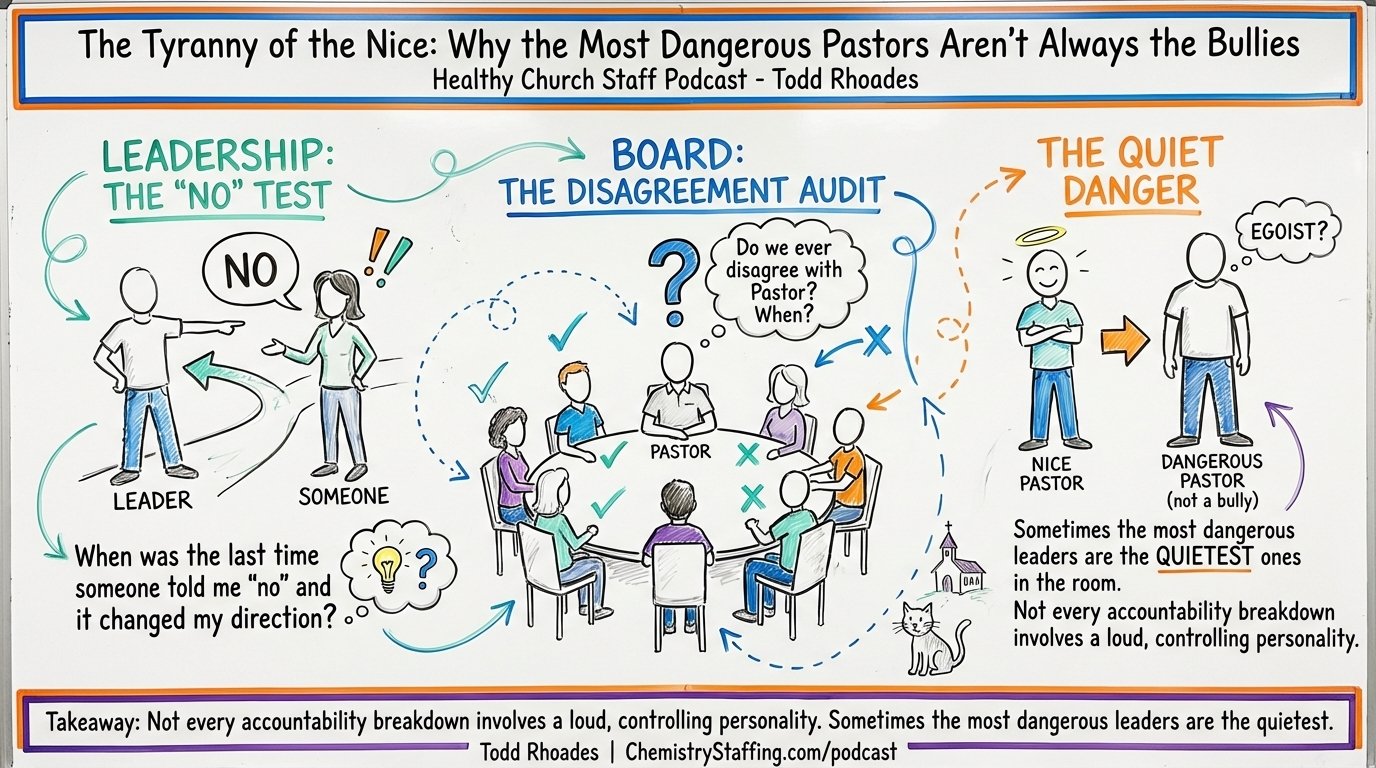
Covert control looks like deference, but it functions like dominance. These leaders aren't necessarily clinical narcissists, but they exhibit something disturbingly close.
Here's how it typically manifests:
They Master the Art of Invisible Steering
They're not bulls in a china shop, but they're absolutely in control. They guide decisions without appearing to manipulate. Everything feels collaborative, yet somehow outcomes always align with their preferences.
They Perfect the Gentle Dismissal
Unlike aggressive leaders who attack dissenters, these pastors quietly dismiss them. They don't argue—they simply deflect, redirect, or spiritualize concerns away. "Let's pray about it" becomes code for "this conversation is over."
They Build an Untouchable Reputation
Over time, their reputation becomes a force field. They're so "nice," so "humble," so "godly" that questioning them feels ungrateful or disloyal. Their gentleness becomes their greatest weapon against accountability.
The Dangerous Signs You Need to Recognize
How do you spot these subtle but destructive patterns? Watch for these red flags:
- Collaborative theater: Decisions appear collaborative, but they consistently go the leader's way
- Kind but unchanged: Pushback is received graciously but rarely leads to course correction
- Emotional burden shifting: Staff carry the weight of "keeping the peace" rather than addressing issues
- Spiritualized deflection: Feedback gets redirected to prayer, God's will, or spiritual maturity rather than practical discussion
- Unspoken loyalty tests: Questioning feels like betrayal, even when done respectfully
Discussion Questions for Your Team:
For Leaders: When was the last time someone told you "no" and it actually changed your direction?
For Board Members: Do we ever genuinely disagree with our pastor? Are we allowed to? When did it last happen, and how did it go?
Why "Nice" Churches Are Particularly Vulnerable
This dynamic is especially dangerous in smaller churches where pastors have served for decades. Deep relational equity—walking with families through deaths, births, crises—creates a beautiful bond. But it can also create an unhealthy dynamic where love and respect morph into unquestioning deference.
When your pastor has officiated your wedding, buried your parents, and baptized your children, challenging his leadership feels like betraying family. But here's the truth: if your pastor is "too nice" to challenge, that may be a bigger red flag than you realize.
"Am I now trying to win the approval of human beings, or of God? Or am I trying to please people? If I were still trying to please people, I would not be a servant of Christ." - Galatians 1:10
The Critical Distinction: Nice vs. Healthy
Here's what every church leader needs to understand: nice is not the same as healthy.
You can have nice pastors with staff members walking on eggshells. Nice pastors with boards that suppress legitimate concerns. Nice pastors whose "humility" has become an impenetrable shield against accountability.
True humility isn't measured by how quiet your tone is—it's demonstrated by how open your posture is to feedback, correction, and collaborative leadership.
Gentleness isn't the same as openness. Soft-spoken doesn't mean safe.
Building Healthy Accountability Systems
Whether you're dealing with an aggressive bully or a gently controlling leader, the solution is the same: true accountability that protects against both passive and aggressive control.
This means:
- Creating systems where respectful disagreement is not just tolerated but expected
- Establishing clear processes for decision-making that can't be manipulated through personality
- Regularly evaluating whether feedback actually influences outcomes
- Training boards and staff to recognize subtle manipulation tactics
- Fostering a culture where loyalty to Christ trumps loyalty to any human leader
Action Steps for This Week:
✓ Leaders: Identify one area where you might be deflecting feedback instead of engaging with it
✓ Teams: Schedule a conversation about your decision-making process—is it truly collaborative?
✓ Boards: Evaluate when you last meaningfully disagreed with pastoral leadership and how it was handled
The Path Forward: Courage Over Comfort
Unquestioned leadership is unhealthy leadership—regardless of tone, tenure, or personality. The most loving thing we can do for our pastors, our teams, and our congregations is to create environments where truth can be spoken with love, where accountability is seen as care rather than attack.
This isn't about becoming suspicious or creating adversarial relationships. It's about recognizing that healthy leaders welcome healthy accountability, while unhealthy leaders—whether loud or quiet—will resist it.
The goal isn't to eliminate "nice" pastors. The world needs more genuinely kind, gentle pastoral leaders. The goal is to ensure that kindness is accompanied by openness, that gentleness includes genuine accountability, and that love for our leaders includes the courage to speak truth when needed.
"Preach the word; be prepared in season and out of season; correct, rebuke and encourage—with great patience and careful instruction." - 2 Timothy 4:2
Take the Next Step
Want to identify potential blind spots in your leadership or governance? I've created a free assessment that helps pastors, staff, and board members evaluate their susceptibility to the kinds of issues that lead to leadership failures.
This isn't about labeling anyone as "bad" or predicting doom—it's about asking important questions that can prevent future problems.
Take the free assessment at whenthechurchfalls.com/assessment
You can also grab a copy of my book "When the Church Falls" at whenthechurchfalls.com—it makes an excellent study guide for leadership teams and boards.
Remember: healthy accountability isn't about being mean or suspicious. It's about loving our leaders and our churches enough to create systems that protect everyone involved.
What's your experience with this? Have you encountered the "tyranny of nice" in church leadership? I'd love to hear your thoughts—send them to podcast@chemistrystaffing.com.