

You walk into your weekly staff meeting and scan the room. Everyone looks fine—engaged faces, laptops open, ready to tackle the agenda. But beneath the surface, something troubling is happening that most church leaders are completely missing.
🎧 Listen to this episode:
According to recent data from annual church staff health assessments, staff health across evangelical churches is quietly sliding downward. We're not talking about dramatic burnout or mass resignations like we witnessed in the immediate post-COVID years. This is different—it's a slow, almost invisible decline that's easy to overlook until it's too late.
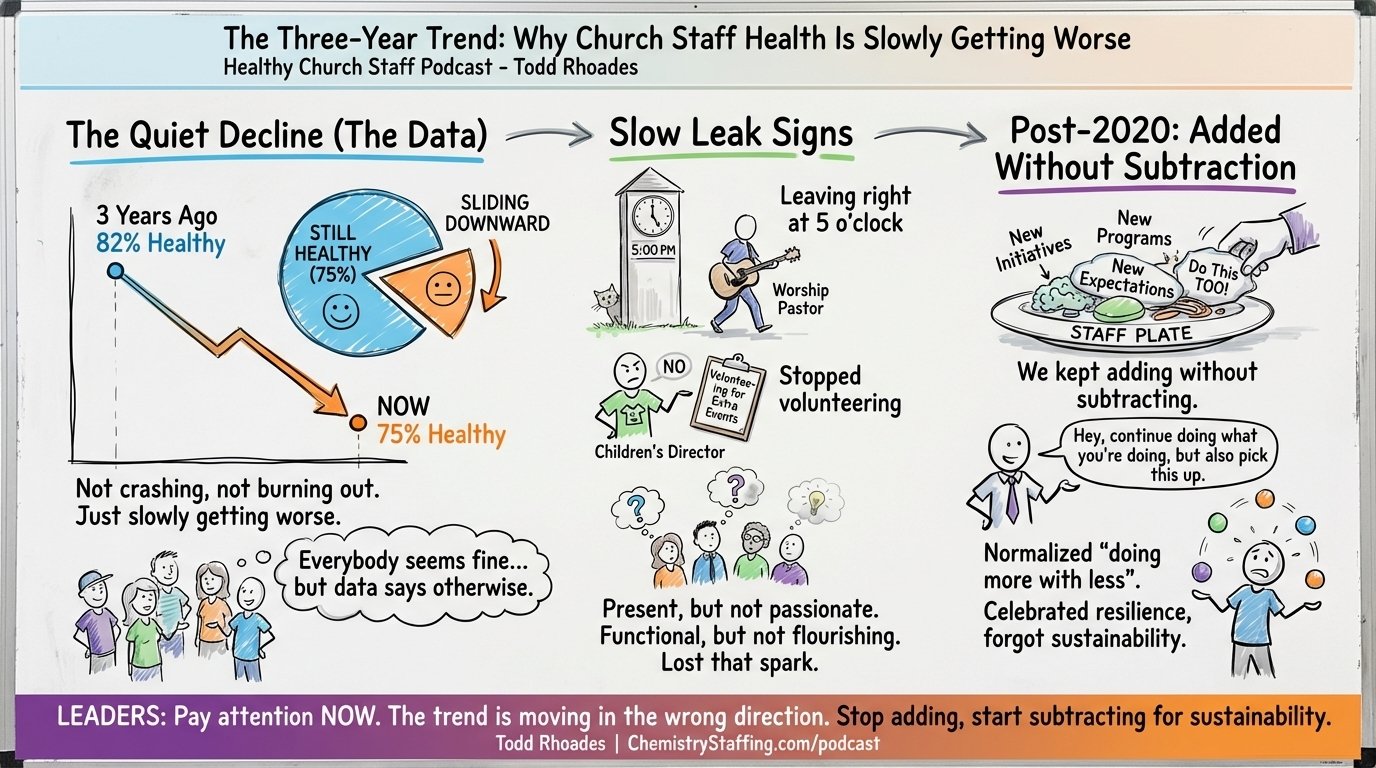
The numbers tell the story: while 75% of church staff still fall into the "healthy" category, that figure was 82% just three years ago. That seven-percentage-point drop might seem small, but it represents thousands of ministry leaders who are slowly losing their spark.
Recognizing the "Slow Leak" Signs
Unlike the obvious warning signs of acute burnout—dramatic resignations, public meltdowns, or complete disengagement—this gradual decline manifests in subtle ways that can easily be mistaken for normal ministry rhythms.
Here's what it actually looks like in your church:
- The worship pastor who used to stay late perfecting Sunday's service now leaves right at 5:00 PM
- The children's director who once volunteered for every extra event now politely declines additional responsibilities
- Staff members who execute their duties well but seem to have lost that distinctive ministry passion
- Team members who are present but not passionate, functional but not flourishing
These aren't lazy employees or uncommitted ministers. These are dedicated servants who are slowly running out of steam, and most of them don't even realize it's happening.
The Root of the Problem: Addition Without Subtraction
The primary culprit behind this decline isn't hard to identify once you know where to look. In the years following 2020, most churches developed a dangerous habit: we kept adding without subtracting.
Think about your own church's journey over the past three years. You've likely added:
- New digital ministry initiatives
- Hybrid event planning requirements
- Additional safety protocols and procedures
- New outreach programs to reconnect with disconnected members
- Enhanced communication strategies across multiple platforms
But here's the critical question: what did you take off your staff's plates to make room for these additions?
If you're like most churches, the honest answer is "nothing." We normalized "doing more with less" as a permanent operational state rather than a temporary crisis response. We celebrated our teams' resilience so enthusiastically that we forgot about sustainability.
"We celebrated resilience so much that we forgot about sustainability. Staff learned to manage their energy instead of expressing their gifts."
The result? Staff members who once thrived in their calling now spend most of their energy simply managing their workload. They've shifted from gift expression to energy management—a subtle but significant difference that slowly drains the life out of ministry.
Time for Intentional Recalibration
The encouraging news is that this trend is entirely reversible, but it requires intentional leadership action. Here are practical steps you can implement immediately:
Measure Energy, Not Just Productivity
Start asking different questions in your one-on-ones and team meetings:
- "What's giving you life right now?" instead of "What's getting done?"
- "Where do you feel most energized in your role?" rather than "How are your projects progressing?"
- "What's draining you that we could potentially change?" not just "What challenges are you facing?"
Create Safe Spaces for Honest Conversation
Your staff needs permission to express what's draining them without fear of judgment or immediate problem-solving. Sometimes they just need to be heard and validated before solutions can be explored.
Audit Your Team Culture
Take an honest look at your last three staff meetings. What was the tone? Did anyone laugh? Did you share stories of life change and ministry wins, or did you only focus on logistics and problem-solving?
Healthy teams experience moments of genuine joy and celebration, not just efficiency and task management. If your meetings consistently feel more like business transactions than ministry partnerships, that's a significant indicator of declining team health.
Scripture Reflection
"Come to me, all you who are weary and burdened, and I will give you rest. Take my yoke upon you and learn from me, for I am gentle and humble in heart, and you will find rest for your souls. For my yoke is easy and my burden is light." - Matthew 11:28-30
How might Jesus' invitation to rest challenge the way we structure ministry workloads?
Stop Praising Unsustainable Performance
We often unknowingly reward the very behaviors that lead to declining staff health. When we consistently praise team members for "handling everything" or "never saying no," we're actually reinforcing unsustainable patterns.
Instead, celebrate instances when staff members set healthy boundaries, delegate effectively, or prioritize self-care.
The Sustainability Test
Here's a simple diagnostic question that will reveal more about your staff health than any formal assessment: Think about your most gifted staff member right now. If they left tomorrow, would you need to replace them with two people?
If the answer is yes—if no reasonable candidate would accept their current job description and salary expectations—then you've identified an unsustainable situation that's slowly eroding that person's health and effectiveness.
Ask yourself:
- Are your best staff members operating in their sweet spot, or just managing their workload?
- When's the last time they shared something about their ministry that genuinely excited them?
- Are they expressing their gifts or simply surviving their responsibilities?
Action Steps for This Week
- Schedule 15-minute check-ins with each staff member focused solely on their energy and health
- Ask the key question: "What part of your role is giving you energy right now?"
- Listen without immediately problem-solving—sometimes people just need to be heard
- Follow up with: "What's draining you that we could potentially change?"
- Audit one current expectation or responsibility that could be eliminated or reassigned
Your Staff's Health Is Your Church's Future
Here's the bottom line that every church leader needs to understand: staff health doesn't collapse overnight—it erodes slowly, and by the time you notice the obvious symptoms, you're already behind the curve.
The encouraging truth is that small course corrections implemented now can prevent major repairs later. You don't need a complete organizational overhaul or a massive budget increase. You need intentional attention to the warning signs and courage to make necessary adjustments before they become urgent crises.
Your staff's health directly impacts your church's capacity to fulfill its mission. Healthy staff members don't just accomplish more tasks—they innovate, inspire, and invest in others from a place of abundance rather than depletion.
The seven-percentage-point decline in staff health over three years represents a trend, not a destiny. With intentional leadership and small but consistent changes, you can not only stop this decline but reverse it entirely.
Your team is worth the investment. Your mission depends on it. And the people your church serves deserve ministry leaders who are thriving, not just surviving.
What warning signs have you noticed in your own ministry context? I'd love to hear about your experiences and any strategies that have worked for your team. Send your thoughts to podcast@chemistrystaffing.com—your insights might help other church leaders navigate this challenge.