

Ever notice how some executive pastors can absolutely nail a budget meeting but suddenly freeze up when a staff member needs emotional support? They're brilliant with spreadsheets, masterful with project timelines, and can make every operational train run precisely on time. But ask them to navigate team conflict or offer spiritual encouragement? Suddenly they're completely out of their element.
🎧 Listen to this episode:
If this sounds familiar—whether you're an executive pastor yourself or you're leading one—today's conversation is going to be incredibly valuable. Because here's the thing: your role still has the word "pastor" in it, and that matters more than you might think.
The Great Executive Pastor Mystery
Let's be honest: executive pastors are fascinating creatures in the church world. Depending on which church you visit, an executive pastor might be handling pure ministry, running all business operations, managing finances exclusively, or even preaching regularly. There's no universal job description because most churches craft these roles around their specific organizational needs.
And that's exactly where things can get tricky.
Many churches, desperate for operational excellence, specifically hunt for business professionals to fill their executive pastor role. They need someone who can handle finances, manage facilities, oversee project timelines, and basically make sure the church doesn't fall apart organizationally. So they find someone with incredible business acumen—someone who's proven themselves over decades in the corporate world.
But then something unexpected happens. This brilliant business mind struggles with the "ministry" aspects of their new role. And if you're that executive pastor, or if you're leading one who fits this description, you're probably nodding your head right now.
When Operations Become Everything
Here's how you know this has become an issue on your team. Maybe you've noticed some warning signs:
Staff meetings have transformed into project updates instead of ministry conversations. Don't get me wrong—those project updates are absolutely crucial. They're a key part of any executive pastor's job. But when that's all your meetings become, you've lost something essential.
Team members are getting managed instead of pastored. This is particularly challenging for leaders with business backgrounds because, frankly, the business world can be harsh. Sometimes that corporate directness gets misinterpreted in a ministry context, or it simply doesn't fit the pastoral environment you're now operating in.
Problems are solved with new processes instead of understanding people. Ministry is fundamentally a people business. You need to be able to work with hearts and souls, not just spreadsheets and systems.
Staff members start feeling like resources to optimize rather than souls to shepherd. This shift is subtle but devastating. When your team senses they're being viewed as human resources rather than humans with souls, everything changes.
"The most effective executive pastors never forget they're shepherds who happen to be really good with spreadsheets."
The Heart-Head-Soul Integration
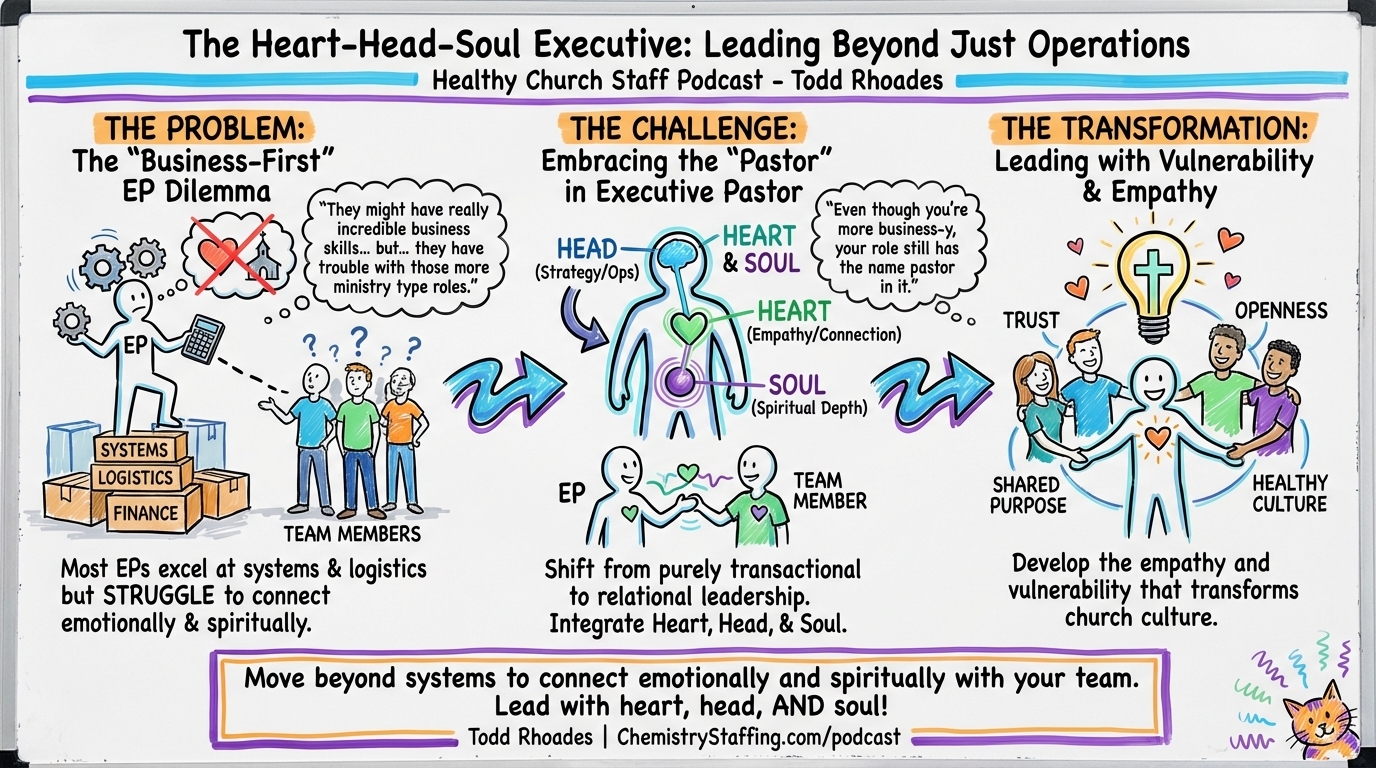
Now listen—I'm not suggesting you abandon operational excellence. Churches absolutely need executive pastors who can execute flawlessly. You were hired for those skills, and they're incredibly valuable. But the best executive pastors I've worked with operate from all three centers: heart, head, and soul.
The Head: They still nail all the logistics. Every train runs on time, every budget balances, every project gets completed. This is the operational excellence you were hired for.
The Heart: They lead with emotional intelligence. They understand that behind every spreadsheet entry is a real person with real feelings, real struggles, and real dreams.
The Soul: They remember this is sacred work with eternal implications. Church work isn't just another business—it's kingdom work, and that changes everything.
When you integrate all three, something beautiful happens. These executive pastors ask "How are you?" and actually wait for the answer. They pray with staff members, not just for them in meetings. They see team conflicts as discipleship opportunities, not just business problems to solve.
Biblical Foundation: The Nehemiah Model
"Then I said to them, 'You see the trouble we are in: Jerusalem lies in ruins, and its gates have been burned with fire. Come, let us rebuild the wall of Jerusalem, and we will no longer be in disgrace.' I also told them about the gracious hand of my God on me and what the king had said to me. They replied, 'Let us start rebuilding.' So they began this good work." —Nehemiah 2:17-18
Notice how Nehemiah combined operational excellence (rebuilding the wall) with spiritual leadership (acknowledging God's hand) and emotional connection (addressing their shared disgrace). He was the ultimate heart-head-soul leader.
What This Looks Like Practically
You might be thinking, "Okay, Todd, this sounds nice in theory, but what does this actually look like in real life?" Great question. Here are some practical ways to integrate heart and soul with your operational head:
Start staff meetings with spiritual check-ins before diving into task lists. Yes, this might feel uncomfortable at first, but it sets the tone that people matter more than projects.
When projects fail, ask about the person first, the process second. This might not be your natural inclination, but in ministry, caring for your team member's heart often matters more than immediately fixing the problem.
Schedule coffee conversations that have absolutely nothing to do with deliverables. I know this might drive your task-oriented brain crazy, but these relationship-building moments are essential in ministry context.
Remember that staff development isn't just skills training—it's soul care. How are your team members doing spiritually? What's happening in their personal lives? How can you support their overall well-being?
The Culture Ripple Effect
Here's something crucial to understand: your church culture flows downstream from how your executive pastor leads. The XP role is enormous, and their leadership style shapes everything.
If they're all head and no heart, your staff becomes mechanical. If they're all systems and no soul, your ministry loses its sacred center over time. But when they integrate all three—head, heart, and soul—efficiency starts serving relationship instead of replacing it.
This Week's Challenge
Have one conversation with a team member that has absolutely nothing to do with their job performance or project deadlines. Ask them how they're doing spiritually. Ask about their family. Ask how you can pray for them. Just put everything aside and shepherd them.
Why this matters: Your operational gifts are a blessing to your church, but they shouldn't be the only tool in your toolkit. Your team needs a pastor, not just a manager.
Moving Forward
If you're an executive pastor reading this, please don't hear condemnation. Hear encouragement. Your organizational skills are desperately needed in the church world. Too many ministries struggle because they lack operational excellence. But remember that you're not just running a business—you're shepherding souls.
If you're leading an executive pastor who fits this description, have grace-filled conversations about this balance. Help them see that pastoral care isn't separate from operational excellence—it's what makes operational excellence sustainable and meaningful in a ministry context.
The churches I've seen thrive are the ones where the executive pastor has learned to be equally comfortable in a budget meeting and a prayer circle, equally skilled at project management and soul care. They've discovered that efficiency and empathy aren't opposites—they're partners in effective ministry.
Reflection Questions
- How would your team rate your current balance between "getting things done" and "caring for people's hearts"?
- What fears or barriers might prevent you from being more emotionally present with your team?
- What's one specific way you can lead with more heart and soul this week while maintaining operational excellence?
Remember: the most effective executive pastors are shepherds who happen to be really good with spreadsheets. Don't let your spreadsheet skills be your only tools. Your team—and your ministry—needs both your head and your heart.
What's your experience been with balancing operations and pastoral care? I'd love to hear your thoughts and stories. Send them over to podcast@chemistrystaffing.com. Let's continue this conversation and help each other become more effective ministry leaders.