

You're sitting in a meeting, and someone's pushing a decision you know isn't right.
🎧 Listen to this episode:
It's nothing major. Nothing that would make headlines. Nothing immoral.
Just a small compromise that would make your life easier and their complaint go away so you can all move on.
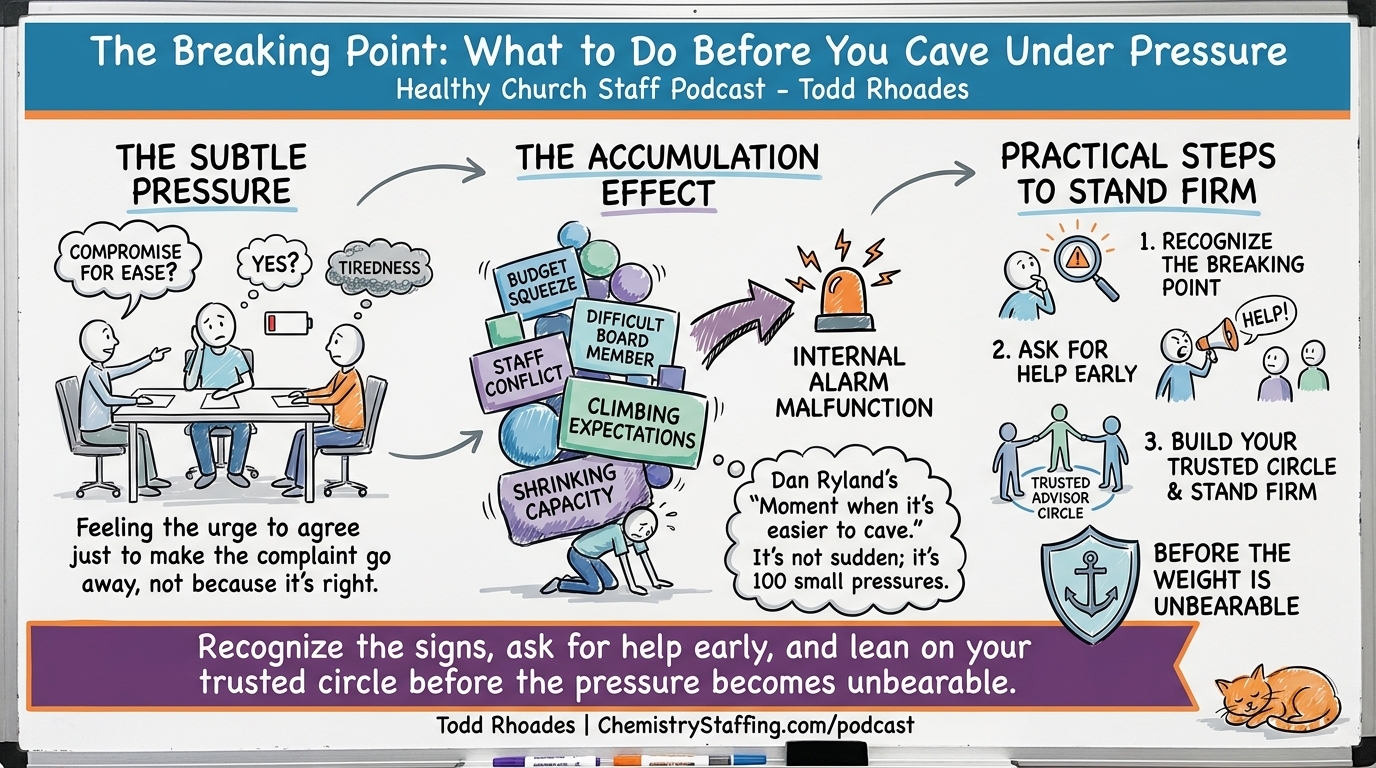
And here's the thing—you can already feel yourself leaning toward yes.
Not because you agree. Not because it's the best decision. But simply because you're tired. Because you've fought too many battles this month. Because you don't have the energy for one more conflict.
My friend Dan Reiland calls this "the moment when it's easier to cave."
And if we're honest, every single one of us has been there.
The Breaking Point Isn't Sudden—It's Cumulative
Here's what nobody tells you about that moment of pressure: the breaking point doesn't just happen. You don't wake up one day and suddenly fold on your values.
It's the accumulation of a hundred small pressures stacking up like weights on your shoulders.
The budget squeeze that won't let up. The difficult board member who questions everything. The staff conflict you've been managing for months. The expectations that keep climbing while your capacity feels like it's shrinking by the day.
And somewhere in the middle of all that weight, your internal alarm system starts to malfunction.
What used to feel clearly wrong starts feeling somewhat negotiable. Not because you've changed your theology or compromised your core beliefs—but because you're exhausted. You're running on fumes, and your discernment is clouded by fatigue.
The Dangerous Drift That Happens in Your Head First
Here's what makes this pattern so dangerous: you start rehearsing the compromise before anyone even asks for it.
Your internal dialogue shifts:
- "Maybe they're right. Maybe I'm being too rigid."
- "This isn't the hill to die on."
- "I just need to get through this season."
- "It's not worth the conflict right now."
You're explaining away your convictions even before you've been tested on them. And the scary part? It feels like wisdom. It feels like maturity, like flexibility, like you're showing grace.
But really, you're just trying to make the pressure stop.
"Moses' father-in-law replied, 'What you are doing is not good. You and these people who come to you will only wear yourselves out. The work is too heavy for you; you cannot handle it alone.'" —Exodus 18:17-18
Flexibility vs. Folding: Know the Difference
Now, I'm not saying every disagreement is worth a fight. That's not leadership—that's just stubbornness. We've all served with that person who won't ever let anything go.
But there is a critical difference between flexibility and folding:
Flexibility is adjusting HOW you do something.
Folding is abandoning WHY you're doing it.
One preserves the mission. The other erodes it, one small compromise at a time.
And you know the difference—but only if you're paying attention. Only if you've got people in your life who can name it when they see it happening.
Build Your Reality-Check Squad Before You Need It
Which brings us to what might be the most practical point in this entire article:
You need to build your trusted advisor circle before you need it.
I'm not talking about your staff. Not your elders. Not your spouse. Not people who report to you or you report to.
I'm talking about two or three leaders—people who love Jesus, love the church, and have absolutely nothing to gain from your decisions. People who don't have a dog in your fight.
These are people who can say, "That sounds like exhaustion talking, not conviction."
People who can tell you when you're being stubborn and when you're caving.
This isn't a therapy group. It's a reality-check squad.
Who's in Your Circle?
Think about these questions:
- Who are 2-3 people you could call right now with a real problem?
- Who knows you well enough to spot when you're compromising out of exhaustion?
- Who loves you enough to tell you the hard truth?
- Who has the wisdom and experience to speak into your specific situation?
If you can't answer these easily, that's your first priority. Build this circle before the pressure hits.
Ask for Help Before the Decision, Not After
Here's the move most leaders miss: we need to ask for help before the decision, not after.
Most of us call our advisors after we've already folded. And honestly, at that point, we're looking for validation, not guidance. We're trying to figure out how to deal with the decision we made rather than getting wisdom to make a good one.
The time to reach out to those trusted people is when you feel the pressure building.
When you notice your internal dialogue shifting. When compromise starts sounding reasonable. When you catch yourself rehearsing explanations.
That's when you text somebody. That's when you call and say, "Hey, I need to talk through something before I make a call on it."
As Dan Reiland says, "Unshakable leaders aren't the ones who never feel pressure. They're the ones who know when to ask for backup."
That's not weakness. That's wisdom.
"Carry each other's burdens, and in this way you will fulfill the law of Christ." —Galatians 6:2
You Need External Anchors When Internal Ones Fail
Think about Jesus in the wilderness. He didn't debate the devil alone in His head. He had Scripture. He had clarity. He had truth outside Himself to anchor on.
Because here's the reality: when you're under pressure, your internal compass can get a little wonky. You need external truth, external voices, external anchors.
And that's not a sign that you're weak. It's a sign that you're human.
It's a sign that you understand how God designed us—to need each other, to carry one another's burdens, to speak truth into each other's lives.
Take Action This Week
Three practical steps you can take right now:
- Identify your early warning signs. What are three specific indicators that you're approaching a breaking point? Physical symptoms? Emotional patterns? Behavioral changes? Write them down.
- Name your advisory circle. Who are 2-3 people you can reach out to? If you don't have them yet, who could they be? Make a plan to invest in those relationships this month.
- Create a check-in rhythm. Schedule a regular time (weekly or bi-weekly) to honestly assess your pressure level with someone who cares enough to ask hard questions.
You Can't Stand Firm If You're Standing Alone
Here's today's bottom line: You can't stand firm if you're standing alone.
Build your circle before the pressure hits. You are not meant to carry this weight by yourself. And asking for help before you cave? That's not weakness—that's strength.
Maybe you're smack in the middle of something right now. Maybe you're feeling that pressure building, and you're not sure who to talk to about it. Maybe everyone around you has a stake in the outcome, and you need an outside perspective.
If that's you, you need to find that person or those people. Find them before everything buckles. Before you make that decision that compromises what you know is right.
"For lack of guidance a nation falls, but victory is won through many advisers." —Proverbs 11:14
If you don't have that person and need someone to talk to, I want you to know: you're not alone. Our heart at Chemistry Staffing is to love churches and church leaders. We're on your side, especially when it comes to creating healthy church culture and supporting leaders under pressure.
Reach out to me at podcast@chemistrystaffing.com. I'd love to have a conversation with you. And if there's any way we can come alongside and help you or your church, please let me know.
You weren't meant to carry this alone.
What about you? What helps you recognize when pressure is building? Who's in your trusted advisor circle? Send me your thoughts—I'd love to hear from you.