

I came across a statistic from Relevant Magazine recently that stopped me cold.
🎧 Listen to this episode:
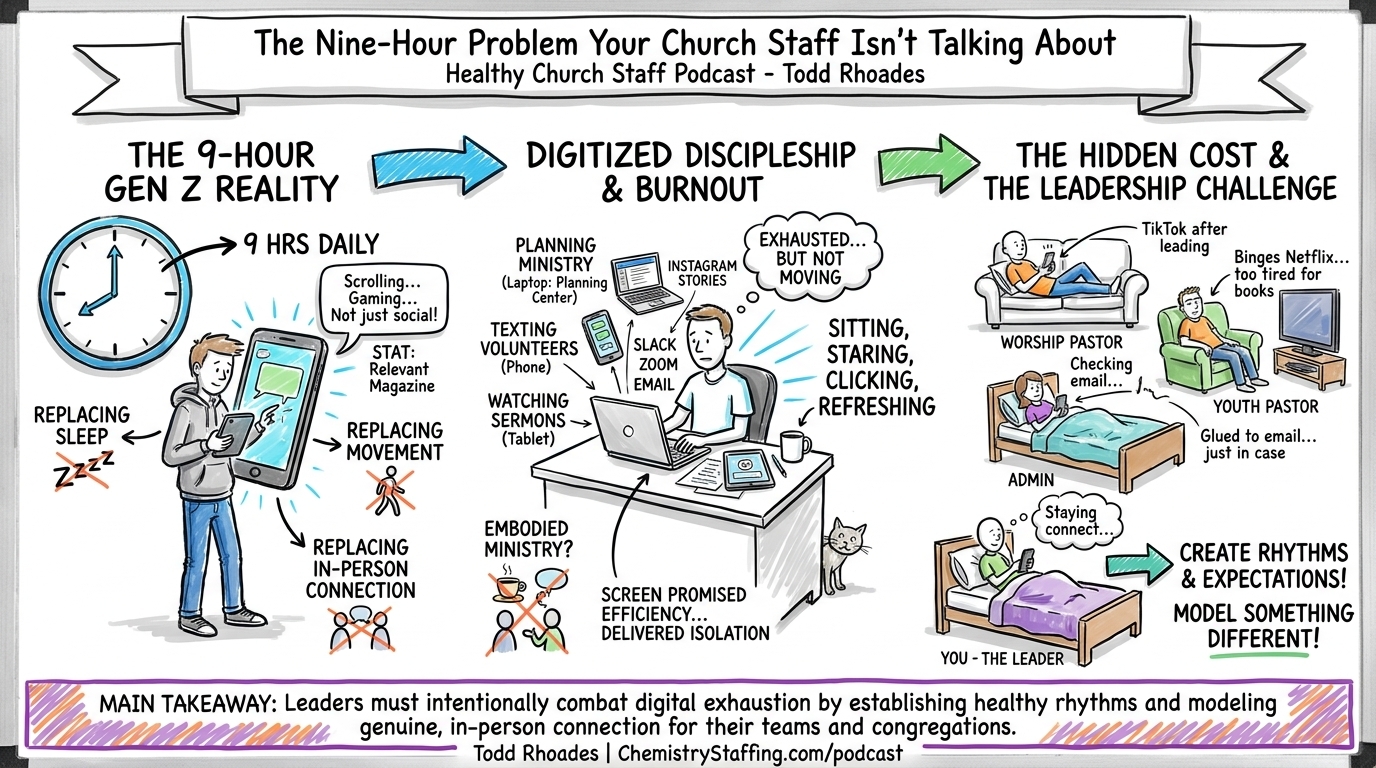
Gen Z is averaging nine hours a day on screens.
Nine. Hours.
That's not just scrolling social media during downtime. That's replacing sleep. Movement. In-person conversation. And here's the part that should concern every church leader reading this: your church staff isn't exempt.
They're planning ministry on screens. Texting volunteers on screens. Watching sermons on screens. And unwinding—you guessed it—on screens.
If you've noticed this pattern among your younger staff members, particularly Gen Z, we need to talk about it. Because this isn't just a generational quirk—it's a church staff health crisis we're pretending isn't happening.
The Invisible Addiction Hollowing Out Your Ministry
Here's the reality we're not saying out loud: Your staff members are more exhausted than ever, but they're not moving. They're sitting. Staring. Clicking. Refreshing.
Ministry used to be embodied. Pastors made hospital visits, grabbed coffee with struggling members, walked the church hallways, and had spontaneous conversations in the parking lot. Physical presence was the default mode of ministry.
But now? It's Slack messages. Zoom prayer meetings. Email counseling. Planning Center coordination. Instagram story updates.
We've digitized discipleship and then wondered why everyone's burned out.
The screen promised us efficiency and reach. What it delivered was isolation and exhaustion. We can now "connect" with hundreds of people without ever actually being present with a single one.
The Hidden Habits No One's Naming
Let me paint a picture you might recognize:
Your worship pastor scrolls TikTok to decompress after leading worship because they're too mentally fried to do anything else. Your youth pastor binges Netflix until 2 AM because they're "too tired to read" that youth ministry book they bought three months ago. Your administrative assistant stays glued to email "just in case" something urgent comes in, even though it's 9 PM on a Saturday.
And you? You're on your phone in bed, telling yourself you're "staying connected with the congregation," but real connection isn't happening. Actual presence—the kind that used to be second nature—is slowly evaporating.
We've normalized constant digital engagement and rebranded it as productivity. Meanwhile, our bodies are breaking down, our minds are getting foggier, and our souls feel increasingly thin.
"Be still, and know that I am God; I will be exalted among the nations, I will be exalted in the earth." — Psalm 46:10
Stillness requires intentionality in a world designed to keep us scrolling.
Why This Matters More Than You Think
Now, hear me clearly: I'm not anti-technology. I love technology. Churches need it. You need it. Digital tools have opened incredible doors for ministry.
But we've let technology become the water we swim in without realizing we might be drowning in it.
Here's what's really at stake: Your church is watching your staff. If your team is constantly glued to devices, the congregation learns that this is normal—even expected. If your staff never truly rests, your people will never rest either. If your leaders can't disconnect, you're inadvertently preaching a gospel of exhaustion.
You want your church community to experience genuine connection? You have to model it with your team first.
What Your Staff Actually Needs From You
So what do you do? Here are practical rhythms—not rigid rules—that can help your team push back against the digital tide:
1. Start By Naming It
Bring this up in your next staff meeting—not as a sermon, but as a confession. Try something like this: "Hey team, I've been on screens way too much lately. It's affecting my clarity and my ability to be present. Anyone else feeling this?"
Give permission for honesty before you demand any change. Leadership isn't about having it all together; it's about being honest about where you're struggling.
2. Create Counter-Cultural Rhythms
Consider implementing these practices with your team:
- One walking staff meeting per month — Go outside. No phones. Just conversation and movement.
- Screen-free evenings — Encourage everyone to block off one evening per week with zero screens. Not because you're being legalistic, but because you care about their actual health.
- Digital Sabbath boundaries — Make it a team value that Sabbath days are truly screen-free (except for emergencies).
3. Model It Yourself First
This is non-negotiable. Your team needs to see you disconnecting. Announce when you're going offline. Don't apologize for it—normalize it.
When you respond to every email within minutes, you're teaching your team that this is the expected standard. When you set boundaries and communicate them clearly, you're giving everyone permission to do the same.
4. Make Embodied Ministry a Value Again
Remind your team regularly that the best ministry still happens face-to-face. Hospital visits matter. Coffee conversations matter. Sitting with someone in their grief without looking at your watch matters.
Jesus didn't disciple through direct messages. He walked. He ate. He lingered. He was fully present with people, and it changed everything.
Discussion Questions For Your Next Staff Meeting
- Without judgment, what's one screen habit you've developed that surprised you when you really thought about it?
- If you're honest, how many hours do you spend on screens in a typical day? How does that number make you feel?
- What are the unspoken expectations about digital availability on our team?
- What's one concrete change we could make together in the next month to model healthier digital rhythms?
Digital Tools Should Serve Ministry, Not Replace It
Here's something important to understand: Digital tools—including AI and automation—aren't the enemy. In fact, they're incredibly valuable when used correctly.
The goal of technology should be to save you time so you can spend more time doing the things only you can do—the face-to-face, soul-to-soul ministry that can't be automated or digitized.
When screens replace presence instead of creating more space for it, we lose the incarnational heart of what we do. We lose what makes ministry actually transformative.
"Do not conform to the pattern of this world, but be transformed by the renewing of your mind." — Romans 12:2
Cultural patterns around technology require the same resistance as any other worldly pattern.
The Bottom Line
You can't pastor people if you're never fully present. And neither can your staff.
Your team desperately needs permission to push back against the always-on culture. They're waiting for you to go first.
You're leading in a digital age, yes. But you're shaping and shepherding embodied souls—people who need presence, not just productivity. People who need a leader who's fully there, not half-present and half-distracted.
Don't let the tools meant to help you end up hollowing you out.
Take Action This Week
Here are three immediate steps you can take:
- Check your screen time report on your phone right now. Write down the total hours. Share that number with one accountability partner this week.
- Schedule one "analog hour" this week that is completely screen-free—no phone, computer, TV, or tablet. Use it for prayer, walking, or face-to-face conversation.
- Bring this conversation to your next staff meeting. Use the discussion questions above to start an honest conversation about your team's digital health.
We Want to Hear From You
Did this resonate with you? Are you seeing this nine-hour screen problem on your staff team? I'd genuinely love to hear your story and learn what's working (or not working) for you.
Reach out to me at podcast@chemistrystaffing.com. If there's any way I or my colleagues at Chemistry Staffing can help you build a healthier church staff culture, we'd be honored to serve you.
P.S. We just launched our free 2026 Church Staff Health Assessment at churchstaffassessment.com. Your input will help us create a comprehensive report on the state of church staff health in America. Take five minutes to complete it today—your voice matters.
Leading in a digital age, but shepherding embodied souls.