

Picture this: You're sitting in a budget meeting, and one of your elders says what you've heard a dozen times before: "We just don't have the resources to do more ministry."
🎧 Listen to this episode:
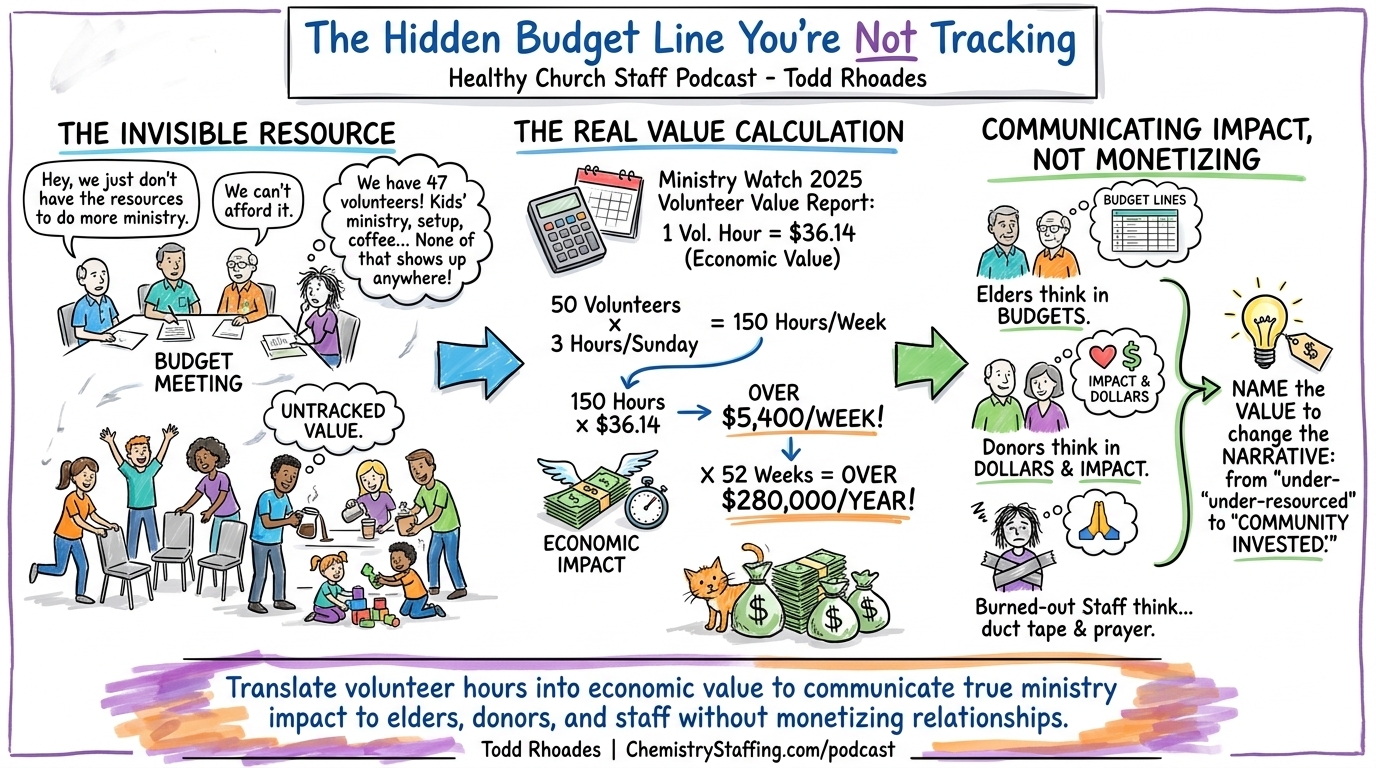
You bite your tongue. Because you're thinking about the 47 volunteers who show up every single Sunday to run children's ministry. The team that arrives early to set up chairs. The sound crew. The greeters. The people making coffee and creating a welcoming environment.
But none of that shows up on a spreadsheet.
So the conversation defaults to what it always does: "We can't afford it."
What if you could change that conversation entirely? What if you could show your board what your church is actually worth?
The Number That Changes Everything
Here's something that stopped me in my tracks recently: MinistryWatch just released their 2025 volunteer value report, and according to actual labor market data, the economic value of one volunteer hour is now $36.14.
Let me help you do some quick math that might blow your mind.
If you have 50 volunteers serving 3 hours on a Sunday, that's 150 hours times $36.14. That's over $5,400 in economic value per week. Multiply that by 52 weeks, and you're looking at over $280,000 a year.
And that's just Sunday morning. That doesn't count your midweek programs, your administrative volunteers, your facility maintenance helpers, or your missions teams.
I Know What You're Thinking
"Todd, this feels gross. We don't pay our volunteers. That's not why they serve."
I completely agree. And I'm not for a second suggesting you should start treating volunteer ministry like a transaction. Your volunteers aren't showing up because of economic value—they're serving because they love Jesus and they love your church. That's sacred, and we're not changing that.
But here's what I've learned after years of working with church leaders:
- Your elders think in budget lines
- Your donors think in dollars and impact
- Your burned-out staff think they're doing ministry with duct tape and a prayer
When you can't name the value, everyone assumes there isn't any.
So the narrative becomes: "We're under-resourced. We can't do anything more." But here's the truth—most of the time, that's simply not accurate.
Ephesians 4:11-12 - "So Christ himself gave the apostles, the prophets, the evangelists, the pastors and teachers, to equip his people for works of service, so that the body of Christ may be built up."
Paid staff exist to equip volunteers for ministry, not to do all the ministry. Understanding volunteer contribution helps us fulfill this calling.
What This Number Actually Does for You
Calculating volunteer economic value gives you a language to communicate impact in ways that different people can understand and appreciate.
For Your Elder Board
When leadership asks, "What are we actually accomplishing?" you can now say: "Our volunteer teams contributed the equivalent of $280,000 in labor this year."
Suddenly, ministry doesn't look small—it looks mobilized.
For Your Donors
When someone asks, "How is my gift being leveraged?" you have a powerful answer: "Every dollar you give is multiplied by the volunteers we're equipping and deploying."
That's not a fundraising gimmick. That's reality.
For Your Burned-Out Staff
When your team members are drowning in logistics and coordination, they start thinking, "I'm just keeping the lights on."
But you can reframe that entirely: "You're not just keeping the lights on. You're mobilizing a volunteer force worth more than our entire budget. You're equipping people to use their gifts. You're stewarding a quarter-million-dollar workforce."
That's not hype. That's the truth. We just never think about it that way.
How to Actually Use This (Practical Steps)
Here's where this gets practical. Most churches don't track volunteer hours systematically, so let's change that.
Step 1: Track Volunteer Hours for One Month
Not to micromanage—just to see. Include:
- Kids ministry
- Setup and teardown teams
- Worship teams
- Hospitality and greeters
- Administrative support (unpaid)
- Facility maintenance
- Small group leaders
- Everything
Step 2: Calculate Your Volunteer Value
Multiply those monthly hours by $36.14. That's your baseline volunteer economic value.
Step 3: Present the Number (Without Making It Weird)
At your next elder meeting, simply say: "I wanted you to see the economic value our volunteers are contributing."
Watch how the room shifts. Because now they're not just hearing about busy Sundays—they're seeing mobilization, discipleship, and leverage.
Step 4: Reframe Budget Conversations
When resource discussions come up again, you now have language:
"We're not under-resourced—we're volunteer-rich and staff-lean."
That's a completely different conversation. It opens up new questions: Are we stewarding our volunteer capacity well? Are we equipping them effectively? Are there areas where volunteers are carrying loads that should be staff positions?
Discussion Questions for Your Team
- When was the last time you felt under-resourced? Looking back, how much volunteer capacity was already flowing through your area that you might not have been counting as "resources"?
- Calculate the value: If you actually tracked volunteer hours in your ministry area and multiplied by a reasonable rate, what number would you get? Would it surprise your leadership?
- Communication shift: How might understanding volunteer economic value help you celebrate and honor volunteers more effectively?
The Bigger Picture
This isn't just about numbers on a page. It's about helping everyone in your church—from the board room to the nursery—see what God is actually doing through ordinary people who say yes to serving.
1 Corinthians 12:4-6 - "There are different kinds of gifts, but the same Spirit distributes them. There are different kinds of service, but the same Lord. There are different kinds of working, but in all of them and in everyone it is the same God at work."
Every volunteer contribution—whether professional expertise or faithful service—is a manifestation of God's work through His people. When we can articulate the value of that work, we're not cheapening it. We're honoring it.
Your Bottom Line
Your volunteers aren't just helping out. They're the hidden budget line that makes your entire ministry possible. Without them, most of our churches would cease to function within a month.
So here's my challenge to you:
Take Action This Week
- Choose one ministry area and track volunteer hours for the next month
- Calculate the economic value using the $36.14 benchmark
- Share that number with your leadership team at the next meeting
- Watch how it changes the conversation about resources and capacity
You're doing more than you think. Your volunteers are contributing more than anyone realizes. And your church is more resourced than the budget spreadsheet shows.
My encouragement to you today: Keep going. You're making a difference.
I'd love to hear how this perspective shift impacts your next budget conversation. What surprised you when you calculated your volunteer value? What questions did it raise for your team? Send me your thoughts at podcast@chemistrystaffing.com—I read every email.
This post is based on Episode 695 of the Healthy Church Staff Podcast. Subscribe to the podcast for weekly encouragement and practical wisdom for church leaders.