

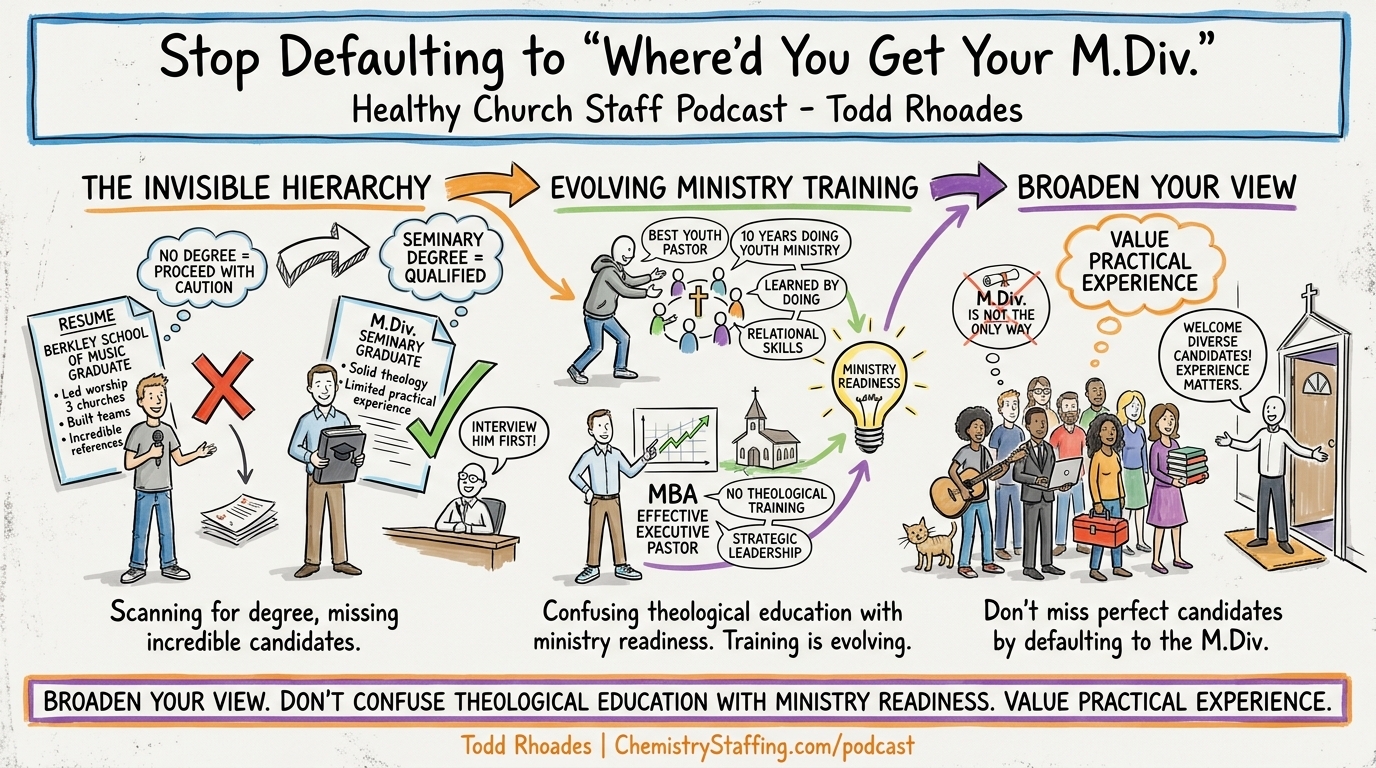
You're reviewing resumes for your new worship pastor position, and two candidates immediately catch your eye.
🎧 Listen to this episode:
Candidate A: Berklee School of Music graduate. Led worship at three growing churches. Built teams from scratch. Incredible references from senior pastors who rave about their leadership.
Candidate B: M.Div. from a well-respected seminary. Solid theology. But very limited practical ministry experience.
Be honest—which resume are you drawn to first?
If you're like most church leaders, you're scanning for that seminary degree before you even process their actual experience. And in doing so, you might be about to pass over some of the most talented ministry leaders who could transform your church.
Let's talk about what I call "the seminary default"—and why it's time to rethink how we evaluate candidates for church staff positions.
The Invisible Hierarchy in Church Hiring
Here's the unspoken rule that exists in many churches, particularly in certain parts of the country:
Seminary degree = qualified for ministry
No degree = proceed with caution
We've created an invisible hierarchy that elevates formal theological education above proven ministry effectiveness. And while I understand the reasoning behind it, I also see how it's causing churches to miss out on exceptional leaders.
The best youth pastor I know learned ministry by actually doing youth ministry for ten years—not by writing papers about adolescent development theories. The most effective executive pastor I've worked with has an MBA and extensive business experience, but no seminary training whatsoever.
Here's what's happening: Ministry training is evolving faster than our hiring practices.
We're Asking the Wrong First Question
The problem isn't that we value theological education—we absolutely should. The problem is that we're confusing theological education with ministry readiness.
These are not always the same thing.
A seminary degree tells you that someone can write comprehensive papers about ecclesiology, systematic theology, and hermeneutical principles. That's valuable. But it doesn't tell you whether they can:
- Build and develop a high-functioning team
- Navigate conflict with a difficult parent or volunteer
- Lead through an unexpected crisis on a Tuesday morning
- Cast compelling vision that mobilizes people
- Create systems that help ministry scale effectively
Meanwhile, we're overlooking candidates who've been sharpened by years of real ministry experience, practical leadership development, and faithfulness in the trenches—even if they lack the formal degree.
Scripture Reflection
"When they saw the courage of Peter and John and realized that they were unschooled, ordinary men, they were astonished and they took note that these men had been with Jesus." — Acts 4:13
Application: Jesus' own disciples lacked formal religious training, yet their time with Jesus and Spirit-empowerment made them extraordinarily effective ministry leaders. Sometimes the best credential is proven faithfulness and genuine calling.
Let Me Be Crystal Clear
Before I go further, I need to say this loudly: I am not anti-seminary. I am not anti-education. Theological training matters deeply, and I have tremendous respect for the academic institutions that train ministry leaders.
But here's what I believe even more strongly:
Competency trumps credentials every single time.
The question isn't whether we should value theological education. The question is whether we're letting degree requirements eliminate candidates who could be exactly what our churches need.
The Competency-First Approach
Instead of leading with "Do they have the right degree?" I'd encourage you to start with a different question: "Can they actually do the job we're asking them to do?"
When you ask that question first, you start looking for different things:
Look for Proven Track Records
What have they actually accomplished in ministry? Don't just accept generic statements—dig into specifics. Have they grown a ministry from 15 to 150? Have they successfully navigated a church conflict? Have they launched something from nothing?
Evaluate Their Ministry Philosophy
How do they think about ministry? How do they handle conflict? What's their approach to building teams? How do they cast vision and lead change? Many seminaries don't extensively teach these practical leadership competencies, yet they make up the majority of actual church work.
Assess Results and Fruit
What results have they produced in their previous roles? More importantly, what leaders have they developed? Ministry isn't just about what you accomplish personally—it's about multiplying yourself through others.
Recognize Alternative Learning Paths
Some of the best ministry leaders have learned theology through intensive mentorship relationships, strategic conference attendance, focused reading programs, and fifteen years of faithful service where they learned by doing.
Seminary can absolutely be one path to competency. But it's not the only path, and we need to stop acting like it is.
Discussion Questions for Your Team
- When was the last time we updated our staff job descriptions and hiring criteria? Are we potentially screening out qualified candidates based on educational requirements that may not be essential for the role?
- Look around our team: What diverse training backgrounds are represented here? How have those different pathways strengthened our ministry rather than weakened it?
- What are the "non-negotiables" we should look for in ministry candidates (character, competency, biblical knowledge), and what are the "flexible pathways" someone might take to develop those qualities?
The Marketplace Has Changed
Today's ministry landscape looks dramatically different than it did 20 years ago. The church needs leaders who can actually lead—not just people who've studied leadership in a classroom.
The marketplace is full of talented people who genuinely love Jesus and bring incredible practical skills to the table. They might not have an M.Div., but they know how to:
- Build organizational systems that work
- Navigate complex interpersonal dynamics
- Communicate clearly and compellingly
- Develop people and teams
- Execute strategy and vision
- Get things done with excellence
And in today's ministry context, where churches need to operate with increasing effectiveness and decreasing resources, these competencies matter more than ever.
Your Action Step This Week
Here's what I want you to do: Audit your current job descriptions.
Pull up every open position or standard job description your church uses. Look specifically for degree requirements. Then ask yourself this honest question for each role:
"Is this specific degree actually necessary for someone to succeed in this role, or is it just a filter we've always used?"
If the answer is that the degree itself isn't essential—that what you really need is theological competency, ministry experience, and proven leadership ability—then consider changing your requirement.
Try something like: "M.Div. or equivalent ministry training and experience" and then define what "equivalent" actually means for that specific role.
Action Items to Consider
- Create a competency matrix for each ministry position that lists actual skills, knowledge areas, and character qualities needed—separate from degree requirements
- Explore alternative training partnerships like online seminary programs, ministry residencies, or apprenticeship models
- Draft an internal development pathway that shows how someone in your church could grow into ministry leadership through mentoring, training, and experience
- Interview a non-traditional ministry leader and ask them to share what training and development was most valuable in their journey
The Bottom Line
Stop letting degree requirements automatically eliminate candidates who could absolutely transform your ministry.
The best hire you never made might be sitting in your inbox right now, filtered out by an automated system or passed over because they don't check the traditional boxes.
Your church needs faithful, competent, called leaders who can actually do the work of ministry effectively. Sometimes that person has a seminary degree. Sometimes they don't.
The question isn't about their credentials—it's about their competency, character, and calling.
Don't let outdated requirements keep you from finding the leaders God is sending your way.
Let's Keep the Conversation Going
What's your take on this? Am I way off base, or does this resonate with your hiring experience? I'd genuinely love to hear your thoughts, pushback, or success stories.
Email me at podcast@chemistrystaffing.com
Need help rethinking your hiring practices or navigating these conversations with your team? Reach out—I'd love to help you work through it.
This post is based on Episode 651 of the Healthy Church Staff Podcast. Subscribe wherever you listen to podcasts to get practical wisdom for church leaders delivered daily.