
It's June, and your youth group just went from 40 kids to 12.
🎧 Listen to this episode:
Your small group attendance is half of what it was back in March. Your worship team is missing three people this week—no drummer, no guitarist.
So what do you do?
If you're like most churches, you panic. You start planning bigger events, more activities, flashier everything. You scramble to figure out what will finally get people to show up.
Meanwhile, the faithful few who actually did show up are sitting right in front of you, watching you completely ignore them.
Sound familiar?
The Summer Slump Is Normal (And That's Okay)
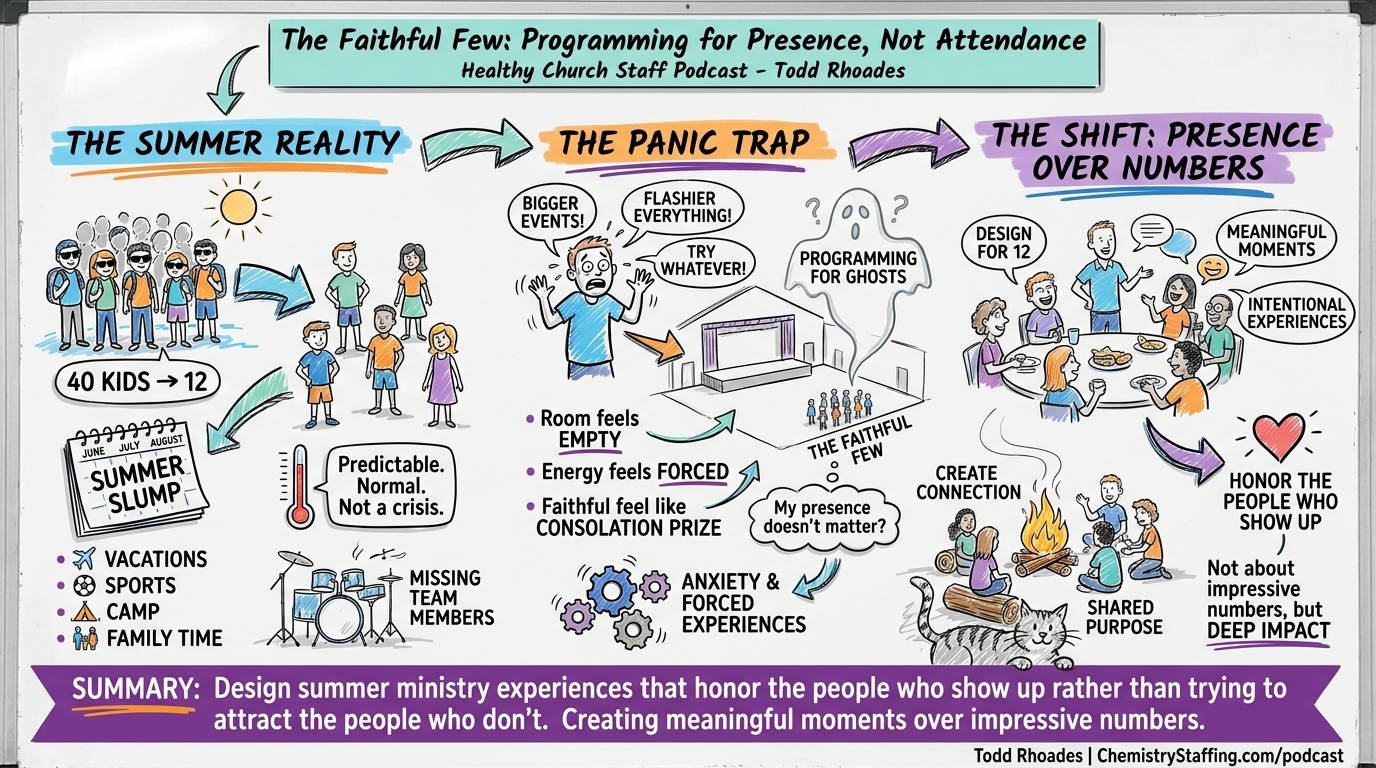
Let's start with something nobody seems willing to say out loud: every single church faces the summer attendance drop. Every. Single. One.
Vacations, sports leagues, summer camps, family reunions—it's all predictable. It's all normal. It's not a crisis.
But we treat it like the building's on fire, don't we? We start programming for ghosts instead of people. We design experiences for crowds that won't materialize and then wonder why the whole thing feels forced and empty.
Here's what actually happens when we do this:
- You plan for 40 people when you have 12, and the room feels empty
- The energy feels forced and awkward
- Your faithful attenders start feeling like they're not enough
- You accidentally communicate that their presence doesn't really matter because the "real" crowd isn't there
- Your team burns out trying to attract people who have other priorities right now
Without meaning to, you've just told your most committed members that they're the consolation prize. That we can't do "real ministry" until everyone comes back in the fall.
There has to be a better way.
The Attendance Anxiety Trap
The real issue isn't the summer slump itself—it's our response to it.
We bring so much anxiety to the situation that we can't see straight. We're so focused on who's missing that we completely overlook who's present. We're programming for empty chairs instead of real people.
And listen, I get it. You want your church to grow. I want your church to grow. That's good, healthy leadership.
But chasing numbers in the summer while ignoring the people who actually show up? That's not growth strategy—that's insecurity.
Matthew 18:20 - "For where two or three gather in my name, there am I with them."
Jesus reminds us that His presence isn't dependent on large crowds—even small gatherings hold sacred potential when centered on Him.
What if we stopped apologizing for who's not here and started celebrating who is?
Programming for Presence: A Better Approach
Here's what I want you to consider: design experiences that honor the people who actually show up.
Smaller circles create deeper conversations. Twelve committed people beats forty distracted ones every single time. This is your chance for the kind of intimacy you simply cannot get when the room is packed.
Think about it: Jesus did his best work with small groups. The early church grew through house gatherings, not mega-events. Some of the most transformational ministry moments in Scripture happened in living rooms, around dinner tables, on walks between towns.
So ask yourself this question: What becomes possible when I stop apologizing for who's not here?
What This Looks Like Practically
I'm not just talking about a mindset shift here (though that's important). I'm talking about actual, practical changes to how you plan and execute summer ministry.
Move From the Big Room to the Living Room
Literally. Cancel the event that needs 30 people and plan the experience that thrives with 8. Stop trying to fill the youth room and start gathering around someone's backyard fire pit.
Thank People for Showing Up
Instead of explaining why others didn't show up (which just makes everyone feel awkward), thank the people who are there. Use their names more. Create space for everyone to contribute something meaningful.
Make Everyone Known
In a smaller setting, you have the opportunity to make sure every single person feels seen, heard, and valued. Don't waste that opportunity trying to recreate the energy of a crowd that isn't there.
Reframe "Exclusive" vs. "Depleted"
Your summer programming should feel exclusive, not depleted. These people chose to be here. They prioritized your ministry gathering over everything else competing for their time. Treat that choice like the gift it is.
Try This This Week
Audit one summer event: Look at your calendar and find one program you're planning for the crowd you wish you had. Now redesign it specifically for the people who will actually be there. Make it smaller, deeper, and more personal.
Identify your faithful few: List 3-5 people in your ministry area who consistently show up. This week, personally thank each one for their faithful presence.
The Biblical Case for the Faithful Few
If you're still not convinced, consider these passages:
Luke 10:38-42 (Mary and Martha) - "Martha, Martha," the Lord answered, "you are worried and upset about many things, but few things are needed—or indeed only one. Mary has chosen what is better, and it will not be taken away from her."
Ministry isn't about impressive production and busyness; it's about presence and priorities—both ours and those we serve.
1 Corinthians 12:21-22 - "The eye cannot say to the hand, 'I don't need you!' And the head cannot say to the feet, 'I don't need you!' On the contrary, those parts of the body that seem to be weaker are indispensable."
Every person who shows up matters to the Body of Christ—we cannot dismiss or devalue the faithful few who remain present.
Scripture consistently affirms that God works powerfully through small, faithful groups. Why do we act like we need a crowd to do meaningful ministry?
Your Bottom Line
Here it is: The people who show up this summer deserve better than programming designed for the people who don't.
Your faithful few are not a consolation prize. They're not "just" the people who couldn't get away for vacation. They're not the bench team waiting for the real players to come back.
They're a gift. They're the people God has entrusted to your care right now, in this season. They deserve your best creativity, your most intentional planning, and your full attention.
So redesign your summer programming for the people who will actually be there. Make it smaller. Make it deeper. Make it more personal.
Honor them.
Questions for Your Team
- How do we currently measure "success" in our summer programming? Where might we be unintentionally communicating that numbers matter more than people?
- What's one summer program we're planning that might be designed more for people who won't show up than for people who will?
- If we removed the pressure to "compete" with vacations and summer activities, what would change about how we design our ministry calendar?
- If we fully embraced "programming for presence, not attendance" this summer, what might God do that we're currently missing?
Let's Talk
Summer ministry doesn't have to feel like survival mode. It can be one of the most fruitful seasons of the year—if you're willing to shift your focus from who's missing to who's present.
I'd love to hear how you're navigating this in your context. What's working? What's challenging? What have you learned about honoring your faithful few?
Send me your thoughts at podcast@chemistrystaffing.com. And if you need help thinking through staffing, compensation, or strategy work during your summer "downtime," I'd be happy to jump on a free 30-minute call with you. No strings attached—just a conversation about whatever you need to talk about.
Your faithful few are watching. Make sure they know they matter.
— Todd Rhoades
Co-Founder, Chemistry Staffing