

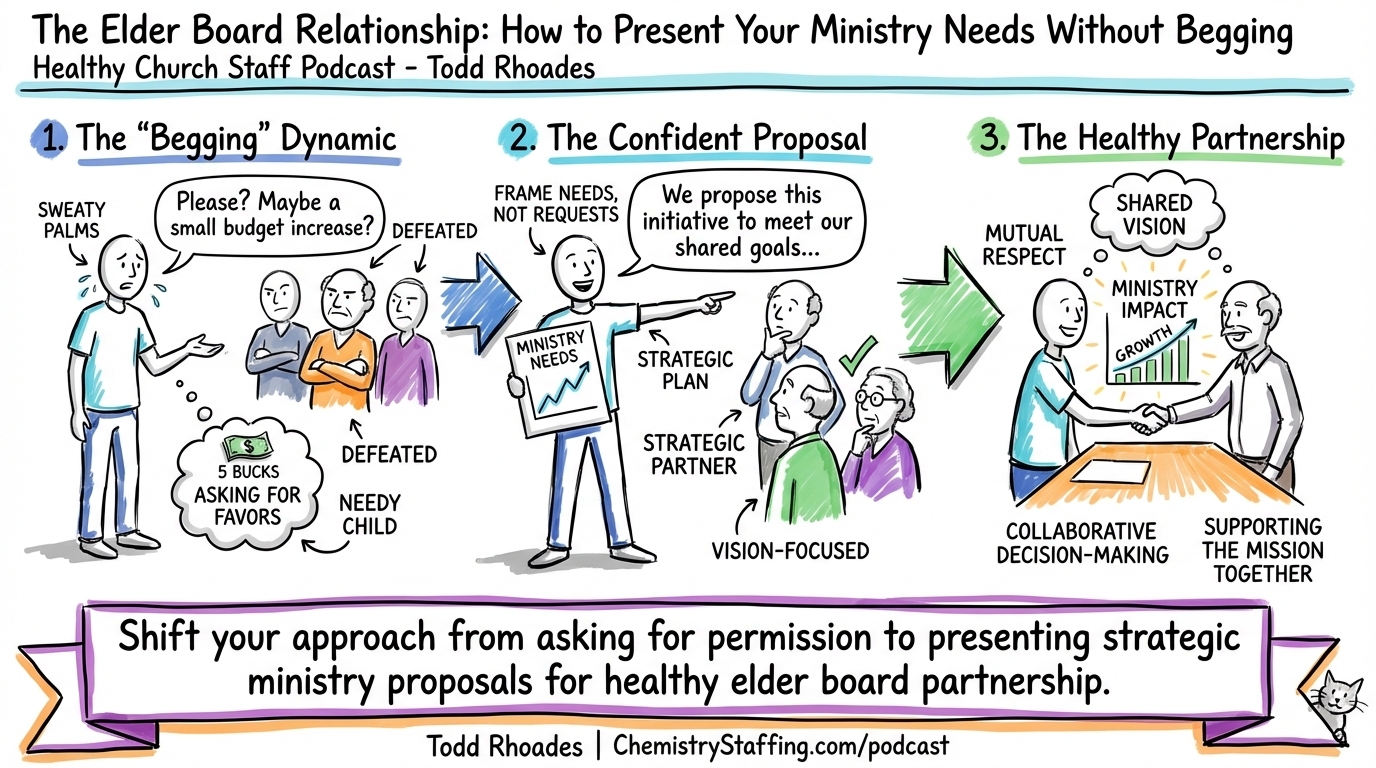
Picture this: You're walking into the elder board meeting with sweaty palms, rehearsing your pitch one more time. You desperately need resources for your ministry, but you already feel like you're about to beg. Like a kid asking dad for five dollars. And somehow, you always leave feeling a little defeated.
🎧 Listen to this episode:
If this scenario hits a little too close to home, you're not alone. This dynamic plays out in churches across the country every week, and it's time we address it head-on.
The Problem: We've Created a Beggar Dynamic
Here's what's happening: Most church staff approach their elder boards like they're asking for favors. The language gives us away immediately:
- "Could we maybe possibly get a small budget increase?"
- "I know money's really tight, but we really need this..."
- "Sorry to bother you with this, but..."
When we position ourselves as the needy child with our hands out, hoping for a positive response, we create a problematic dynamic that hurts everyone involved.
What Happens When You Operate From This Position
The consequences of the beggar approach are more damaging than you might realize:
You become known for problems, not solutions. After a few meetings where you only show up with needs, elders start bracing themselves when they see you coming. They begin to associate your presence with budget strain and difficult decisions.
You reinforce the cost-center mentality. Instead of positioning ministry as an investment in the kingdom, you accidentally frame it as a financial burden. Every conversation becomes about what you lack rather than what you're building.
You undermine your own credibility. When you consistently approach discussions from a position of desperation, it becomes harder for board members to see you as a strategic leader worth investing in.
"Plans fail for lack of counsel, but with many advisers they succeed." - Proverbs 15:22
The Solution: Think Like a Business Partner, Not a Dependent
Now, let me be clear: you care deeply about your ministry, and you absolutely should fight for the resources it needs. But there's a better way—one that positions you as a strategic partner rather than a department with its hand out.
Come With Data, Not Just Passion
Your passion for ministry is beautiful and necessary, but it's not enough to make a compelling case to board members who are often thinking with a business mindset. Instead, try language like this:
- "Here's what we're seeing in our youth engagement numbers..."
- "Based on our growth trends, here's what we need to serve effectively next quarter..."
- "This investment would allow us to reach 20 more families in our community..."
Show them the return on investment, not just the investment itself. Many of your elder board members come from business backgrounds where ROI is a natural way of thinking. Speak their language.
Frame Stewardship as Opportunity, Not Problem-Solving
The language shift here is crucial and can completely change how your proposals are received:
Language Transformation:
Instead of: "We need more money."
Say: "Here's an opportunity we could capture."
Instead of: "Can we please get this?"
Say: "I'm recommending we invest in..."
Instead of: "I know it's a lot to ask..."
Say: "Here's why this makes sense for our mission."
Notice how this reframing moves from desperation to opportunity, from asking permission to making recommendations?
Remember: Your Elder Board Wants You to Succeed
Here's something that might shift your entire perspective: your elders and board members want your church to succeed just as much as you do. They're not sitting in that boardroom trying to say no to good ideas. They're trying to say yes to the right ones.
Your job isn't to convince them that your ministry matters—they already know it does. Your job is to help them see why your specific proposal is the right investment at the right time for the right reasons.
"Now it is required that those who have been given a trust must prove faithful." - 1 Corinthians 4:2
Make Your Case for God's Leading
This isn't just about business strategy—it's about demonstrating that you've thoughtfully considered how God might be leading your church. When you present a well-researched, data-backed proposal that connects to your church's mission, you're showing that you understand stewardship in its fullest sense.
From Plea to Proposal: Your Action Plan
Ready to transform how you approach your elder board? Here's your challenge:
Step 1: Identify one upcoming request you need to make to your board.
Step 2: Rewrite it as a strategic proposal that includes:
- Current data about your ministry area
- Clear connection to your church's mission
- Expected outcomes and how you'll measure them
- Why this investment makes sense now
Step 3: Practice presenting it with confidence—because you've done the work, you know your ministry matters, and it deserves thoughtful investment.
Discussion Questions for Your Team:
- How would you describe our current relationship with our elder board? Are we seen as partners or departments asking for funding?
- What information do our elders need from us to make good decisions about ministry investment?
- Looking at our upcoming ministry needs, which ones are we presenting as "asks" rather than strategic proposals?
The Bottom Line: You're Not Begging—You're Leading
Stop asking for permission and start making proposals that demonstrate you understand the bigger picture. When you approach your elder board as a ministry partner who speaks their language and shows thoughtful stewardship, everything changes.
Your ministry matters. It deserves thoughtful investment. Present it that way.
The relationship between church staff and elder boards doesn't have to be adversarial or uncomfortable. When both sides approach it as a partnership in advancing God's kingdom, beautiful things happen—for your ministry, your church, and the community you're called to serve.
Have questions about working with your elder board? I'd love to hear about your experiences and challenges. Send your thoughts to podcast@chemistrystaffing.com or visit ChemistryStaffing.com for more resources on building healthier church teams.