

Picture this: You're sitting at your desk on a Tuesday morning. Someone slides a printed report in front of you—staff names in one column, giving amounts in another. You scan down the list, and your eyes stop at a number that seems low. Your jaw tightens. A question forms: "Are they really on board?"
🎧 Listen to this episode:
If this scenario sounds familiar, we need to talk.
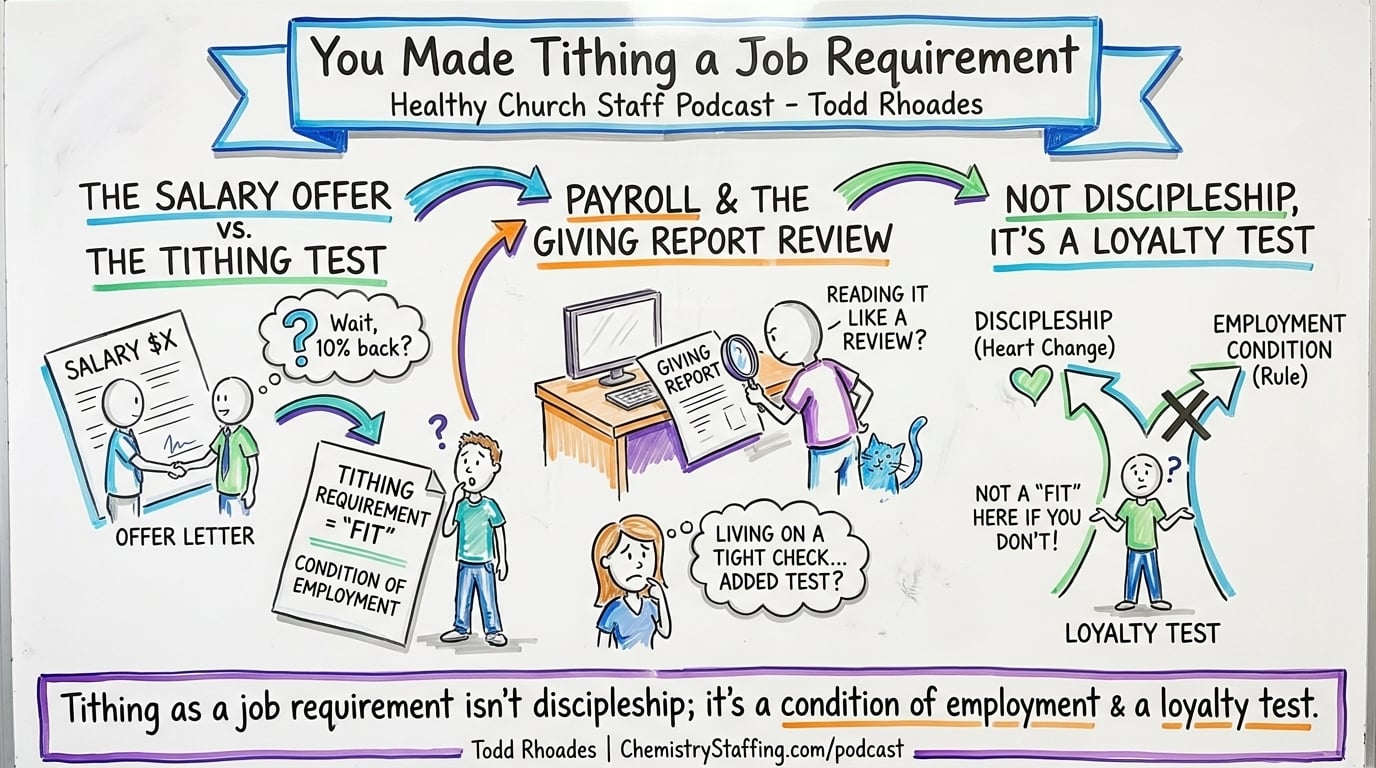
You told them the salary when you made the offer. They accepted. Then—whether in the fine print of the employee handbook or woven into the culture—came the other expectation: 10% comes back to the church. Or they're not a good fit. Not really part of the team. Not fully "on board."
Here's what I want to explore with you today: When does an expectation of generosity cross the line into a condition of employment? And what does that do to the people you've called to serve alongside you?
The Salary, Then the 10 Percent
Let's be honest about what's happening in many churches across the country. During the interview process, you named a number—the salary. The candidate weighed that number against their bills, their family's needs, their student loans. They prayed about it. They said yes.
Then came the other number: 10%.
Maybe it was explicit: "We expect all staff to tithe." Maybe it was more subtle—embedded in the culture, communicated through side conversations, reinforced when someone's name appears low on the giving report. Either way, the message is clear: part of that paycheck needs to come back, or there will be questions about your commitment, your spirituality, your fit.
They're already living on a ministry salary—which, let's be real, is often lower than what they could earn in the marketplace. Now a portion of that tight paycheck has become a test. Not a test of their ministry effectiveness. Not a test of their character or competence. A test of whether they're "really" with you.
"Each of you should give what you have decided in your heart to give, not reluctantly or under compulsion, for God loves a cheerful giver." — 2 Corinthians 9:7
When the Giving Report Becomes a Performance Review
Here's where it gets complicated. You tell yourself you're watching over spiritual health. You're modeling biblical stewardship. You're making sure your team lives what they preach.
But here's what your staff member experiences: a scorecard.
A late gift becomes a character question. A thin month becomes a meeting. The gap between what you intended (spiritual formation) and what they're experiencing (performance management) grows wider every time that report lands on your desk.
You would never write "Must give 10% or face termination" in an offer letter. But if you're treating a missed month of giving like a performance issue, if you're having conversations about "commitment" based on giving records, if job security feels connected to that number—then that's exactly what you've created. It's an HR rule with a holy label taped to it.
The Heart Behind the Policy (And Why It Still Matters)
Now, I know your heart. I've worked with enough church leaders to understand you're not trying to shake people down. You genuinely want a staff that lives what you preach. You believe generosity matters. You think requiring giving is how you form people, not how you police them.
That's a decent motivation. It's also how a spiritual practice becomes a condition of employment.
Here's the critical distinction: Discipleship invites. Job requirements enforce.
If a staff member can lose their job over how much they give, you're not forming a disciple. You're running payroll with a loyalty clause. You can love generosity. You can model it powerfully. You can teach it passionately. You cannot make their paycheck prove it—especially when that paycheck is already stretched thin.
Consider This Scenario
A youth pastor earning $38,000 has $400/month in student loan payments, a spouse in graduate school, and a baby on the way. A mandatory 10% tithe means $316 comes out of every monthly paycheck. That's not just a spiritual discipline—that's a grocery budget, a medical bill, or an emergency fund that doesn't exist.
When giving is mandated rather than invited, what are they really learning about God's grace?
You Turned a Practice Into a Rule
Giving is a practice. A beautiful, biblical, life-changing practice. A job is a contract. When you glue those two things together, something shifts in the heart.
Now staff give because they need the job, not because they've been captured by the joy of generosity. The person who gives under threat isn't "on board"—they're employed. You wanted buy-in. You got compliance.
And here's what happens next: The staff members who cannot hit that 10% on their current salary start hiding. They stop telling you the truth about their financial struggles. They're not behind spiritually—they're under an HR rule you never actually wrote down but enforce nonetheless.
"No one can serve two masters. Either you will hate the one and love the other, or you will be devoted to the one and despise the other. You cannot serve both God and money." — Luke 16:13
So What Do We Do With This?
I can hear some of you saying, "Todd, we've done this forever. Of course we expect our staff to tithe. That's just part of ministry."
I get it. And I'm not saying generosity doesn't matter. I'm not suggesting we let staff off the hook for spiritual maturity. What I'm saying is this: There's a difference between a hope and a requirement. And we need to be honest about which one we're actually implementing.
Here's the clarity you need this week: Is giving a hope or a job requirement at your church? Those are different sentences with different implications.
If it's a requirement: Put it in the offer letter. Write down exactly what happens if someone misses. State the percentage expected and the consequences for non-compliance. Let candidates accept or walk away before they unpack their office. Be fully transparent about what they're agreeing to.
If it's not a requirement: Stop treating the giving report like a performance review. Stop having "are they really committed" conversations that start with a gift total. Stop the side-eye when someone's name is low on the list. A hope can be named, taught, and modeled. A hope cannot fire people.
If you're not willing to put it in the offer letter as an explicit condition of employment, then it's not actually a requirement—and you need to stop managing it like one.
Action Steps for This Week
- Review your employment policies. Are there giving expectations buried in handbooks or implied in culture that aren't explicit in offer letters?
- Audit your compensation. Are you paying staff enough that tithing is financially feasible, or are you asking them to give from scarcity?
- Examine your practices. Do you review staff giving reports? If so, what do you do with that information? Is it truly about spiritual formation, or has it become about control?
- Create safe spaces. Can your staff be honest with you about financial pressure without fear of judgment or job consequences?
- Model, don't mandate. Share your own generosity journey (appropriately), including the struggles and growth, rather than requiring a percentage from people you've hired.
The Bottom Line
You told them the salary. Then you told them 10% comes back or they're not a fit. That's not discipleship. That's a condition of employment you never put in the offer letter.
I know this feels like a fight with generosity. It's not. This is a fight with the loyalty test you attached to a paycheck. It's a fight for the hearts of your staff members—so they can give freely, joyfully, from a heart captured by grace rather than from fear of losing their job.
The practice didn't become the problem. The rule did.
"For Scripture says, 'Do not muzzle an ox while it is treading out the grain,' and 'The worker deserves his wages.'" — 1 Timothy 5:18
Let's Talk About It
This is one of those conversations that might make you uncomfortable. Good. The best growth often happens in discomfort. Maybe you need to have a conversation with your leadership team about your policies. Maybe you need to revisit how you've been thinking about staff giving. Maybe you need to have an honest conversation with a staff member you've judged based on a giving report.
Whatever your next step is, I'd love to hear from you. What's your experience with this issue? Where do you see the line between expecting spiritual maturity and requiring financial compliance? What policies have worked well in your context—or created problems you're now trying to untangle?
Send me your thoughts at podcast@chemistrystaffing.com. I read every email, and your insights help shape future conversations that benefit church leaders everywhere.
Let's build healthier churches together—churches where generosity flows from hearts transformed by grace, not from paychecks monitored for compliance.
Need Help Building a Healthier Church Staff Culture?
At Chemistry Staffing, we help churches find the right people and build environments where they can thrive. Whether you're hiring, restructuring, or working through staff culture challenges, we're here to help.