

If I asked who handles HR at your church, would you name a role or just give me someone's first name?
🎧 Listen to this episode:
"Oh, Karen takes care of all that."
Karen might be your office manager, church administrator, or operations coordinator. She handles the calendar, keeps the office running, and somehow knows where everything is. She's the glue that holds your church office together.
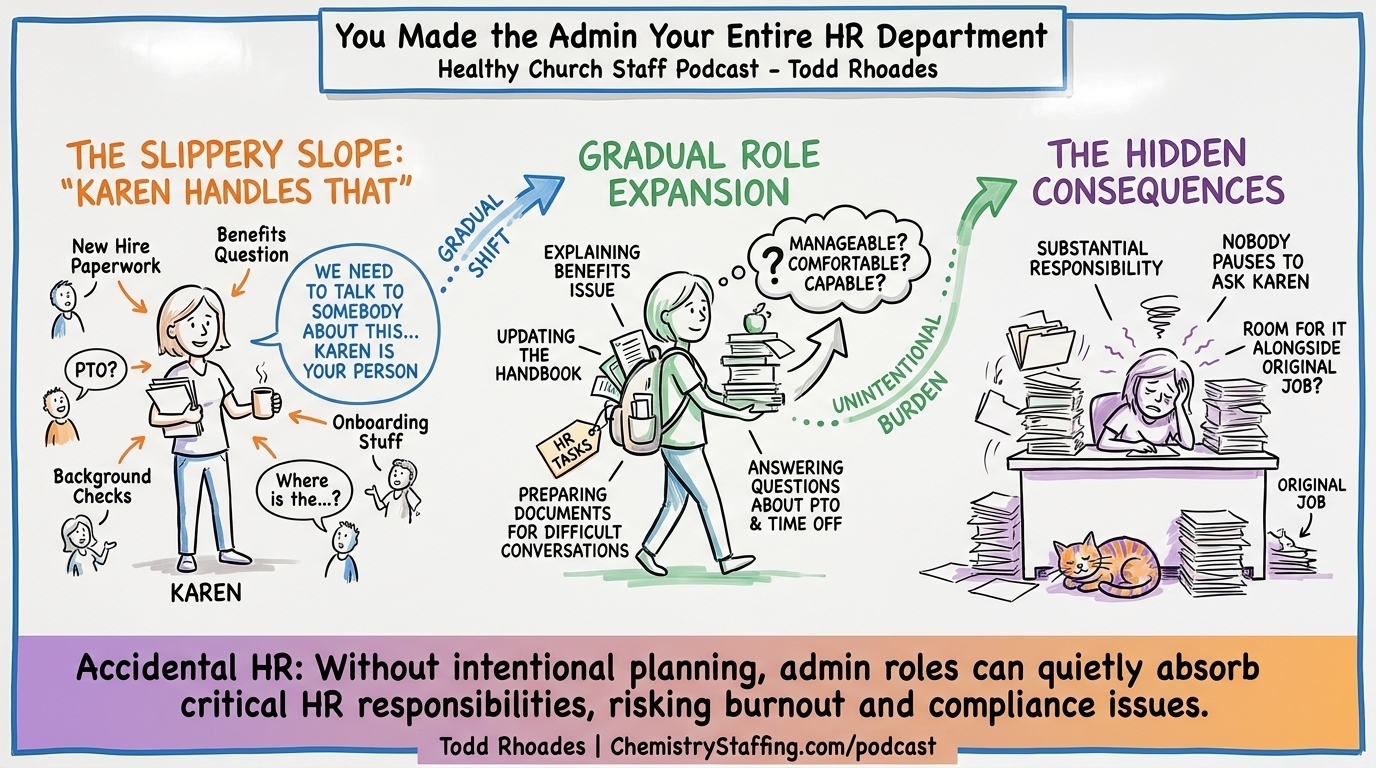
But here's what else Karen does: She processes new-hire paperwork, answers benefits questions, runs background checks, coordinates onboarding, and fields whatever comes up when someone says, "We probably need to talk to somebody about this."
Karen has become the answer to a much bigger question than anyone remembers asking.
Today, let's talk about what happens when a capable administrator gradually becomes your church's entire HR department—and what to do about it.
How Did We Get Here?
It usually starts innocently enough. Karen begins by helping with hiring paperwork. That makes sense—she's organized, detail-oriented, and reliable.
Then someone asks her to explain a benefits issue. Next, she's updating the employee handbook, answering questions about PTO, and preparing documents for a difficult staff conversation.
Each individual request sounds perfectly manageable: "Karen, could you just take care of this?"
But together, those requests become a substantial responsibility. And here's the problem: Nobody ever pauses to ask whether Karen wants that responsibility, knows how to handle it, or has room for it alongside her original job.
The work simply follows the person who reliably gets things done.
Is This Really a Problem?
Let me be clear: There's nothing inherently wrong with an administrator handling HR responsibilities. In a smaller church, combining roles isn't just practical—it's often necessary.
The question is whether you've intentionally built that role and properly supported the person doing it, or whether you've just kept piling on responsibilities as they arose.
Here's the distinction that matters: Are you asking Karen to handle administrative HR tasks within a clear scope, or are you expecting her to navigate complex employment situations, make judgment calls on sensitive issues, and essentially function as an HR professional without the training, authority, or compensation to match?
Exodus 18:17-18 - "Moses' father-in-law replied, 'What you are doing is not good. You and these people who come to you will only wear yourselves out. The work is too heavy for you; you cannot handle it alone.'"
Three Things Every Church Leader Should Consider
1. Separate Administrative Work from Leadership Decisions and Specialized Advice
Not all HR work is created equal. Understanding the difference is crucial:
- Scheduling interviews is different from deciding who gets hired
- Keeping personnel records is different from interpreting a sensitive employment situation
- Preparing termination paperwork is different from taking responsibility for the decision and conversation
These tasks may be connected, but they require different levels of authority, expertise, and experience.
Your administrator needs to know:
- Which decisions they can make independently
- Which decisions belong to a supervisor or pastor
- When to bring in qualified outside help
"Use your best judgment" can be appropriate guidance within a clearly defined role. It becomes a crushing burden when it means, "Figure out whatever the rest of us don't understand."
And here's what's non-negotiable: Leaders need to stay present for the difficult parts. You can delegate preparation and coordination, but you still need to own the decisions that are yours to make. Don't ask Karen to make leadership decisions that should rest with pastoral or executive leadership.
2. Match the Role with the Resources
If HR has become a meaningful part of someone's job, it's time for a direct conversation:
- Do they want to develop in this area?
- Is this work they enjoy, or does it drain them?
- What training would actually help them succeed?
- What responsibilities should move off their plate to create capacity?
- Does their compensation reflect the scope of work you're asking them to do?
A new title might help clarify the role, but it won't create capacity or expertise by itself. And buying HRIS software won't answer every question either. Software can organize a process, but someone still needs to understand how that process works and recognize when a situation requires more than a workflow can provide.
💡 Consider This: Support might come from an experienced HR professional who works with your church a few hours a month, or another qualified outside resource tailored to your situation. You don't necessarily need a full-time HR position, especially in a smaller church. But you do need a realistic plan for getting the work done well—without overwhelming anyone.
1 Timothy 5:17-18 - "The elders who direct the affairs of the church well are worthy of double honor, especially those whose work is preaching and teaching. For Scripture says, 'Do not muzzle an ox while it is treading out the grain,' and 'The worker deserves his wages.'"
Honoring workers includes proper compensation for the actual work being done.
3. Give Staff a Clear Place to Go When the Usual Route Isn't Appropriate
Here's a scenario that should make every church leader pause:
Imagine Karen reports to the executive pastor, and a staff member has a serious concern involving that executive pastor. What is Karen supposed to do with that information?
That shouldn't become a process she has to invent in the moment.
Your staff need to know:
- Where concerns go
- Who will respond to those concerns
- What happens if the concern involves their direct supervisor
Karen needs those answers too—especially if you're asking her to handle HR functions. Without clear pathways, Karen becomes the unofficial counselor, investigator, and messenger for every difficult situation in the building.
That's not what she signed up for. And it's not fair to put her in that position.
Your Next Step This Week
Here's something practical you can do right now:
Sit down with the person who handles your administrative work. (Maybe her name isn't even Karen—but you know who I'm talking about.)
Ask them to walk you through every staff-related responsibility they currently carry. Don't start by defending how things ended up this way. Just listen and learn what the actual job involves.
Then work together to identify:
- Who truly owns each responsibility
- What support each responsibility requires
- What needs to change (if anything)
Put dates beside those changes and schedule a follow-up conversation.
Questions to Ask in That Conversation:
- What HR-related tasks are you currently handling that weren't in your original job description?
- Which of these responsibilities do you feel confident managing, and which ones feel outside your comfort zone?
- What would help you succeed in this work—training, clearer authority, outside consultation, or something else?
- Are there tasks that should be handled by someone else entirely?
- Does your current compensation reflect the scope of work you're actually doing?
The Bottom Line
Your administrator's competence is a tremendous asset to your church. But competence without proper support, authority, and compensation isn't stewardship—it's exploitation, even if unintentional.
The goal isn't necessarily to hire a full-time HR director (though some churches need that). The goal is to ensure that whoever handles these critical functions has:
- A clearly defined role with appropriate boundaries
- The authority to do the job well
- Access to training and outside expertise when needed
- Compensation that reflects the actual scope of their work
- Leadership that shares the responsibility for difficult decisions
That way, the next time you say, "Karen handles that," you can be confident that Karen actually knows it's coming and has what she needs to handle it well.
Colossians 3:23-24 - "Whatever you do, work at it with all your heart, as working for the Lord, not for human masters, since you know that you will receive an inheritance from the Lord as a reward. It is the Lord Christ you are serving."
Let's Talk About Your Situation
I know this can be a touchy subject. Many churches aren't large enough to have a dedicated HR professional, and that's okay. But that doesn't mean we can ignore the work or burden one person unfairly.
If you're wrestling with this in your church—if you're stuck and don't know what to do next—I'd love to hear from you. Reach out to me at podcast@chemistrystaffing.com and let me know what's going on. Let's see if there's a way we can help.
And if you're looking for more resources on building a healthy staff culture, head over to blog.chemistrystaffing.com where you'll find tons of articles, tools, and insights for church leaders navigating staffing challenges.
This post is based on Episode 730 of the Healthy Church Staff Podcast. Subscribe to never miss an episode.