

Picture this: You just finished a performance review with one of your staff members. You walked in with three real concerns about their work. You walked out having addressed absolutely none of them.
🎧 Listen to this episode:
Instead, you spent twenty minutes dancing around the issues, complimenting their heart, and mentioning their "growth areas" in passing. They left feeling encouraged but unchanged. You left feeling like a coward.
Sound familiar?
If you're nodding your head right now, you're not alone. Most church staff performance reviews fall into one of two equally problematic camps: either they avoid the hard stuff completely, or they crush people's spirits entirely. But there's a better way—a way to give honest feedback that actually helps people grow in both competence and character.
The Annual Charade: Why Most Church Reviews Fail
We've turned performance reviews into elaborate kindness competitions. We're so afraid of hurting feelings that we end up hurting futures instead. Here's the uncomfortable truth: we mistake being nice for being loving, and we confuse encouragement with enabling.
Meanwhile, your staff member keeps making the same mistakes, the team keeps carrying their slack, and you keep hoping they'll magically figure it out on their own. Spoiler alert: they probably won't.
"Encouragement without honesty isn't love—it's enabling."
The Dangerous Drift
Here's what happens when we consistently avoid the hard conversations:
- The staff member thinks they're crushing it when they're actually struggling
- They get blindsided when issues finally explode
- The rest of your team loses respect for your leadership
- You start managing around their weaknesses instead of developing their strengths
- Church culture suffers because standards disappear
The only person who doesn't see the problem is the staff person who thinks they're hitting it out of the park. Everyone else—your entire team—watches and wonders why you're not addressing what's obvious to them.
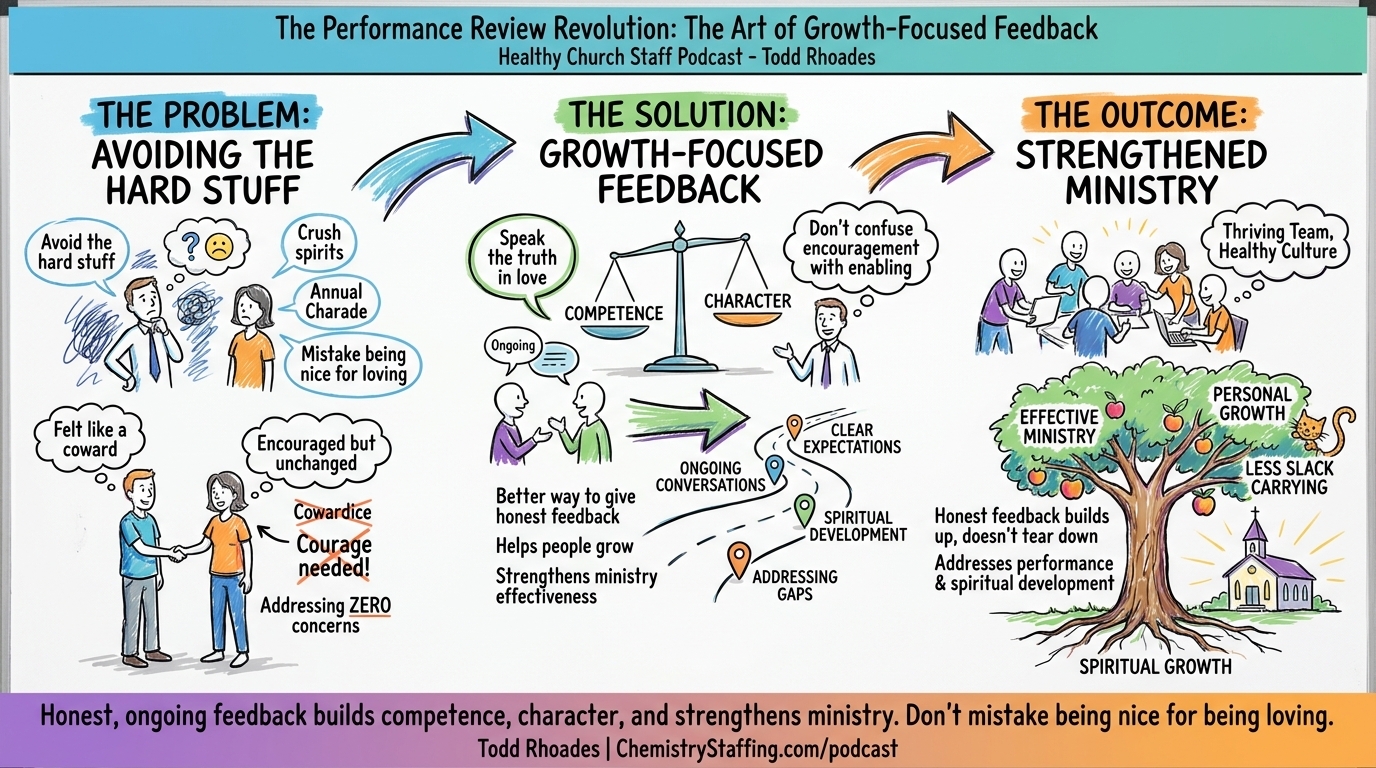
The Growth-Focused Approach: A Better Way Forward
Your heart to encourage people is exactly right—don't lose that. But what if we could combine honest feedback with genuine encouragement? What if we could create performance reviews that people actually look forward to?
Here's a revolutionary framework that transforms how both you and your staff experience these crucial conversations:
1. Start with Their Calling, Not Their Failures
Begin every difficult conversation this way: "God has gifted you for ministry, which is why we need to talk about this."
This isn't just a nice opener—it's foundational. You're establishing that this conversation flows from their calling, not from your frustration. You're saying you believe in their potential so much that you're willing to invest in their growth.
2. Name Specific Behaviors, Not Character Flaws
There's a world of difference between saying "Your reports are consistently late" and "You're disorganized." One addresses behavior that can be changed; the other attacks character and leaves people feeling hopeless.
Focus on observable actions and their impact. Be specific, be factual, and be kind.
3. Connect Performance to Mission Impact
Help them see the bigger picture: "When this happens, here's how it affects the people we're trying to reach."
This isn't about making them feel guilty—it's about helping them understand that their role matters. Every task, every responsibility, every standard exists to serve the mission God has given your church.
4. Ask Before You Tell
Instead of launching into solutions, try this: "What do you think is getting in the way here?"
You might be surprised by their self-awareness. Often, they know exactly what the problem is and just need permission to talk about it. Other times, this question reveals blind spots that need addressing.
5. End with a Development Plan
Don't let them walk out feeling criticized without feeling equipped. Close every challenging conversation with: "Here's how we're going to help you grow in this area."
This changes everything about how people receive feedback. It transforms criticism into investment and problems into opportunities.
Biblical Foundation: Speaking Truth in Love
"Instead, speaking the truth in love, we will grow to become in every respect the mature body of him who is the head, that is, Christ. From him the whole body, joined and held together by every supporting ligament, grows and builds itself up in love, as each part does its work." - Ephesians 4:15-16
Ministry is Discipleship, Not Task Management
Here's where most of us get it wrong: we think performance reviews are about getting tasks off our plate and onto someone else's. That's task management.
But ministry is discipleship. Your staff reviews should develop disciples who happen to do ministry work, not just employees who complete assignments. When feedback is done right, character and competence grow together.
People will leave feeling challenged and equipped, not crushed and confused. They'll see their work as part of their spiritual journey, not just their job description.
Rewriting Your Review Framework
The goal of a performance review isn't to make people feel good or bad—it's to help them become who God has designed them to be in their role.
This week, I challenge you to rewrite your performance review template. Start by adding these three powerful questions:
Three Game-Changing Review Questions
- How is God developing you through this role?
- What obstacles are preventing your best work?
- How can we most help you grow in the areas that matter most?
Notice how these questions shift the entire conversation. Instead of focusing on what's wrong, you're exploring what God is doing and how you can partner with Him in their development.
Taking the Next Step
Your people want to grow more than they want to be comfortable. They're hungry for leaders who will invest in their development, even when it requires difficult conversations.
Remember: faithful feedback is a form of spiritual care. When you avoid the hard conversations, you're not protecting people—you're preventing their growth.
Action Steps for This Week
- Review your current performance review template (or create one if you don't have one)
- Identify one team member who needs honest, growth-focused feedback
- Schedule a conversation using the framework above
- Practice starting with their calling and ending with a development plan
Whether you have a well-developed performance review system that needs tweaking, a horrible one that needs overhauling, or no system at all, there's hope. You can create a feedback culture that builds people up while addressing real issues.
If you need help developing a comprehensive performance review system specifically designed for churches, I'd love to hear from you. Send your questions, challenges, or success stories to podcast@chemistrystaffing.com.
Your team is depending on you to help them grow. Give them the gift of honest, loving feedback—they'll thank you for it, and your ministry will be stronger because of it.