

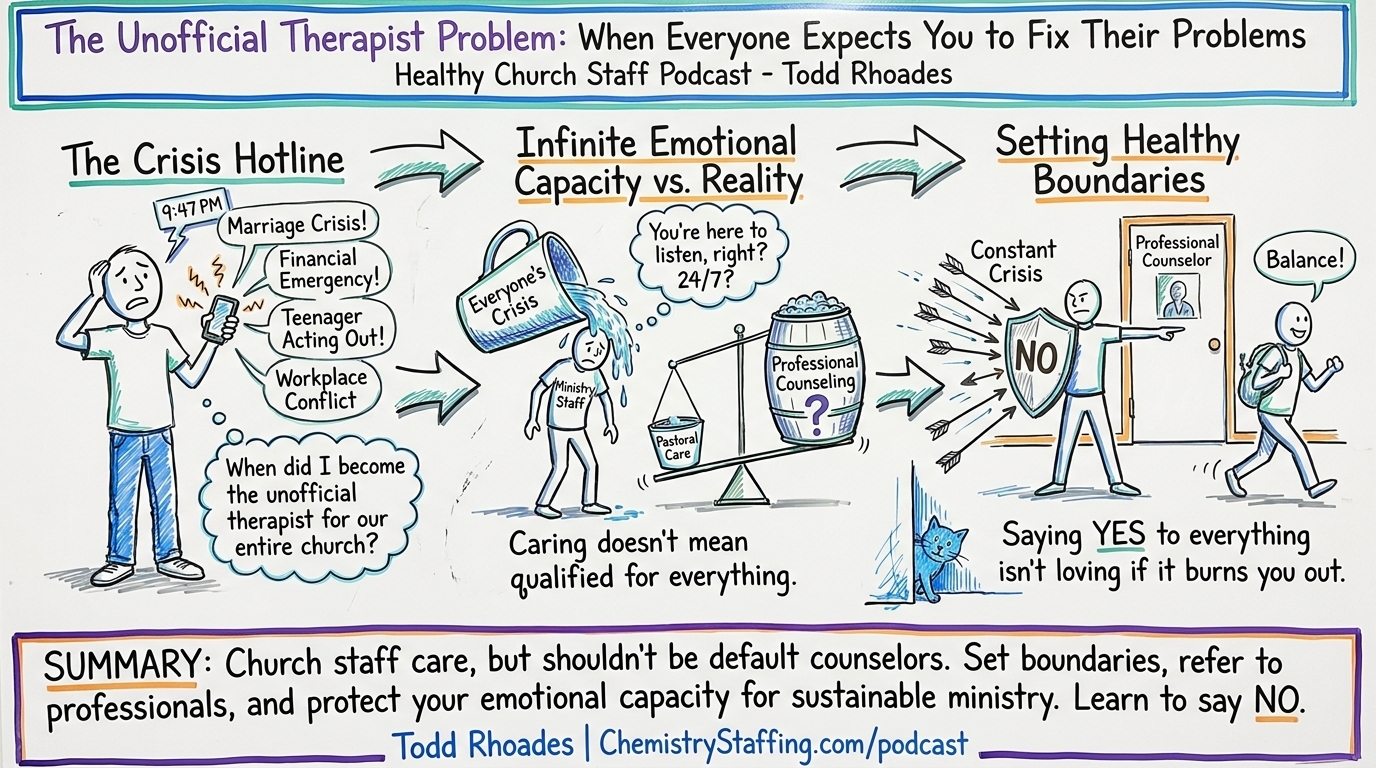
It's 9:47 PM. You're about ready for bed when your phone buzzes with yet another text about someone's marriage crisis. Yesterday it was a financial emergency. Last week, someone's teenager was acting out. Before that, a workplace conflict that "only you could help with."
🎧 Listen to this episode:
Sound familiar? If you're asking yourself, "When did I become the unofficial therapist for our entire church?" you're not alone. And more importantly, you're not stuck in this pattern forever.
The truth is, many church staff members find themselves drowning in other people's problems, feeling guilty about setting limits, and wondering how caring for people turned into managing everyone's personal crises 24/7.
The Expectation Trap That's Burning You Out
Here's what's really happening behind the scenes: People assume that ministry staff have infinite emotional capacity. They think your calling includes being available around the clock for all their problems. You became the go-to person because you hold the title and because you genuinely care about people.
But here's the crucial distinction many miss: caring doesn't mean you're qualified to handle everything. There's a significant difference between pastoral care and professional counseling—and you learn this reality very quickly in ministry.
The drift into dysfunction happens gradually. You start saying yes to everything because it feels loving, like that's what you're supposed to do as a staff member and pastor. Over time, your phone becomes a crisis hotline you never signed up for. You find yourself:
- Giving advice outside your expertise (and wondering if it's even right)
- Watching people stop taking responsibility because they know you'll "fix it"
- Having your family time hijacked by other people's emergencies
- Feeling exhausted but guilty about setting any limits
Why Your Good Heart Isn't Helping Anyone
Your heart to help people is exactly right—that's not the problem. But you're not helping anyone when you're burned out and operating outside your gifting. In fact, you might be causing more harm than good.
"Bear one another's burdens, and so fulfill the law of Christ... For each will have to bear his own load." - Galatians 6:2, 5 (ESV)
Notice the balance in this passage: we're called to bear burdens together, but everyone must also carry their own load. There's a difference between supporting someone through a crisis and becoming their personal problem-solver.
The Boundary Solution That Actually Works
Here's something that's not very popular in pastoral ministry: Boundaries aren't selfish—they're stewardship. You can care without carrying everybody's problems.
Start practicing this simple phrase: "I care about you, and I want you to get the best help." Then follow through by building a referral list of actual counselors and professionals.
How many times have people brought you situations where, two minutes in, you realize you're way out of your league? Issues with legal consequences, complex moral implications, or problems requiring lengthy professional intervention that you're simply not trained for.
Practical Boundary-Setting Strategies
Create office hours for non-emergency conversations. Not every text demands a two-hour counseling session, and certainly not every text demands one this afternoon. Stop responding to messages immediately just because you can. Yes, it might drive some people crazy initially, but it helps establish healthy expectations.
Distinguish between emergencies and urgencies. There are absolutely real emergencies where your pastoral presence is needed immediately. But many things people label as "emergencies" are actually just issues weighing heavily on their hearts that day.
Build systems, not just staff heroics. Healthy churches have processes for handling different types of crises. When you're always the fix-it person, you're actually disempowering people and preventing them from developing their own problem-solving skills.
This Week's Challenge
Write down three types of problems that regularly land on your desk but shouldn't. Then identify one person or resource you can refer those situations to instead. Practice this phrase: "I care about you, and I want you to get the best help for this."
Leading by Example: The Senior Pastor's Role
If you're a senior pastor, your congregation learns what's acceptable by watching you. If you're constantly available for every crisis, you're setting an unsustainable standard for your entire team.
If you're on staff under a senior pastor, this conversation might need to start with your leadership. Teams that model healthy boundaries together create church cultures where people grow in resilience rather than dependence.
"Come to me, all who labor and are heavy laden, and I will give you rest... For my yoke is easy, and my burden is light." - Matthew 11:28-30 (ESV)
Notice that Jesus promises rest, not endless labor. Even He withdrew from crowds to rest and pray. If the Son of God needed boundaries, so do you.
The Bottom Line That Changes Everything
You can't love people well when you're trying to be their savior instead of pointing them to the Savior. Your role is to minister effectively within your calling and gifting, not to manage everyone's life chaos.
This doesn't mean you stop caring or that counseling isn't part of pastoral ministry—it absolutely is. One-on-one investment in people's lives is one of the most purely pastoral things you can do. But you can't be on call 24/7 and remain effective long-term.
Discussion Questions for Your Team
- What types of situations do we commonly encounter where people expect us to be unofficial therapists?
- How can we better distinguish between appropriate pastoral care and situations requiring professional help?
- What local professional counselors or social services could we build relationships with for referrals?
- How can we educate our congregation about healthy boundaries while still demonstrating Christ's love?
Moving Forward with Healthy Ministry
You have to guard your own soul and the souls of your family as you minister to the people God has entrusted to you. This isn't selfish—it's sustainable ministry that honors God and serves people well over the long haul.
Remember: You were called to ministry, not to be everyone's personal crisis manager. There's a difference, and your sanity—and your family's well-being—depends on knowing it.
Setting boundaries is actually one of the most loving things you can do. It ensures you'll be available for the ministry God has specifically called you to, and it helps people develop the skills and resources they need to handle life's challenges with resilience and faith.
What's your experience with the "unofficial therapist" problem? Have you found strategies that work for setting healthy boundaries while still caring well for people? I'd love to hear your thoughts and stories. Send them my way at podcast@chemistrystaffing.com.
Looking for help building a healthier church staff culture? At Chemistry Staffing, we help churches find the right people and build sustainable ministry teams. Reach out if we can help with your staffing needs or team development.