
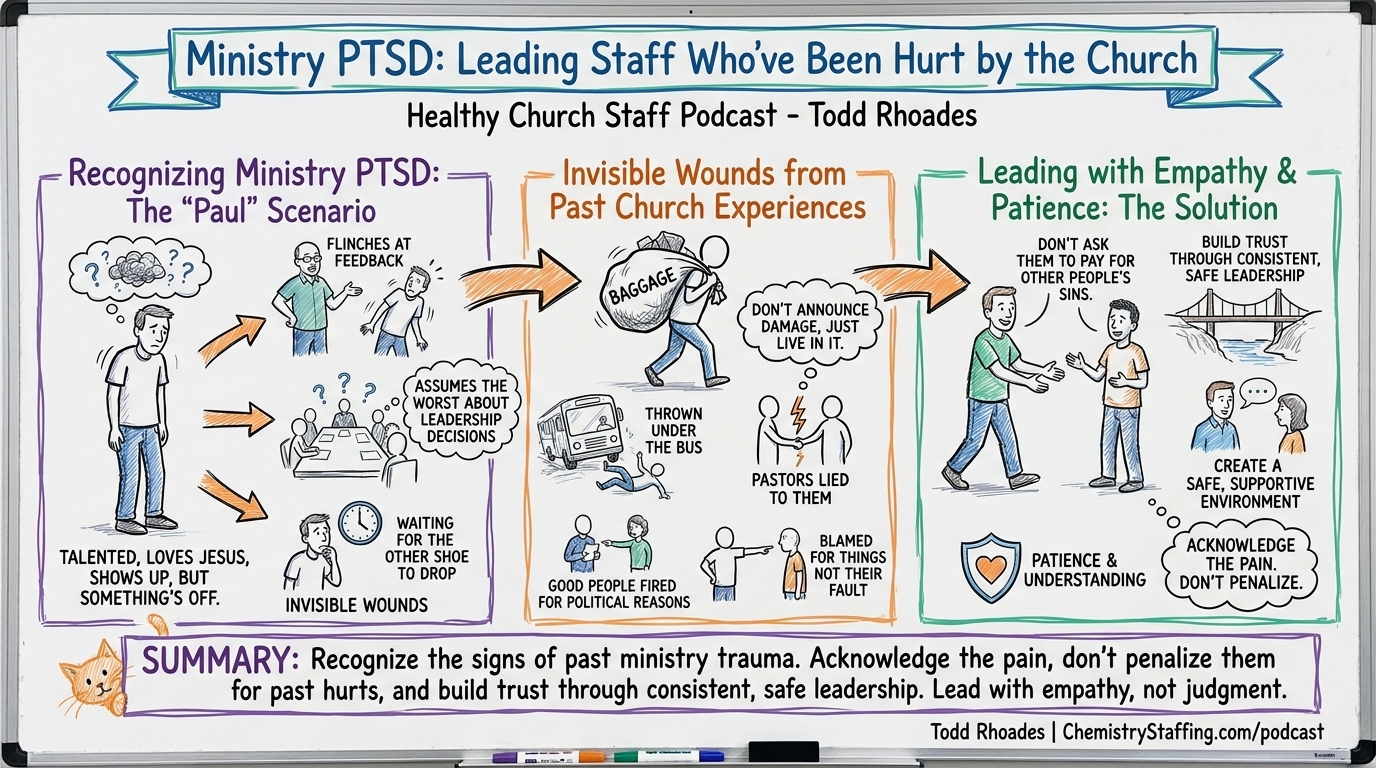
You hired someone three months ago—let's call him Paul. He's talented, loves Jesus, and shows up faithfully every single day. But something's off.
🎧 Listen to this episode:
Paul flinches when you give him feedback. He assumes the worst about leadership decisions immediately. You can almost see him waiting for the other shoe to drop.
If this sounds familiar, you're not alone. You're witnessing what I call "ministry PTSD," and it's far more common on church staffs than most of us want to admit.
The Invisible Wounds Your Staff Members Carry
Here's what makes ministry PTSD particularly challenging: most wounded staff members don't announce their damage. They don't walk into your office and say, "Hey, I'm carrying some serious church hurt from my last position." Instead, they just live in it. They operate from it.
These are people who've been thrown under the bus at their previous church. They've had pastors lie to them. They've watched good people get fired for political reasons. They've been blamed for things that weren't remotely their fault.
And now they're on your team, bringing all that invisible baggage with them.
What Ministry PTSD Actually Looks Like
If you're wondering whether someone on your team might be carrying church wounds, here are the telltale signs:
- They document everything in writing (often following up verbal conversations with detailed email summaries)
- They're hypervigilant about church politics (reading into every closed-door meeting or leadership conversation)
- They assume leadership meetings are about them (even when they have nothing to do with their role)
- They read rejection into normal feedback (turning a simple suggestion into an existential threat to their job security)
- They keep their resume updated "just in case" (one foot always out the door)
- They're excellent at their job but terrible at trusting (high competence, low relational openness)
Now listen—they're not being dramatic. They're being protective. And honestly, given what they've been through, can you blame them?
"Wounded staff members don't announce their damage. They just operate from it."
The Reality You Need to Accept
Here's something I tell churches all the time when they're interviewing candidates coming from difficult situations: you cannot ask this person to pay for other people's sins.
But the reality is, in some ways, you are paying for other people's sins. You're dealing with the fallout from how this person was treated at their last church. You're working to rebuild trust even though you've done nothing to break it.
And yes, that can feel frustrating at times.
But it's also holy work.
How to Lead Staff Members Carrying Church Wounds
1. Acknowledge the Elephant Without Demanding the Details
You don't need to make wounded team members tell their war stories. A simple acknowledgment goes a long way: "I know churches can be hard places to work."
That's it. Don't pry. Don't make them relive their trauma. Just let them know you're aware that ministry can be wounding, and you're committed to creating a different environment.
2. Create Predictable Rhythms They Can Count On
Wounded people desperately need to see patterns of safety. This means:
- Same meeting times (not constantly rescheduled)
- Same check-in style (consistent approach, not erratic)
- Same follow-through (you do what you say you'll do)
Think about it: if someone's been burned by unpredictable leadership before, predictability becomes a healing balm.
3. Be Boringly Consistent With Your Word
This is how you rebuild trust with wounded staff: through boring consistency.
If you say Tuesday, mean Tuesday. If you say you'll revisit something, actually revisit it. If you promise a follow-up conversation, put it on your calendar and make it happen.
Trust isn't built through grand gestures. It's built through a thousand small moments of reliability.
4. Over-Communicate Your Thought Process
What seems like simple feedback to you might feel like a career threat to someone carrying ministry wounds. So over-communicate:
- "Here's why I'm asking this question..."
- "This feedback isn't about your job security..."
- "I'm just thinking out loud here, not making a decision..."
Yes, it requires extra effort. But it prevents wounded staff members from filling in the blanks with their worst fears.
Biblical Perspective
Psalm 147:3 - "He heals the brokenhearted and binds up their wounds."
God is in the healing business, and as His representatives in leadership, we partner with Him in creating environments where healing can happen. Your consistency, patience, and grace create the safe space where the Holy Spirit does His restorative work.
The Leadership Mistakes You Must Avoid
Here's where well-meaning leaders often get it wrong with wounded staff members:
Don't Try to Heal Them
You're their boss, not their therapist. Don't make their healing your personal mission. You can't fix them, and attempting to do so crosses professional boundaries.
Don't Take Their Triggers Personally
When they overreact to something that seems minor to you, remember: you're not seeing the full picture. Their response is about their history, not your leadership.
Don't Rush Their Trust Timeline
Some wounds take literally years to heal. You might be the healthiest leader they've ever worked with, but they won't know that until they've seen you handle conflict, navigate stress, and weather a few storms together.
Your job is to create space for them to heal while they work, not to fix them while they work.
The Unexpected Gift of Wounded Staff Members
Here's something that might surprise you: wounded staff members often become your most loyal team players.
Why? Because they know what bad leadership looks like. They can recognize and appreciate good leadership when they finally encounter it.
They've seen churches implode from the inside, so they'll fight harder than anyone else to protect healthy culture.
They just need time to believe that your church is different.
Questions for Reflection
- Which staff member might currently be carrying church wounds that I haven't fully recognized?
- What patterns of safety have I established (or failed to establish) with my team?
- Am I being boringly consistent with my word, or am I contributing to an environment of uncertainty?
- Have I tried to "fix" someone when I should have simply created space for healing?
Your Next Step This Week
Here's your challenge: Identify which staff member might be carrying church wounds, and have a simple conversation with them. Ask: "How can I lead you better?"
Then listen. Don't fix. Don't explain. Don't defend. Just listen.
You might be surprised what you learn.
The Bottom Line
You cannot heal your staff members' wounds from previous ministry experiences. That's God's job, possibly with the help of a good Christian counselor.
But here's what you absolutely can do: you can stop creating new ones.
You can be the leader who proves that not all churches are toxic. You can model what healthy leadership actually looks like. You can create an environment where wounded people don't just survive—they thrive.
Leading wounded people is holy work. Thanks for doing it with patience and grace.
"Your job is to create space for them to heal while they work, not to fix them while they work."
Need Help Leading Your Staff Well?
If this resonated with you, or if you're navigating a challenging staff situation and could use some coaching, I'd love to have a conversation. Reach out to me at podcast@chemistrystaffing.com. Let's talk about how to create a healthier environment for your entire team.
And if you know another church leader who needs to hear this, share this article with them. We're all in this together.
Todd Rhoades is co-founder of Chemistry Staffing and host of the Healthy Church Staff Podcast, where he helps church leaders build healthier teams every Monday through Friday.