

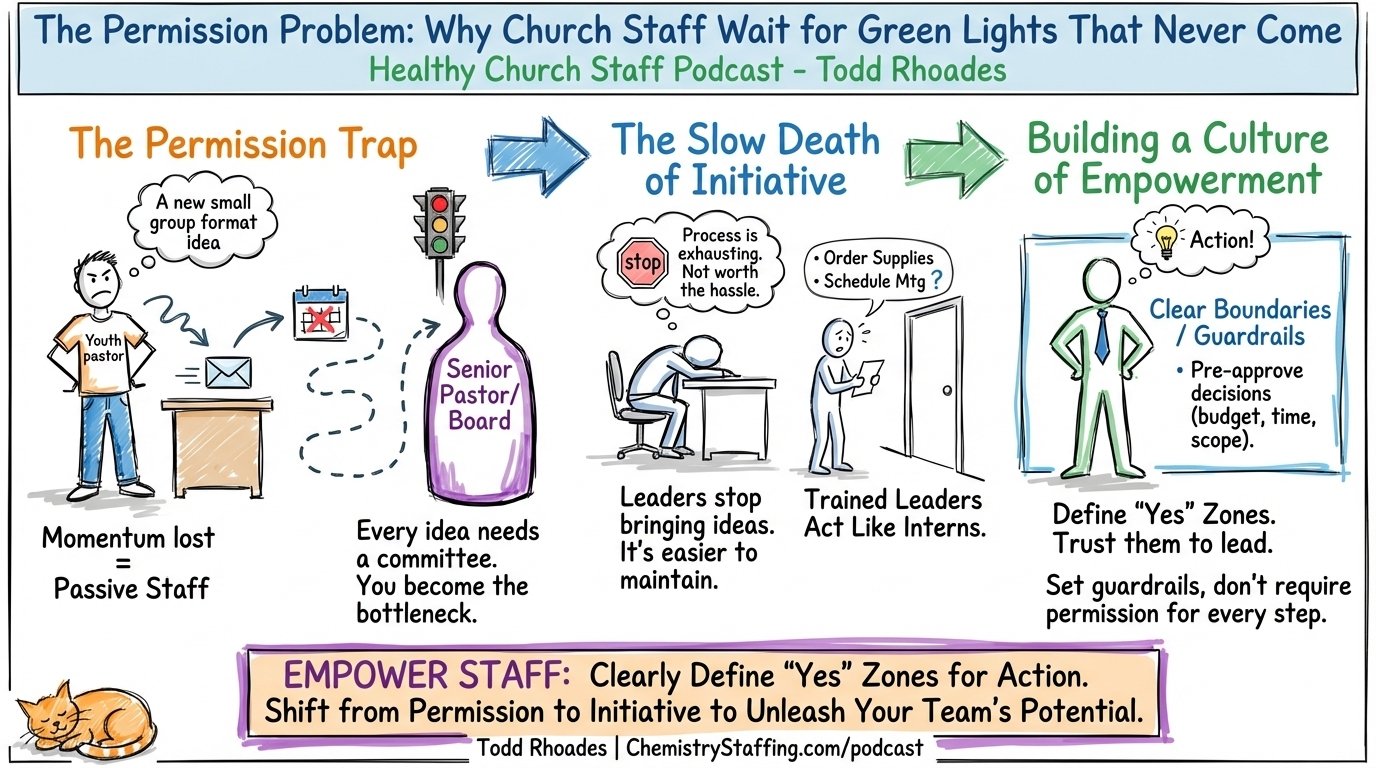
Your youth pastor has an idea for a new small group format. They write an email, schedule a meeting, then wait three weeks for your calendar to open up. By the time you finally say "yeah, sounds good," they've lost all momentum—and honestly, they've stopped caring.
🎧 Listen to this episode:
If this scenario feels painfully familiar, you're not alone. I'm seeing this pattern in churches everywhere: well-meaning leaders who've accidentally created what I call "permission addicts."
Your staff used to be leaders. Now they're order-takers. Somewhere along the way, we taught them that every decision needs approval, every idea needs a committee, and every change needs a green light from the top.
The Slow Death of Initiative
Here's what's happening behind the scenes in permission-heavy churches, and it's heartbreaking to watch:
Staff stop bringing you ideas because your process is exhausting. Think about it—when bringing a simple suggestion requires multiple emails, meetings, and weeks of waiting, innovation dies.
They stop taking risks because it's easier to keep their heads down and maintain the status quo. Why rock the boat when you know you'll have to navigate an approval maze?
They start asking permission for things they should just handle. We're talking about ordering supplies, scheduling volunteer meetings, or changing room setups. We've trained capable leaders to act like interns.
"Moses' father-in-law replied, 'What you are doing is not good. You and these people who come to you will only wear yourselves out. The work is too heavy for you; you cannot handle it alone.'" - Exodus 18:17-18
Sound familiar? Even Moses needed to learn about empowering others to make decisions.
How We Got Here (And It's Not Your Fault)
Listen, this didn't happen overnight, and it didn't happen on purpose. Most permission cultures develop because leaders are trying to avoid chaos.
Maybe you got burned by a staff member who made a rogue decision that caught you off guard. Maybe you inherited a mess from loose oversight. So you tightened the reins—understandably so.
You probably created this system to avoid those uncomfortable phone calls from members upset about decisions they didn't see coming. The problem is, when you pull that rope too tight, you become the bottleneck for everything getting done.
Permission Culture vs. Boundary Culture
Here's the game-changer: Permission culture kills initiative, but boundary culture creates confidence.
Permission culture says: "Ask first." Every time. For everything.
Boundary culture says: "Here's your sandbox. Here are the guardrails. Now go build something amazing."
Your staff needs to know what they can do, not just what they can't. They need decision rights, not decision paralysis.
What Boundary Culture Looks Like in Practice
Instead of making your children's pastor ask permission for every programming decision, try this: "You own programming for ages 2-12. Your budget limit is $500 per month. Keep me posted on major changes, but you don't need to ask permission for anything within those boundaries."
Tell your worship leader: "Sunday mornings are yours to lead. Just don't surprise me with a 45-minute guitar solo, and let me know if you're planning anything that might be controversial."
Tell your admin: "Anything under $200 that helps people or improves our operations? Handle it. If it's more than that, just run it by me first."
Discussion Questions for Your Team
- On a scale of 1-10, how empowered do you currently feel to make decisions in your ministry area?
- Where do we see "permission paralysis" happening on our staff team?
- What decisions or actions do we unnecessarily delay while waiting for approval?
- What would change in our ministries if everyone felt permission to act boldly within their areas of responsibility?
The Permission Audit: A Simple Exercise
If you suspect this might be an issue in your church, here's a simple diagnostic tool I call the Permission Audit.
For the next week, grab a piece of paper and write down every decision your staff asks you about. Every email request, every "quick question," every meeting to get approval.
After you have ten decisions logged, ask yourself this simple question: How many of these should they have just handled?
How many times did you find yourself saying, "Yes, that sounds fine, but next time you don't need to ask me about this"?
That's your permission problem in real time.
"His master replied, 'Well done, good and faithful servant! You have been faithful with a few things; I will put you in charge of many things.'" - Matthew 25:21
Making the Shift: From Bottleneck to Empowerment
The bottom line is this: Leaders who have to ask permission for everything stop leading and start waiting.
You hired your team to lead. You want them to lead. And sometimes, we just need to get out of their way.
Practical Steps to Build Boundary Culture
1. Define Decision Rights
Give each staff member clear authority over their ministry area. Specify budget limits, scope boundaries, and communication expectations.
2. Establish "Bias Toward Action" Guidelines
Create simple criteria that help staff know when to act versus when to pause and consult. Make action the default, not paralysis.
3. Replace Permission Meetings with Update Meetings
Instead of asking "Can I do this?" shift to "Here's what I'm doing and why." Keep communication flowing without creating bottlenecks.
4. Celebrate Initiative
When staff takes appropriate action within their boundaries, affirm it publicly. You get more of what you celebrate.
Action Items for This Week
- Pick one staff member and clearly define their decision-making authority
- Identify three decisions you made this week that your staff should have handled
- Schedule a conversation about empowerment rather than permission
- Create simple budget or scope guidelines that free your team to act
The Freedom to Lead
Church ministry is too important and moves too fast for every decision to require committee approval. Your staff has the calling, gifting, and expertise to make good decisions within their areas of ministry.
The goal isn't to eliminate all oversight—it's to create clear boundaries within which your team can operate with confidence and speed.
When you shift from permission culture to boundary culture, something beautiful happens: Your staff starts leading again. They bring you solutions instead of problems. They innovate instead of maintaining. They take ownership instead of just taking orders.
And honestly? It takes a huge load off your shoulders too.
Your team wants to lead. Sometimes we just need to get out of the way and let them.
What's your experience with permission culture in your church? Are there areas where you could give your team more decision-making authority? I'd love to hear your thoughts and questions. Drop me a line at podcast@chemistrystaffing.com.
For more resources on building healthy church staff culture, visit chemistrystaffing.com.