

You're sitting across the table from a talented ministry leader. They're passionate, gifted, clearly called by God and on mission. Then you mention salary expectations and their response is, "Oh, I don't really think about money. God will provide."
🎧 Listen to this episode:
Your heart sinks a little.
Not because they trust God—that's beautiful. But because you've just discovered they have no idea what "provide" actually looks like in practical terms. And as a church leader, you know where this road leads: stress, burnout, bitterness, and eventually, a resigned staff member who never learned to connect their calling with financial reality.
Sound familiar? If you've been in church leadership for any length of time, you've encountered this scenario. Today, we need to talk about why "God will provide" isn't a financial plan—and how to help your ministry staff develop one without diminishing their faith.
The Drift We've Accidentally Created
Somewhere along the way, we've convinced ministry leaders that church staff financial planning shows weak faith. That asking about salary is unspiritual. That good Christians just "trust God" and figure it out later.
We've made budgeting feel like the opposite of faith. The result? People enter ministry with zero financial literacy. And here's the uncomfortable truth: Bible colleges and seminaries often don't teach this. Not personal finances. Not how to manage a church budget. Not how to have honest conversations about ministry compensation.
So young leaders step into ministry roles believing that thinking about money somehow contradicts trusting God. And we, as church leaders, sometimes let them believe it because these conversations are uncomfortable.
"The plans of the diligent lead surely to abundance, but everyone who is hasty comes only to poverty." — Proverbs 21:5
What "God Will Provide" Actually Means
Here's what many people miss: when God provides, He usually uses systems, planning, and yes—budgets.
Think about the biblical examples:
- Joseph didn't just pray during the famine. He stored grain. He created systems. He planned ahead.
- Nehemiah didn't just trust God for the wall. He calculated materials. He counted the cost.
- Even Jesus had a treasurer. Judas carried the money bag for a reason.
God providing doesn't mean you stop thinking and just throw everything over to divine intervention. It means you think prayerfully and plan wisely. Faith and planning aren't opposites—they're partners in stewardship.
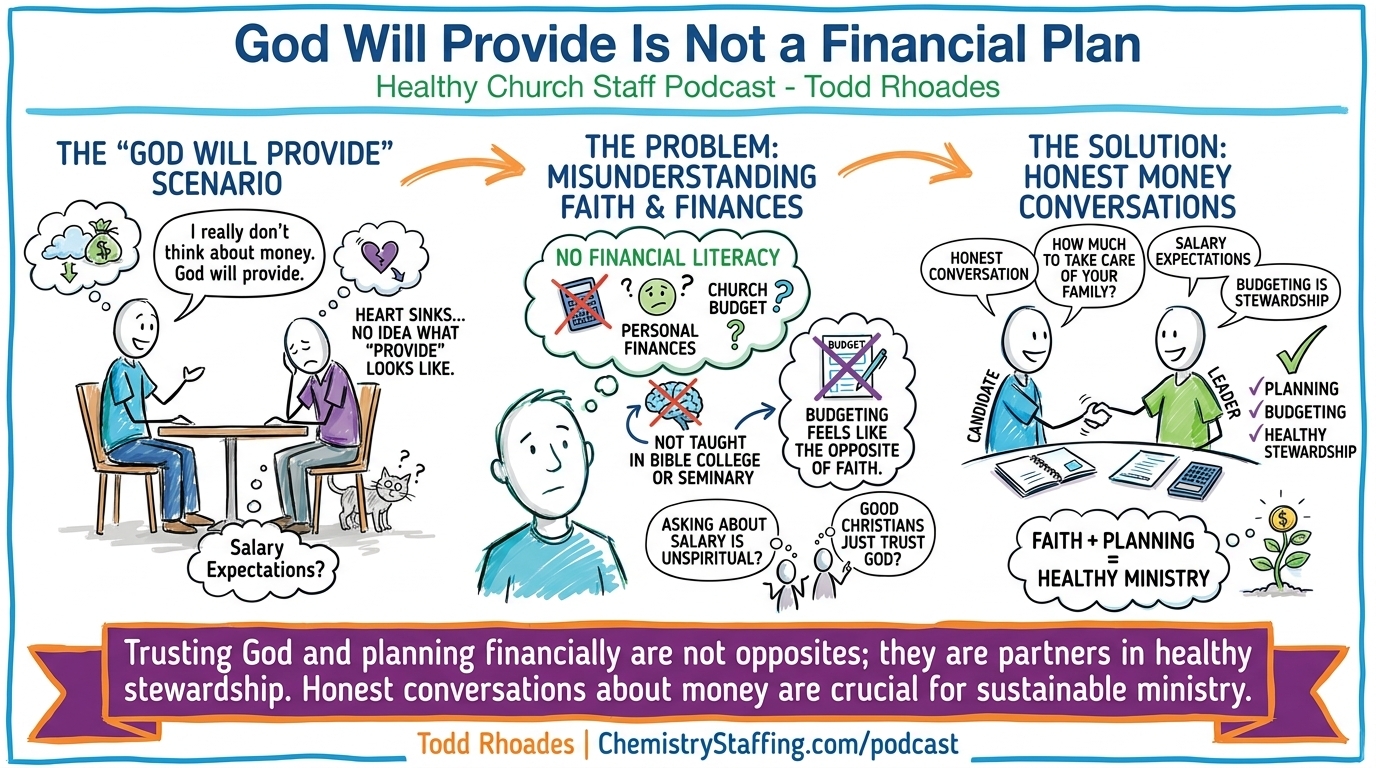
The Honest Conversation Your Candidates Need
Now listen—I'm not attacking anyone's faith here. If you've said "God will provide" in the past, I probably have too. It sounds like a spiritual thing to say. But we have to connect calling with reality, and that begins with honest conversations about church staff financial planning.
When you're interviewing candidates, especially those who seem financially naive, help them think through actual numbers before they say yes. Ask questions like:
- "What does your family actually need to live on? Not survive—but live."
- "Have you thought about retirement? Are you giving anything toward that?"
- "Have you thought about your kids' college?"
- "Do you have any kind of emergency fund?"
- "Let's look at what this role actually pays and see if it works."
This isn't unspiritual. It's plain and simple stewardship. You're helping them make sustainable decisions about ministry compensation before those decisions create problems down the road.
"For which of you, desiring to build a tower, does not first sit down and count the cost, whether he has enough to complete it? Otherwise, when he has laid a foundation and is not able to finish, all who see it begin to mock him, saying, 'This man began to build and was not able to finish.'" — Luke 14:28-30
The Hidden Cost of Skipping This Step
Now, maybe you're thinking, "Todd, I don't have this problem. When I hire people, they always want more than what we can pay." That's sometimes the case. But this scenario happens more often than you'd think. And when we skip the honest money conversation, here's the predictable timeline:
They take the job without understanding the financial reality.
Six months in, they're stressed about money. They're still saying "God will provide," but they're stressed.
Twelve months in, that stress turns into bitterness about compensation. "Yeah, sure, God's providing, but He's not providing through my salary here. I need to look elsewhere."
Eighteen months in, they're looking for secular work or a side gig—not because they lost their calling, but because they never did the math. And you never helped them do the math.
You didn't help them fail. But you didn't help them succeed either.
The Leadership Move: Financial Literacy as Ministry Development
Let me be clear: this isn't about paying people less or justifying low wages. This is about having the money conversation early and honestly as part of good church staff financial planning.
Don't assume candidates have thought through their finances. Some people know to the penny how much they need. Others don't know within $10,000. Don't let them spiritualize away basic financial planning by saying "God will provide."
Instead:
- Help them see that trusting God includes being wise with resources
- Give them permission to ask hard questions about ministry compensation
- Make financial literacy part of their ministry development
- Offer resources like matching retirement (and help them understand why they should take it)
I remember serving on an elder board where we offered matching retirement, but hardly anybody took it. Most staff were in their 20s and early 30s, starting families, and they weren't thinking about retirement. Some didn't think they had the extra money. Others believed "God would provide when we get to retirement." Both groups needed better financial education from us as leaders.
Questions for Your Leadership Team
- On a scale of 1-10, how comfortable is our staff culture with having honest conversations about budgets, compensation, and financial constraints?
- What's one area of our ministry where we've been spiritually optimistic but practically underprepared financially?
- What financial information or planning tools do we need but don't currently have?
- How can we model healthy financial stewardship for our congregation while still encouraging generous faith and trust in God's provision?
The Bottom Line
Your job as a church leader isn't to convince someone to take less money. Your job is to help them make informed decisions about ministry compensation.
Some people can live on less because their spouse has income. Others need more because they're the primary breadwinner. Both are fine. But both need to know the numbers upfront.
Faith-based decisions should be informed decisions.
God will provide—ultimately, always. But often, He provides through your planning, their preparation, and honest conversations about money before anyone signs anything.
Your people deserve honest conversations about money. That's not unspiritual. That's loving leadership.
Action Steps for This Week
- Review your hiring process. Are you having real money conversations or hoping people figure it out?
- Next time you're in interviews, ask: "Have you thought through what your family needs financially? Let's make sure this role actually works for you."
- Create or update a simple one-page financial reality document that helps candidates understand total compensation, not just salary.
- Establish a regular rhythm for financial updates in staff meetings so money isn't a taboo topic.
Church staff financial planning isn't just about numbers—it's about sustainability, stewardship, and helping good people thrive in their calling for the long haul.
Have questions about compensation, hiring, or helping your team have healthier conversations about church staff financial planning? I'd love to hear from you. Reach out to me at podcast@chemistrystaffing.com. Let's figure this out together.
About the Author: Todd Rhoades is co-founder of Chemistry Staffing and host of the Healthy Church Staff Podcast, where he helps church leaders build healthy, sustainable ministry teams. With years of experience in church leadership and staffing, Todd is passionate about helping churches and ministry leaders thrive.