

Picture this: Your senior pastor just asked you what seemed like a simple question during your annual review.
🎧 Listen to this episode:
"If you had to leave tomorrow, who would take over your role?"
And suddenly, you're sitting there like a deer in headlights. Because honestly? You have absolutely no idea.
You've been so busy doing the ministry that you never thought about replacing yourself or training anyone else to do what you do. If this scenario makes your palms sweat a little, you're not alone—and more importantly, you're not stuck there.
Why Most Church Staff Get Succession Planning Wrong
Here's what most of us miss: we think church staff succession planning is only about emergency exits. What happens when you die, get hit by a bus, or land that dream job in another state.
But succession planning is really about something much bigger—growth.
It's about creating space for your ministry to expand beyond you. It's about building systems that thrive whether you're there or not. And yes, it's about preparing the next generation of leaders to carry the vision forward.
But here's where it gets uncomfortable for most of us.
The Territorial Drift We Don't See Coming
Without realizing it, many church staff members become territorial about their roles. We start saying things like:
- "Nobody else knows the youth like I do"
- "I'm the only one who understands our worship culture around here"
- "If I'm not here, everything falls apart"
And somehow, we convince ourselves that this makes us valuable. That this level of indispensability equals job security.
But can I be honest with you? Making yourself irreplaceable isn't job security—it's ministry malpractice.
"And the things you have heard me say in the presence of many witnesses entrust to reliable people who will also be qualified to teach others." - 2 Timothy 2:2
Paul understood something we often miss: true leadership isn't about becoming indispensable. It's about making others capable.
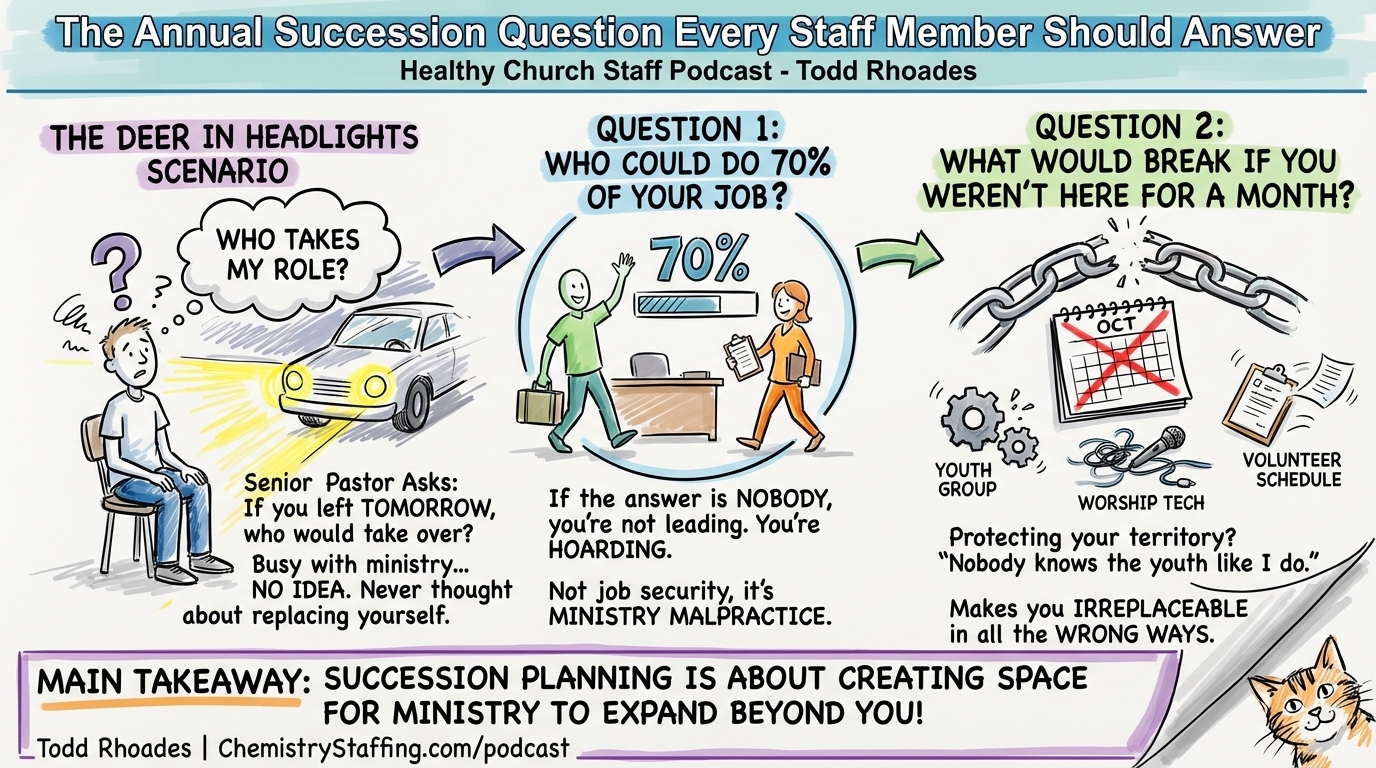
The Annual Succession Audit: 4 Questions Every Church Staff Member Should Answer
I've learned from almost 30 years of watching church staff transitions that the healthiest ministries regularly evaluate their succession readiness. Here's your annual succession audit—four questions that will reveal whether you're truly leading or just hoarding responsibility:
Question 1: Who Could Do 70% of Your Job If You Left Tomorrow?
Notice I didn't ask who could do 100% of your job perfectly. That's an unrealistic standard that keeps us from developing others.
But 70%? That's the threshold where ministry continues, relationships are maintained, and the vision keeps moving forward.
If your answer is "nobody," here's some tough love: you're not leading—you're hoarding.
Question 2: What Would Break If You Weren't Here for a Month?
This question reveals your system gaps. Those things that would break? Those are the processes, relationships, and knowledge transfers you haven't built yet.
Maybe it's the volunteer scheduling system that only exists in your head. Or the relationship with the local school principal that depends entirely on your personal connection. Or the budget process that you've never documented for anyone else.
Every "breaking point" is really a building opportunity.
Question 3: Who Are You Actively Developing to Surpass You?
This one separates managers from leaders. Managers protect their territory. Leaders expand it by developing others.
If you can't name someone you're actively mentoring and developing, you're not thinking like a leader yet. And that's okay—it just means it's time to start.
Scripture Reflection
1 Corinthians 4:1-2 - "This, then, is how you ought to regard us: as servants of Christ and as those entrusted with the mysteries God has revealed. Now it is required that those who have been given a trust must prove faithful."
What if being faithful with our trust means ensuring others can carry it forward?
Question 4: What Would You Want Your Successor to Do Differently?
This question is huge because it reveals what you know needs to change but haven't addressed yet.
Maybe you'd want them to be more systematic about volunteer appreciation. Or more strategic about social media. Or more intentional about connecting with parents.
Those insights aren't just helpful for a future successor—they're improvements you could start implementing now.
From Overwhelmed to Equipped: Where to Start
I know what you're thinking: "Todd, I'm already overwhelmed. Training someone else feels like one more impossible thing on my list."
I get it. But here's what I've learned from watching hundreds of church staff transitions: the ministries that thrive after leadership changes are the ones where the outgoing leader prepared the ground.
They didn't just hand over a job description and a prayer list. They handed over a culture, a vision, and people who could carry it forward.
Here's how to start this week:
- Write down three specific things that only you know how to do in your role. Don't edit yourself—just brain dump everything that's currently locked in your head.
- Pick one person you could teach one of those things to. It doesn't have to be a perfect fit. Just someone who's teachable and available.
- Schedule the conversation. Don't wait for the perfect moment. Put it on the calendar and start.
Discussion Questions for Your Team
- If you had to train someone to do your exact job in just one week, what would be the first three things you'd teach them?
- What systems, processes, or relationships in your area exist only in your head and nowhere else?
- How can we create a culture where succession planning feels like good stewardship rather than planning our exit?
The Beautiful Truth About Succession Planning
Here's the beautiful truth that makes all this effort worth it: the healthiest thing you can do for your ministry is to work yourself out of being the only one who can do it.
Your ministry is bigger than you, and that's exactly how it should be.
When you develop others, you're not working toward your own irrelevance. You're working toward your ministry's sustainability. You're creating space for growth that goes beyond what you could accomplish alone.
And ultimately, you're being faithful with the trust God has given you—not just to do the work, but to ensure the work continues.
"Each of you should use whatever gift you have received to serve others, as faithful stewards of God's grace in its various forms." - 1 Peter 4:10
Your Next Steps
Church staff succession planning doesn't have to be overwhelming. Start with one conversation. Document one process. Invest in one person.
The question isn't whether you'll eventually transition out of your current role—you will. The question is whether you'll leave your ministry stronger or scrambling when that time comes.
What would you add to this conversation? Have you been through a ministry transition that went particularly well (or particularly poorly)? I'd love to hear your story and learn from your experience.
Send me your thoughts at podcast@chemistrystaffing.com - I read every email and often share insights from our conversations in future episodes.
Your ministry is too important to leave to chance. Let's build something that lasts.