

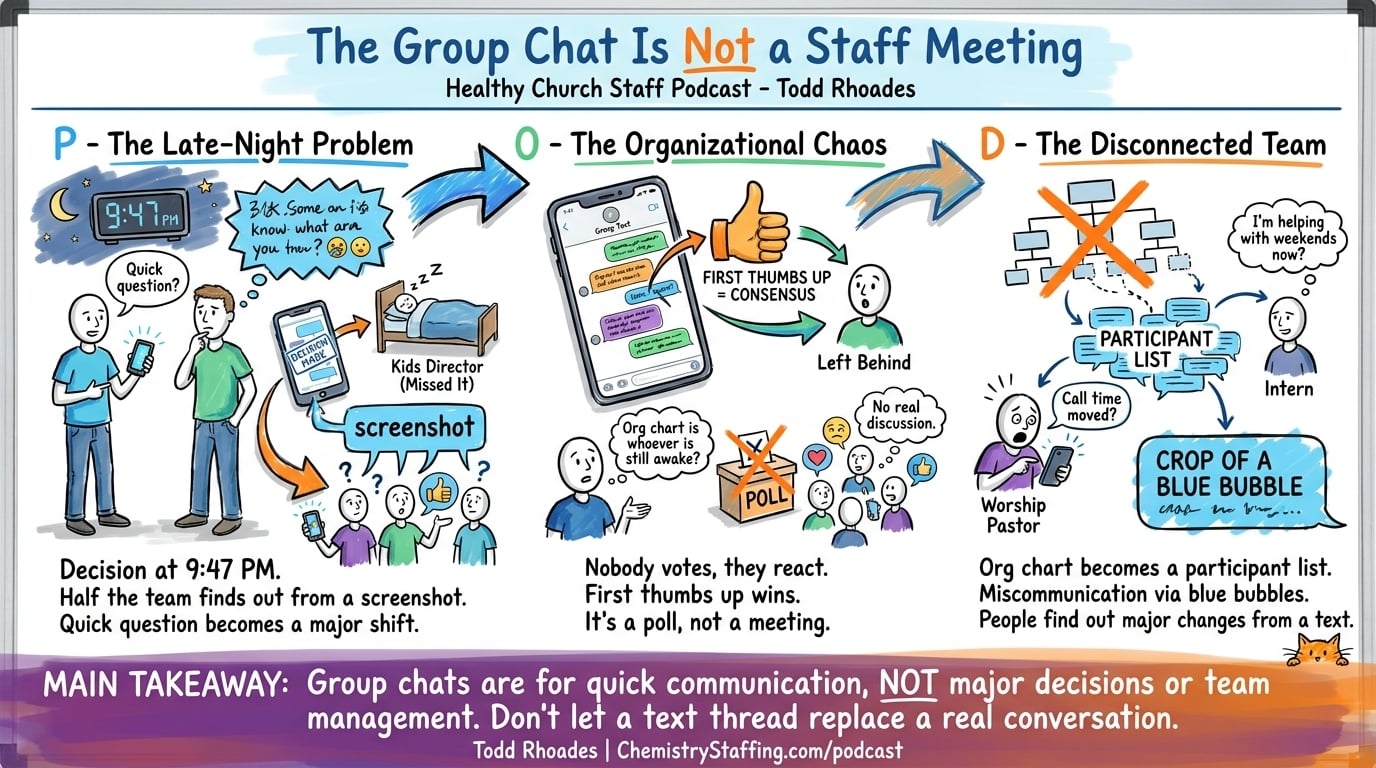
It's 9:47 PM. You send a "quick question" to the staff group chat. By morning, half your team has different versions of what was decided. The kids director wasn't even in the thread. And Sunday? Sunday becomes damage control for a decision that happened in someone's pocket while they were putting their kids to bed.
🎧 Listen to this episode:
If this sounds familiar, you're not alone. And if there's confusion on your team about who decided what and when, you're in the right place.
Let's be clear from the start: This is not an episode about putting your phone in a drawer. This is about recognizing when you've accidentally started using a group text as a form of management. And friend, that's not sustainable for you or your team.
9:47 PM Is Not a Staff Meeting
You sent it after the kids were in bed. Just a quick question: "Can we move her to Sundays?" or "What if we shifted the intern to help with weekends?"
Here's what happens next: Nobody votes in a thread. Nobody records a decision in a thread. People just react. That first thumbs-up? It becomes the consensus. And the last person who checks their phone in the morning is already behind.
You didn't hold a meeting. You held a poll of whoever still had their ringer on at 10 PM.
And that's not leadership—that's accidental chaos dressed up as responsiveness.
Half Your Team Got a Screenshot, Not a Decision
Then the screenshot does what you should have done in a room.
Someone wasn't included in the original chat, so someone else sends them a cropped image of blue text bubbles. That's how your worship pastor finds out the call time moved. That's how your kids director discovers the intern is now "helping with weekends."
Not from you. From a screenshot.
You added the people who were "in the conversation," but the conversation was just a text exchange. Your org chart became a participant list. Your chain of command became whoever was still awake.
Here's the hard truth: If the way a person learns about a decision is through a screenshot, you did not communicate. You leaked.
You Think You're Being Responsive (But Your Team Feels Something Else)
I know your heart. You tell yourself that staff can reach you anytime. You answer at night so they don't have to wait until Tuesday. That's the story you tell yourself—and it's a noble one.
But the story your staff is living? It's probably different.
Your administrator is putting a child down when the notification buzzes. Your associate pastor is trying not to look at their phone during family dinner. And last week's "quick question" somehow became this week's plan—except nobody's quite sure when that happened.
Being responsive is not the same as being always-on. And being available is not the same as making decisions.
You're using speed as a substitute for a room. And that substitution is costing you more than you realize.
Proverbs 15:22 - "Plans fail for lack of counsel, but with many advisers they succeed."
Real counsel requires more than text messages—it requires presence, tone, and the ability to read the room and truly hear one another.
Sunday Morning Is Where the Fallout Happens
Here's what you need to understand: Sunday does not care that the decision happened in a chat.
The volunteer heard one version from the person who was in the thread. The kids director walks in and learns about the room change from a parent. You spend the first 20 minutes of Sunday morning doing damage control for communication that could have been handled clearly in an email or a 10-minute meeting.
The fallout isn't the text itself. The fallout is all the people who weren't in it, standing in the lobby on Sunday morning, pretending they knew what was happening.
Your team didn't fail Sunday. Your communication channel failed the team.
Where Real Decisions Actually Live
So let's get practical. Let's name where decisions should actually live on your team.
A church staff group text is for things like:
- "The building is locked"
- "There's ice on the parking lot"
- "Running 5 minutes late"
- "Printer is jammed in the office"
A group text is NOT for:
- Who reports to whom
- Moving a person to a different role or schedule
- Cutting a program or ministry
- "Just thinking out loud here..." (until thinking becomes policy)
If it changes somebody's week, it does not belong in a chat bubble. It belongs in a meeting or an email they can search for later.
Discussion Questions for Your Team
- What types of topics or decisions should ALWAYS require a meeting rather than a group chat thread? Can we create some team guidelines together?
- Is everyone on our team equally heard in both formats (digital and in-person)? Who might be getting lost in the shuffle of our current communication patterns?
- Can someone share a time when a group chat conversation went sideways or created confusion that could have been avoided with a 5-minute in-person conversation?
Your Action Step This Week
Here's what I want you to do—and I know it might feel a little uncomfortable:
Pick one decision that's sitting in a text thread right now. One that belongs in a meeting or an email, but definitely not in a chat. And move it.
Then tell your team—out loud, in a meeting or clear email—where real decisions live around here. Not "we're trying to be better about texts." Tell them the actual place.
Maybe you create a simple communication charter: "Staff meetings are for decisions. Email is for updates everyone needs. Group text is for urgent logistics only."
I know you might be thinking, "Todd, you're being a little nitpicky here." But I also know you're trying to be reachable, not chaotic. You're trying to lead well, not leak information. And that's exactly why this matters.
James 1:19 - "Everyone should be quick to listen, slow to speak and slow to become angry."
Group chats often invert this wisdom—we're quick to speak (type), slow to listen (read carefully), and misunderstandings escalate quickly without tone and body language.
The Bottom Line
A group text is not a staff meeting. A group text is not your org chart.
One-on-one texting? Absolutely—that can be helpful for quick coordination. But when you're using group texts to make decisions that affect multiple people, change someone's responsibilities, or set direction for your ministry, you're not being efficient. You're being unclear.
Your team needs to know where decisions live. They need clarity about how they'll be informed. And they need to trust that when something important happens, they won't be the last to know—or worse, find out from a cropped screenshot.
Action Items for This Week
- ☐ Audit one week of group chat messages and identify 2-3 conversations that should have been meetings
- ☐ Create a team communication charter that defines what belongs in group chat versus what requires a meeting
- ☐ Establish a "take it offline" signal that anyone can use when a conversation is getting too complex for chat
- ☐ Set group chat boundaries such as no work messages after certain hours
- ☐ Schedule a recurring "real talk" time where issues that have been simmering in chats can be actually discussed
If this post resonated with you—or if you know a church leader whose staff meetings are still happening at 9:47 PM in a group chat—would you share it with them? Sometimes we all need permission to slow down our communication so we can actually speed up our clarity.
And hey, I'd love to hear from you. What's your biggest communication challenge on your church staff right now? What's working? What's driving you crazy? Send me your thoughts at podcast@chemistrystaffing.com.
You're doing important work. Let's make sure your communication systems support your team instead of creating confusion.
Want to Assess Your Church Staff Health?
Take our free Church Staff Health Assessment at churchstaffassessment.com. Your 10 minutes will help you think through important team dynamics—and contribute to helping church staff across the country.
Take the Free AssessmentThis post is based on Episode 708 of the Healthy Church Staff Podcast with Todd Rhoades. For more resources on building healthy church teams, visit chemistrystaffing.com.